
Parlando confronts darkness and history in Haas’s unsettling ‘in vain’
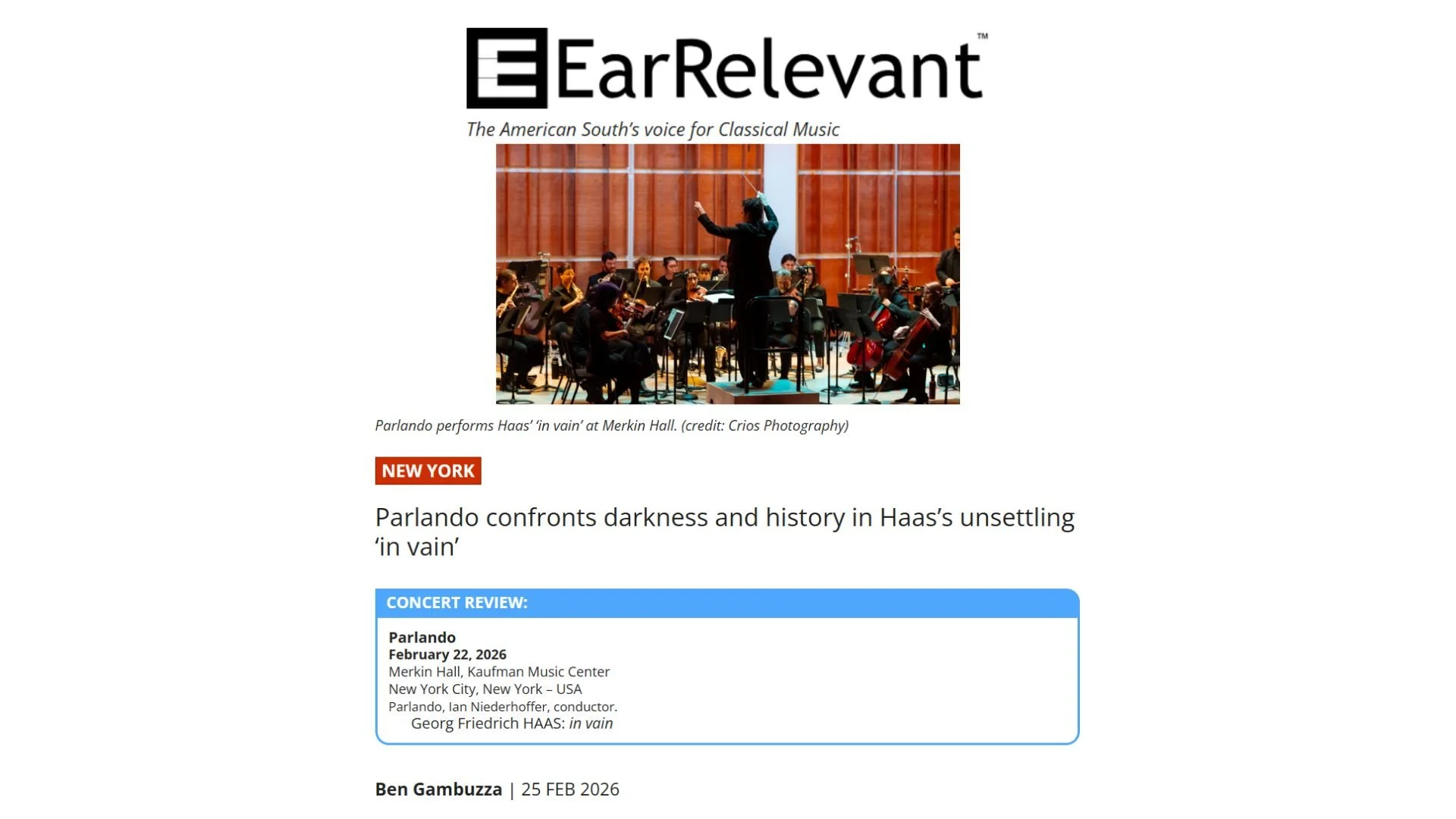
Ben Gambuzza reviews Parlando’s stirring performance of in vain, by Georg Friedrich Haas, composed in 2000 as a response to the rise of the far right in Austria. It is scored for 24 instruments and explores microtonality and the acoustic properties of sound, creating strikingly novel tonalities and textures. It is performed in different levels of low lighting, even in darkness, blending with the music over 70 minutes. Simon Rattle declared in vain “one of the first masterpieces of the 21st century.”
“in vain is tragic,” writes Gambuzza about Parlando’s Feb. 22 performance at Kaufman Music Center, conducted by Ian Niederhoffer, who founded the New York-based chamber ensemble. “Haas himself has acknowledged that the ending, which takes us back to the beginning, is anything but optimistic: ‘I still cannot imagine that anybody can perceive the moment when the music from the beginning returns at the end as anything but oppressive.’”
Parlando leaned into these final moments with strung-out and exhausted descending scales. They get slower and slower, minute by minute. As the red light seeped into the blue, I had to tell my brain not to render the glockenspiel’s descending sequence as a grotesque “Three Blind Mice.” But it wouldn’t listen.
…
Like all concert music, in vain is capable of prompting a revolution in the mind rather than in the street. And like a Bach Passion, it’s music for reflection, not for celebration. It conceptualizes a fallen utopian idea. It’s an obituary in music. There was something healthily naive about Parlando’s interpretation, but for such a young ensemble, their sound was mature.
Read the full piece here.
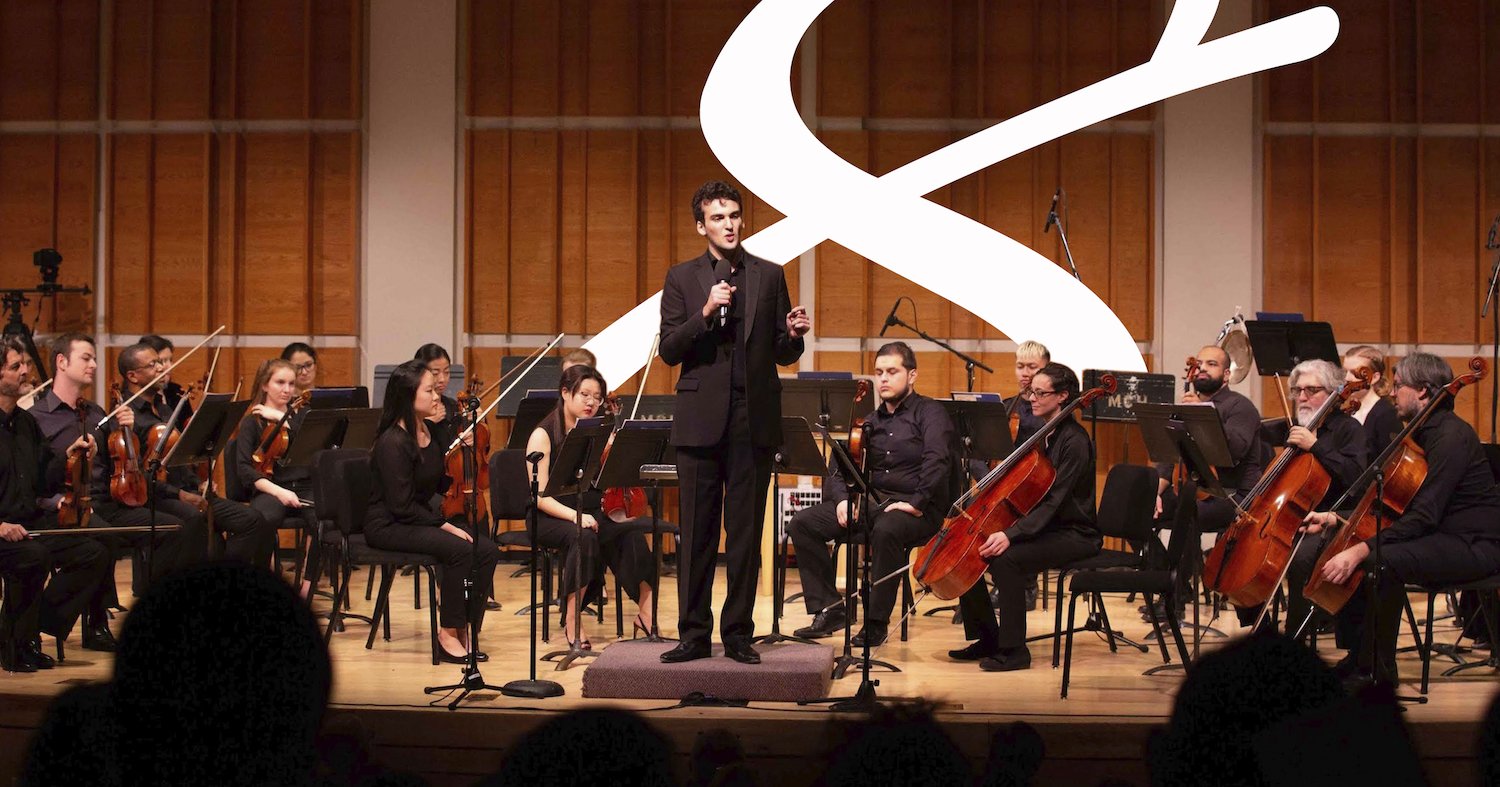
Parlando, with conductor and founder Ian Niederhoffer.