

BBC Music Magazine: An American Adventure
Editor of BBC Music Magazine, Oliver Condy, travels to the majestic mountains of Wyoming for the Grand Teton Music Festival

BBC Music Magazine
'Welcome to Jackson Hole', says the sign at the exit to the airport, 'The last of the old west.' Driving through the wide open plains of the Grand Teton National Park framed by the majestic Teton Range, calls to mind Jerome Moross's evocative music to the opening minutes of the 1958 film, The Big Country. You can still see genuine cowboys at work here, who share the spectacular landscape with bison, elk, moose, eagle, bear (black and grizzly) and the odd peckish mountain lion, who add a frisson of excitement to any hill runner's morning constitution.
Just down the road from Jackson Hole (in American terms, that is – it's a three-hour drive) is Yellowstone National Park, packed full of thrilling geological wonders, the most famous being the Old Faithful geyser that spouts a gigantic column of boiling water almost 200 feet into the air every hour and a half, and the otherworldly, primordial Grand Prismatic Spring that reflects the entire spectrum of colours around its rim accompanied by warm, eggy gusts of sulphurous steam.
The Teton area, by winter, is one of the finest places to ski anywhere on earth, but by summer, its mountains and valleys, now devoid of snow, seduce lovers of cycling, climbing, kayaking, bird watching, fishing, and hiking. It also plays host to one of the oldest and best classical music festivals in America.
Since 1962, Jackson Hole has been the backdrop to a seven-week celebration of orchestral and chamber music, the Grand Teton Music Festival, at the heart of which is the festival orchestra, a super-ensemble comprising the finest players from America's orchestras, from Atlanta to Louisiana, Dallas to Pittsburgh. And the conductor of this staggering group of musicians is none other than Donald Runnicles, musical director of the Deutsche Oper, principal guest conductor of the Atlanta Symphony Orchestra, and, until September 2016, principal conductor of the BBC Scottish Symphony Orchestra, after which he becomes conductor emeritus. 'It’s a testament to this place that the players keep coming, year in, year out'. Runnicles has been the festival's musical director since 2006.
The players themselves, some of whom stay for a couple of weeks, some for the entire seven, see it as a chance to renew their vows with orchestral music, as it were, among friends and away from the stresses of unions, orchestra politics and the school run. ‘Each and every musician is here because they want to be’, Runnicles explains. ‘There’s no compulsion to be here – their focus is on this bucolic experience and great music-making. And many of their absolute best friends were made here. They can’t wait to get back.’
The festival audience benefits from this unique chemistry through exciting, fresh, often revelatory performances in the stunning 800-seat Walk Festival Hall, although the real challenge, Runnicles admits, is finding repertoire that will fascinate his group of musicians but that will still attract audiences. The final two concerts of this year's festival featured Vaughan Williams's Symphony No. 3, a work that Runnicles had never conducted before, and which only two members of the orchestra had played before. ‘So many musicians have thanked me for bringing this repertoire to the festival – that’s beautiful,’ he smiles, ‘and each of these musicians will return to their institution and share their new love of Vaughan Williams.’
The GTMF closed with a stupendous performance of Respighi’s breathtaking Pines of Rome – a grand ending to the Grand Teton. The festival traditionally allows its players to stay for one more day following the final concert, easing them gently back into the real world. Just about enough time for a decent mountain hike and one last moose encounter…

Financial Times: Overtures that Bridge East and West
How one of China's top conductors, Long Yu, is extending the appeal of his country's music.
Financial Times

Photo: Yao Xu
Put together a pair of anniversaries as far-reaching as those falling this year — the end of the second world war and the founding of the UN in 1945 — and it is fitting that as many nationalities as possible are involved. On Friday the UN marks the double anniversary with a special invitation-only concert, with soloists from each of the major Allied powers, together with the Shanghai Symphony Orchestra and Chinese conductor Long Yu.
It is the start of a tour of the Americas by the orchestra, and will be repeated in Rio de Janeiro and Buenos Aires.
One element of the concert may be unexpected: the inclusion of a new work by a Chinese composer, Shanghai 1937 by Zou Ye, part of a project called “Compose 20:20” and a sign of how much the world of classical music has changed since 1945. Look to the future and it is likely to be found in Asia — thanks not only to the hordes of young pianists following in the footsteps of Chinese superstar Lang Lang, but also to new and interesting composers.
There is what Long Yu calls a “cultural bridge” between east and west waiting to be crossed. Any composer who wants to make the journey from the Chinese classical tradition to the concert halls of the west needs an uncommon degree of ingenuity, and nobody understands this better than China’s leading conductor. In recent years he has been successful in bringing a string of new Chinese works to the west (UK music-lovers will recall Qigang Chen’s Joie éternelle when the China Philharmonic made history as the first Chinese orchestra to visit the BBC Proms in 2014).
“Actually, it’s more than a hunger,” says Long Yu. “It is an absolute need, if we are to keep the cultural fires alive. We have seen so far a wonderful fascination in China for western classical music, and the same coming the other way from the west. But this frenzy of energy has too often been somewhat diffuse and without shape. Now is the time that we can start using it to explore and to experience in a curated way.”
That “curated way” is “Compose 20:20”. Between now and 2020, Long Yu will present 20 new works by Chinese composers in the west and 20 contemporary works by western composers in China. “Some of the composers are good friends, like Qigang Chen and [Polish composer Krzysztof] Penderecki,” says Long Yu. “Some, like Philip Glass, I have already commissioned; others not, such as John Adams and Bright Sheng. If ‘Compose 20:20’ can provide the motivation to generate commissions, I will count it a success.”
A nation coming out of the cultural revolution needed its own version of Britain’s inimitable Thomas Beecham, serial founder of orchestras and, in Long Yu, China has found him. Among the exhausting array of positions he holds are artistic director and co-founder of the China Philharmonic Orchestra, music director of the Shanghai and Guangzhou Symphony Orchestras, founder of the Beijing Music Festival and the Shanghai MISA Festival.
It might seem a challenge to introduce a programme of new Chinese music in the west, but Long Yu argues that audiences across the world are equally suspicious of what they do not know.
“In China, the taste in music varies hugely between different areas,” he says. “For example, people in Beijing love Wagner. Our Götterdämmerung there didn’t finish until one in the morning, but the audience stayed for many curtain calls. Contrast that with a concert we did of extracts from Wagner’s operas in the south, where there just wasn’t the same enthusiasm. For a long while China stuck with Tchaikovsky and endless repeats of La traviata and La bohème. But more recently there have been so many premieres — Stravinsky, Ligeti, Britten’s Peter Grimes and War Requiem, even Berg’s Lulu, as far back as 2002, and that was tough. Half the audience left the theatre at the end of the first act. You have to keep fighting to bring forward new works.”
This is part of the picture that Long Yu paints of a country that has moved on from laying the foundations for a new artistic life after the cultural revolution. The previous generation, he says, had to work out what the best system for the arts might be in China, what the professional structures would look like. The present generation, he says, has to build on that.
“I am very committed to moving on to the second-level cities in China and encouraging their development,” he says. “People are critical of China for building new concert halls and theatres, as the buildings are nothing more than symbolic unless there is content. Now we are working on the next part of that. Music is something you can’t see, can’t touch. It comes from creativity, and we have to show the younger generation that music is not just about giving a concert or having a career. It is about freeing the imagination.”
From his unique position of influence Long Yu is able to take the long view. “What matters to me now is that one generation passes on the fire to the next. We have this one-child policy in China and every parent wants his kid to become a star. People talk about 50m Chinese children learning the piano, but do we really think all 50m will find a job as a musician? There isn’t too much space for stars.
“I would be quite happy if those 50m grow up to become music-lovers, the people who buy tickets and support music in the future. That would make me happier than seeing the kids struggling to perfect their harmony every day. If only their parents could see that what is important is how to bring joy through music to their children.”

Washington Post: China Philharmonic’s Silk Road tour wends to Iran
"On Friday night, the music of Dvorak’s “New World” symphony was heard in Tehran, performed from the original music the New York Philharmonic has guarded since the work’s 1893 premiere. This orchestra, though, wasn’t American. It was the China Philharmonic."
Washington Post
By Anne Midgette

Photo: China Philharmonic Orchestra
Cultural diplomacy is a significant activity for symphony orchestras. The Boston Symphony Orchestra toured Russia in 1956. The Philadelphia Orchestra went to China in 1973. The New York Philharmonic played Pyongyang in 2008; the Minnesota Orchestra went to Cuba this past May. And on Friday night, the music of Dvorak’s “New World” symphony was heard in Tehran, performed from the original music the New York Philharmonic has guarded since the work’s 1893 premiere.
This orchestra, though, wasn’t American. It was the China Philharmonic.
“The New York Philharmonic gave me the original parts,” said China Philharmonic music director Long Yu, speaking by cellphone from an airport en route to Greece the day after a concert he described as historic. “So it’s very touching if you see the music, you’re touching that history.”
The China Philharmonic, created in 2000 from what had formerly been the China Broadcasting Symphony Orchestra, and still technically the state radio orchestra, is wrapping up a six-stop Silk Road tour with Long Yu. Unlike Yo-Yo Ma’s ongoing Silk Road Project, which since 1998 has celebrated the Silk Road’s melange of cultures and history of exchange through chamber music and educational programs, the China Philharmonic’s tour takes a traditional approach to cultural diplomacy. The orchestra is playing Chinese and Western repertory and effectively showcasing its strengths to China’s not-so-distant geographical neighbors.
It also showcases Long Yu, a superpower of China’s burgeoning music world who also leads the Guangzhou Symphony Orchestra, the Shanghai Symphony Orchestra, the Beijing Music Festival, and the Shanghai Orchestra Academy, in a role he would dearly like to assume: that of cultural diplomat.
Speaking the day after the concert, which was met with the requisite standing ovation, two encores and seven curtain calls (not an unprecedented number on international tours), he embraced the time-honored rhetoric trotted out on such occasions of “the universal language of music” and the joys of bringing the treasures of the West to a new audience.
“You can see how the people are looking for life, and the passion for life,” he said, waxing eloquent on the beauties of Tehran.
The West tends to think of China as a recipient of its cultural diplomacy, not as its purveyor. And yet at a time when some Iranians are chanting “Death to America” in the streets, it’s a Chinese orchestra, rather than an American one, that brought this American-flavored music, with the imprimatur of its American parts and what Long Yu describes as “liberal ideas,” to Iran.
The Pittsburgh Symphony, which last played in Tehran in 1964 as part of a tour sponsored by the State Department, voiced hopes last year of playing there again; and it’s been rumored that Daniel Barenboim may lead the Berlin Staatskapelle there during Angela Merkel’s state visit in October. But China has beaten them to the punch — with a work that symbolizes the appropriation of traditional forms by a “new world.”
On Friday, there were a couple of “new worlds” at play. China is planting a flag to show itself as a player in the international cultural community. But Tehran was also spreading its wings as a city that wants such culture. The performance, in fact, was shared between the China Philharmonic and the Tehran Symphony Orchestra, founded in 1933, defunct for several years, and revived this past April with what by one account was a struggling but eager performance of Beethoven’s Ninth.
On Friday, led by Ali Rahbari (who has had a distinguished career in the West, and has come under fire in Iran in the past for “promoting Western values”), the ensemble played Rimsky-Korsakov’s “Scheherazade” — a snapshot of the East through Western eyes.

New York Times: China Philharmonic Orchestra to Play in Tehran
As the world focuses on the accord to limit Iran’s nuclear capabilities that was reached last month, the China Philharmonic Orchestra, a major ensemble from one of the six nations that negotiated the deal, is planning to play two concerts in Tehran next week.

Photo: Daniel Barry
The New York Times
By Michael Cooper
As the world focuses on the accord to limit Iran’s nuclear capabilities that was reached last month, the China Philharmonic Orchestra, a major ensemble from one of the six nations that negotiated the deal, is planning to play two concerts in Tehran next week.
The Tehran concerts by the group, whose music director, Long Yu, enjoys a growing international reputation, have been scheduled for some time as part of a tour of the ancient Silk Road trade route, with stops planned in Tajikistan, Kyrgyzstan, Kazakhstan, Turkey and Greece.
But coming a month after the accord was reached between Iran and the United States, Germany, Britain, France, Russia and China, the concerts are sure to be seen as a bit of cultural diplomacy at a moment when many nations are gearing up for more open relations with Iran.
One piece the orchestra plans to play in Tehran is Dvorak’s Ninth Symphony, “From the New World,” which was written in the United States and incorporates American folk music. They also plan to play the Polovtsian Dances from Borodin’s “Prince Igor”; “The Butterfly Lovers,” a violin concerto by Chen Gang and He Zhanhao; and Tchaikovsky’s Symphony No. 5.
“This tour across the Silk Road trade route has been years in the planning,” Mr. Yu said in a statement, “and we in the China Philharmonic Orchestra hope that we can build a cultural bridge that stretches across the region and indeed across the world, that will bring people closer together at a level that can inspire them to make this world truly harmonious.”
An American orchestra, the Pittsburgh Symphony Orchestra, considered playing concerts in Iran last year to mark the 50th anniversary of its last concerts there, but ultimately did not go.

Broadway World: Opera Star Renée Fleming To Perform Gala Concert At Grand Teton Music Festival
A regular performer on the world's grandest stages, international opera superstar Renée Fleming's radiant voice and compelling artistry will soon be heard for the first time in the heart of the American West—Jackson Hole, Wyoming.

Photo: Jonathan Tichler
Broadway World
A regular performer on the world's grandest stages, international opera superstar Renée Fleming's radiant voice and compelling artistry will soon be heard for the first time in the heart of the American West--Jackson Hole, Wyoming. Program to run gamut from opera arias to Broadway show tunes.
GTMF Music Director Donald Runnicles invited his long-time collaborator to perform as part of a special, gala event at Walk Festival Hall tonight, July 29 at 7pm--an invitation Ms. Fleming happily accepted. Guest conductor Edo de Waart leads the Festival Orchestra for this concert at the request of Maestro Runnicles who will be appearing at the Proms in London with the BBC Scottish Symphony Orchestra.
Joining Ms. Fleming on stage is the Grand Teton Music Festival Orchestra. This unique ensemble, which is brought together each summer by Maestro Runnicles, is comprised of leading orchestral musicians from North America's top orchestras, the nation's finest orchestra of this kind.
Tickets for this gala event are $85 and go on sale June 2 at 10am. They can be purchased at GTMF.org or by calling 307-733-1128. Tickets include a complimentary beverage at intermission. Advanced purchase is highly recommended.
Ms. Fleming, known for her sumptuous voice, consummate artistry, and compelling stage presence, has appeared in concert and in operas on every major stage in the world. Ms. Fleming is among a handful of classical artists who have transcended her art to reach millions of adoring fans worldwide. A frequent performer at high profile events, Ms. Fleming was the first classical artist to sing at a Super Bowl (2014), performed at the Beijing Olympics (2008), and sang on the balcony of Buckingham Palace in the Diamond Jubilee Concert for HM Queen Elizabeth II. Fans of the Metropolitan Opera's Live in HD series also know her as a charismatic, charming host to these lavish, big screen productions.
GTMF presents exhilarating musical experiences, and reunites a celebrated orchestra of musicians with Music Director Donald Runnicles each summer. During its annual, seven-week summer classical music Festival, GTMF presents full Festival Orchestra concerts on weekends and smaller ensembles on weeknights.

Lara Downes Releases "A Billie Holiday Songbook"
A centennial tribute to Lady Day from the critically-acclaimed American pianist Lara Downes.

Steinway & Sons celebrates the centenary of iconic jazz singer Billie Holiday with an album of songs she made famous, arranged for solo piano by New York-based composer and pianist Jed Distler and performed by Steinway artist Lara Downes. The result is a musical portrait of the singer’s life.
Available on CD and MP3 via ArkivMusic.com:
www.arkivmusic.com/classical/album.jsp?album_id=1673717#custReviews

Long Yu awarded the Chevalier de la Légion d'Honneur
France recognizes Maestro Long Yu's leadership in strengthening China's cultural connections with other nations around the world.

Conductor Long Yu awarded France's highest honor of merit as the recipient of the fabled Chevalier de la Légion d'Honneur.
France recognizes Maestro Long Yu's leadership in strengthening China's cultural connections with other nations around the world.
Maestro Long Yu received the Chevalier de la Légion d'honneur in a ceremony at the French Consulate General in Shanghai this week. As Chevalier, he joins the highest order of the Légion d'honneur, whose past recipients include Antoine de Saint-Exupéry, the Lumière brothers, Auguste Rodin, and Honoré de Balzac. The honor dates back to the early 19th century and is among the highest decorations of merit in France.
Maestro Long Yu is only the third Chinese National to receive the award. His notable collaborations with leading French orchestras include Orchestre de Paris, Orchestre National de Lyon and Orchestre National du Capitole de Toulouse.
This award marks a highlight of an impressive season for Maestro Long Yu. In July, star-studded concerts in Shanghai and Beijing coincided with his 50th birthday, and colleagues including Lang Lang, Alison Balsom and Maxim Vengerov performed, with new works composed by Tan Dun, Qigang Chen and John Williams. At the same time, he led the Shanghai Symphony into their incredible new home, a state-of-the-art venue built mostly underground, acoustically designed by Yasuhisa Toyota (famously, the man behind the sound of Walt Disney Hall). Only weeks later, he conducted the China Philharmonic as the first Chinese orchestra to perform at the BBC Proms. The New York Philharmonic welcomes Maestro Long Yu for subscription concerts in January 2015, and he returns in February with Yo-Yo Ma for his now-traditional Chinese New Year concert with them.
Long Yu is represented for general management worldwide by CAMI Music; please contact Anastasia Boudanoque (+1 212 841 9740, ab@camimusic.com). Further information available here.
Notes for Editors:
Maestro Long Yu is the Artistic Director, Chief Conductor and co-founder of the China Philharmonic Orchestra, and Music Director of the Shanghai and Guanzhou Symphony Orchestras. He is also Founding Artistic Director of the Beijing Music Festival.
He created China’s first orchestral academy, as a partnership between the Shanghai Symphony Orchestra, Shanghai Conservatory and the New York Philharmonic.
Other China ‘firsts’ include bringing the first-ever performances of Wagner’s Ring cycle in the country, presenting its first-ever Mahler cycle, releasing the first album of Chinese music on a major recording label (Dragon Songs, alongside Lang Lang, for DG), and bringing the first-ever Chinese orchestra to play at the Vatican when the Shanghai Philharmonic played for Pope Benedict XIV. This year, he led the China Philharmonic as the first Chinese orchestra ever invited to play at the BBC Proms. The Shanghai Symphony under his baton was the first orchestra other than the New York Philharmonic to perform on Central Park's Great Lawn.
He has commissioned new works from many of today’s leading composers, among them Tan Dun, Krzystof Penderecki, Philip Glass, John Corigilano, Guo Wenjing and Ye Xiaogang.
Long Yu regularly conducts important orchestras and opera houses in the West such as the New York Philharmonic, Los Angeles Philharmonic, Orchestre de Paris, Chicago Symphony, BBC Symphony, Teatro La Fenice, Hamburg Staatsoper and Philadelphia Orchestra. He was previously honored to be appointed a Chavelier dans L’Ordre des Arts et des Lettres in France, and a L’onorificenza di commendatore from the Republic of Italy. He recently joined the Artistic Advisory Committee of the New York Philharmonic.

Gramophone: Julian Rachlin Appointed Principal Guest Conductor of the Royal Northern Sinfonia
The violinist and conductor Julian Rachlin will join Principal Conductor Lars Vogt at the Sinfonia

Photo: Janine Guldene
Gramophone
Following their appointment earlier this year of a Principal Conductor better known as a pianist, Lars Vogt, the Royal Northern Sinfonia now complete their artistic team with a Principal Guest Conductor better known as a violinist, Julian Rachlin. Rachlin made his conducting debut with the Sinfonia in October 2013 and has since led the Israel Philharmonic, Czech Philharmonic and the Academy of St Martin in the Fields. Rachlin will be appearing as conductor and soloist with the Sinfonia in a concert at Milton Court in London tomorrow evening (November 14). The programme comprises of Schnittke's Sonata No 1 for violin and chamber orchestra, Mozart's Violin Concerto No 5 and Beethoven's Symphony No 7.
Rachlin was just 14 years old when he appeared as a soloist with the Vienna Philharmonic, still the youngest soloist to have appeared with that orchestra. Andrew Achenbach interviewed Rachlin for Gramophone in 1995 when the violinist was just 19 but already had two recordings for Sony Classical under his belt. At that time Rachlin said, 'When I'm playing, I really want to tell the people something, to move something within them, and I believe that the public will always respond to any artist who is genuinely trying to convey some sort of emotional message. After all, why should we be ashamed of expressing our innermost feelings?' It looks as if the Royal Northern Sinfonia have some exciting concert seasons ahead.

Washington Post: Pianist Lara Downes gives insightful performance of Czech composers
"Downes — who admitted that Korngold was “the new love of my life” — gave the thing an impassioned performance, but it was her insights into the more complex, understated and subtle works on the program that more deeply impressed."

Washington Post
By Stephen Brookes
Franz Kafka may have been ignored in his own lifetime, but his novels — and the sense of dread and alienation they evoke — came to have an extraordinary impact on the 20th century mind. So it was intriguing to hear pianist Lara Downes at the Embassy of the Czech Republic on Thursday evening, playing music by Czech composers who endured the rising totalitarianism that Kafka’s writing seemed to presage — and who were either killed by it or forced into decades of exile.
Perhaps the most tragic of these was Erwin Schulhoff, who produced an astonishingly innovative body of work — including the “Suite Dansante en Jazz,” which Downes opened with — before dying in a Nazi concentration camp in 1942. The six-movement suite is an earthy, slow-burning piece from 1931, bluesy at its heart but imbued with edgy, wildly colored, often brilliant ideas, and Downes gave it a fine reading — more thoughtful than sensual, maybe, but very engaging.
She followed with Andre Singer’s “Nine Parables to Franz Kafka’s ‘Amerika,’ ” which alternated short passages from Kafka’s enigmatic 1914 novel with equally enigmatic and expressive musical fragments — a fascinating work from Singer (who was forced into exile in the 1930s) that seemed to capture a complex and Kafkaesque world where nothing is what it seems to be. Robert Rehak and Mary Fetzco delivered the written passages with aplomb.
Jaroslav Jezek’s lovely “Svita” (Shining) — famous for boosting Czech morale during World War II — provided a few moments of sunshine, as did five of Bohuslav Martinů’s “Etudes and Polkas.” Written in exile (where the composer spent much of his life), these brief pieces seemed to evoke both the freedom of a new world and nostalgia for the old; a poignant glimpse into the heart of the exiled composer.
The final work on the program was the biggest but the least satisfying. Erich Wolfgang Korngold was a remarkable prodigy, and his Sonata No. 2 in E Major, Op. 2, written when he was all of 13 years old, is a remarkable accomplishment for an adolescent, technically accomplished and ambitious in every way. That said, it’s a noisy show-off piece, full of heroic chest-pounding and thundering charges up and down the keyboard, anchored by a largo con dolore that fairly wallows in adolescent woe. Downes — who admitted that Korngold was “the new love of my life” — gave the thing an impassioned performance, but it was her insights into the more complex, understated and subtle works on the program that more deeply impressed.

Critics rave about Lara Downes and Zuill Bailey's "Some Other Time"
"The music, the performances, and the sound are extraordinary"
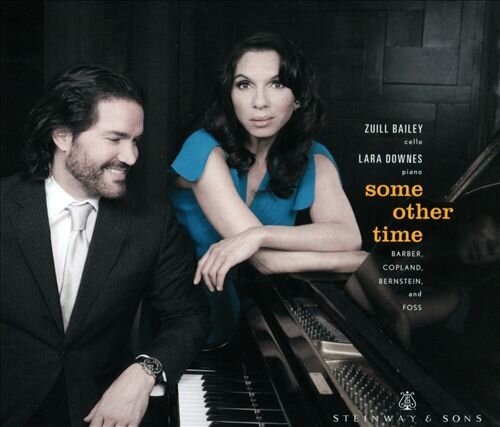
Pianist Lara Downes and cellist Zuill Bailey have each, in their own way and quite often together, been credited with seeking out new ways of presenting classical music, of reinventing the art of the recital for our time. But for both of them, the tireless quest to touch audiences through reawakening their musical curiosity owes everything to the pioneering spirit of earlier American composers. To Samuel Barber, Aaron Copland, Lukas Foss and articulated most charismatically by Leonard Bernstein. Their new album Some Other Time released by Steinway & Sons digitally on April 1st and physically on 29th, 2014, takes its title from a number in Bernstein’s musical On The Town. It’s a number about moving on, about remembering a great adventure, but with the promise that it will all come together another day, another time. Except that, for Lara Downes and Zuill Bailey, that time is now.
Here is what the critics are saying about Some Other Time:
Classical Candor reviews the album here.
"What more could you ask for than a collaboration between preeminent cellist Zuill Bailey and innovative pianist Lara Downes? I've admired their work separately for several years already, and now they've produced an album together...And just to make myself clear, the music, the performances, and the sound are extraordinary."
WGBH Boston's CD of the week.
"Cellist Zuill Bailey and pianist Lara Downes have collaborated on a recording inspired by friendship, adventure, and nostalgia."
And All Music Guide raves!
"The recital as a whole is engaging, original, and insightful, bringing together a particular musical scene in a fresh way, and the studio sound is superb. Highly recommended."