

New York Classical Review: Long Yu Leads New York Philharmonic in Chinese New Year Program
The Philharmonic played brilliantly, sounding secure and powerful under Long Yu’s baton, and the performance of the solo part by the Philharmonic’s principal harpist, Nancy Allen, was exquisite.

Photo: Chris Lee
New York Classical Review
By Eric C. Simpson
The New York Philharmonic’s fifth annual Chinese New Year celebration on Tuesday night was something of a riddle. On the one hand, there was a ninety-minute program with a sought-after violinist, a stage address from United Nations Secretary General Ban Ki-moon, and no intermission suggested an emphasis on providing entertainment for the gala patrons whose tables were being set on the promenade outside the hall.
On the other, the most substantial item on the program by far was the New York premiere of a forty-minute piece from the last decade that proved as artistically and intellectually stimulating as anything the Philharmonic might present on a regular subscription concert.
The first music of the evening was certainly more in the former spirit, like any good concert overture: Li Huanzhi’s Spring Festival Overture, composed in 1955-56, is a peculiar product of the early years of Western-style composing in China. Li’s darting melodies and galloping energy, combined with a Romantic idiom, almost conjure reminiscences of something between the American West and a Parisian Can-can. Under the direction of guest conductor Long Yu, the music was dignified, but not humorless.
More substantial, though opaque in its own way, was the famous The Butterfly Lovers, a violin concerto written jointly by Chen Gang and He Zhanhao just a few years after the Spring Festival Overture. The soloist on this occasion was Maxim Vengerov, who a decade ago was at the top of an intensely competitive field before an injury forced his career into hiatus. Technical problems, such as murky passagework and wandering intonation, linger, but the most attractive elements of Vengerov’s playing are the ones that always stood out: the effortless warmth of his tone and keen expression of his interpretation.
The Butterfly Lovers offered the violinist ample opportunity to demonstrate these two qualities. The concerto has its stretches of showy virtuosity, but at its core it is an innocently lyrical piece, lightly orchestrated and unassuming, its solo part taking inspiration from traditional Chinese instruments rather than Romantic violinistic flair. Vengerov’s interpretation was poignant, finding moments of intense passion in the gleaming lines without ever hurrying them
Less successful was Vengerov’s performance of the Kreisler chestnut Tambourin Chinois, a fleeting bonbon that served essentially as a programmed encore. A master of pastiche, Kreisler in this brief showpiece combines Chinese musical idiom with violinistic fireworks of considerable difficulty—too much difficulty, apparently, for Vengerov, who rushed through the piece and failed to convey much its charm.
After the relative pleasantness of the first forty minutes, hearing Tan Dun’s The Secret Voices of Women was like stepping into an ice bath. Though the composer calls the piece a “Symphony for 13 Microfilms, Harp, and Orchestra,” there are no microfilm readers called for in the score; rather, “microfilm” is his name for a series of short films he has captured and edited of women in rural China singing traditional Nu Shu songs, cataloguing folk melodies in danger of being lost. Around these, Tan Dun constructs what is essentially a harp concerto, drawing inspiration from the songs and echoing them in his writing for orchestra and soloist.
At times, the writing takes the form of a simple and comfortably harmonious accompaniment, whether in the form of light pizzicato and percussion or burnished strings. At others, the echoed vocal melody becomes a maddening refrain, dissolving into interludes of shivering ice or harrowing fury.
The video scenes themselves are emotionally affecting, portraying mostly elderly women in a variety of activities, projected in three different frames above the stage. One in particular shows a song of ritual mourning, accompanied by frantic worrying in the solo harp. The songs are presented without any English text, a choice that avoids distracting from either the images or the music. One feels that Tan Dun made the correct decision here, though undoubtedly many audience members missed a layer of the work as a result.
The Philharmonic played brilliantly, sounding secure and powerful under Long Yu’s baton, and the performance of the solo part by the Philharmonic’s principal harpist, Nancy Allen, was exquisite. Tan Dun’s writing for harp is extremely demanding, not just in degree of difficulty, but in its length and relative continuity. More than equal to the technical challenges, Allen brought a strong voice to the varied solo line. Would that every gala concert left so strong an impression.

Washington Post: Julian Rachlin in Washington with Orchestre National de France
"And when Rachlin got going into the final cadenza, he became a wild thing, a kind of inspired mad scientist in a monologue both profound and terrifying..."

Washington Post
By Anne Midgette
I confess I wasn’t very excited about going to hear the Orchestre National de France play a program of chestnuts on Sunday afternoon. Evidently, a lot of other music-lovers shared my sentiments, because the Kennedy Center Concert Hall was only about half-full.
Why, after all, should we want to hear the Orchestre National de France? It’s partly the presenter’s job to let us know. And indeed, Doug Wheeler, the president emeritus of Washington Performing Arts, answered in his brief and on-point remarks from the stage before the show: because the orchestra was among the first that the organization’s founder, Patrick Hayes, presented in Washington even before Washington Performing Arts came to be, and the two institutions have had a long and fruitful collaboration ever since. [Ed: The previous sentence has been corrected; it originally misstated the date of Washington Performing Arts’s founding.] Maybe knowing that would have incited a few ticket-buyers; as it was, it was a bit of too little, too late.
Why else? Because their music director, Daniele Gatti, is a heavyweight in the conducting world, and will take over the Concertgebouw in Amsterdam, one of the world’s greatest ensembles, when his contract with this group ends at the end of the current season.
But we couldn’t have known some of the other reasons beforehand. For instance: because Julian Rachlin, the violin soloist in the Shostakovich first concerto, is a veritable force of nature who turned out to be the centerpiece of a searing performance of that work. And because everything the orchestra played on Sunday was pretty remarkable — even for those of us who said beforehand that we had heard Tchaikovsky’s Fifth Symphony done so often, and done so well, that we had no desire to hear it again any time soon. (An awful lot of my job these days seems to involve defending fine performances of over-familiar works.)
Gatti is a formidable presence on the podium: visually, he conveys a sense of physical power, so that his delicacy and restraint and detail take on a kind of implicit force. He used this to full effect throughout hte afternoon, starting with an exquisite, languid, idiomatic performance of Debussy’s “Prelude to the afternoon of a faun,” in which every instrument offered precision while maintaining the soft, fluid contours of this score.
But it was the Shostakovich that was the real tour de force. Rachlin, the violinist, is a small contained firebrand of a man onstage, and he eased his way into the opening movement with playing that was almost painful in its muted restraint, over the humid, brooding chords of the orchestra. The second movement then uncurled into some of the most biting fierce Shostakovich playing I can remember hearing. And when Rachlin got going into the final cadenza, he became a wild thing, a kind of inspired mad scientist in a monologue both profound and terrifying, until the orchestra finally chimed in with ferocious clashes of regretful understanding.
I didn’t even need to fight to lower my defenses against the Tchaikovsky; Gatti and the orchestra simply leveled them, with authoritative, urbane playing. Gatti even nodded to the piece’s familiarity by leaving off conducting entirely at times, keeping himself to the most minimal of gestures even in the final movement, which nonetheless seemed informed by the Shostakovich that had preceded it: more abrasive and aggressive than a triumphant resolution.
So those of us who went to this concert were pretty happy we had gone. Now, Washington Performing Arts is looking for ways to convince you that you want to go hear Ivan Fischer and the Budapest Festival Orchestra, who arrive with Marc-André Hamelin and a slightly less overworked program on February 15th. You can get tickets at a 50% discount now.
Seattle Times: ‘All-Star Orchestra’ premieres classical music on TV
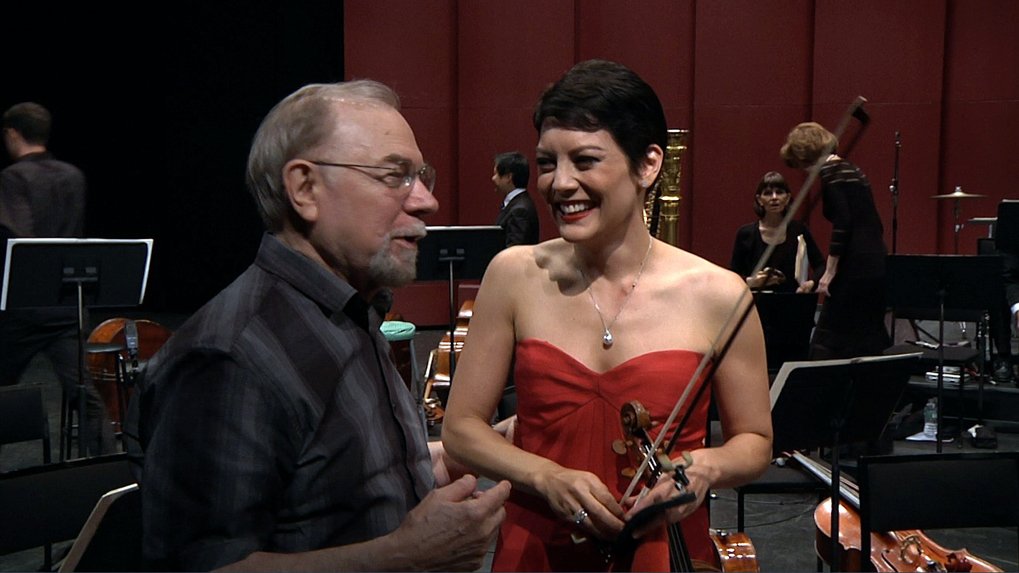
Schwarz’s post-Seattle passion project, “The All-Star Orchestra” debuted in 2014, bringing together 95 top orchestral musicians from across the country to perform no-audience, in-studio concerts, shot with 18 high-definition, roaming cameras. The series satisfies Schwarz’s lifelong desire to bring classical music to a broader audience.

Composer Samuel Jones and violin soloist Anne Akiko Meyers after the TV filming of his new concerto for “All-Star Orchestra.”
The Seattle Times
By Tom Keogh
What do Gian Carlo Menotti’s 1951 one-act opera “Amahl and the Night Visitors,” Igor Stravinsky’s 1962 “The Flood: A Musical Play” and Samuel Jones’ 2014 “Concerto for Violin and Orchestra” have in common?
They are some of the only works of classical music whose world premieres were television productions, sans concert hall or live audience.
Those three are part of an exclusive club, with Tacoma resident Jones’ piece making history in its debut on public television’s Emmy-winning series “The All-Star Orchestra.”
Some have already seen Jones’ “All-Star” episode pairing “Concerto” with Mozart’s magnificent “Posthorn Serenade,” which was recorded at SUNY Purchase College in New York and is being broadcast over 80 PBS stations this winter. Seattle’s PBS station KCTS-9 has quietly tucked the program’s local debut (at 4 p.m., Sunday, Jan. 17) into the end of a four-hour marathon of the current “All-Star Orchestra” season.
That’s a somewhat indifferent presentation that doesn’t befit the broadcast’s regional significance or extensive roots in Seattle Symphony Orchestra history.
Jones, a founder and longtime dean of the Shepherd School of Music at Rice University, has a long and fruitful association with SSO. Beginning in 1997, he spent 14 years as the organization’s composer-in-residence (with a total of 13 premieres), 16 years as director of the annual Merriman Family Young Composers Workshop and two terms on the board of directors.
It’s no wonder Gerard Schwarz, while nearing the end of his own 26-year tenure as SSO music director, conducted a “Samuel Jones Celebration” in June 2011. The following night, Schwarz led the ensemble in the world premiere of Jones’ “Reflections: Songs of Fathers and Daughters,” commissioned by a group of donors led by Seattle real-estate businessman Charlie Staadecker.
These key relationships — between Jones, Schwarz and Staadecker — carried over to the “All-Star” presentation of “Concerto for Violin and Orchestra.”
Staadecker (who with his wife, Benita, had also commissioned Jones’ 2009 “Concerto for Trombone and Orchestra”) put together another consortium of donors to back the new work.
Meanwhile, Schwarz wanted his longtime collaborator to join him in working without a net. He offered a televised world premiere of the violin piece as an exciting — if nerve-wracking — special event, without the security of collective rehearsals, performed by the ready-for-anything All-Star Orchestra and renowned violin soloist Anne Akiko Meyers.
Schwarz’s post-Seattle passion project, “The All-Star Orchestra” debuted in 2014, bringing together 95 top orchestral musicians from across the country to perform no-audience, in-studio concerts, shot with 18 high-definition, roaming cameras. The series satisfies Schwarz’s lifelong desire to bring classical music to a broader audience.
Meyers learned the piece’s expressive and complex three movements over several weeks. The All-Star players prepared individually as well.
“On the day of taping,” Jones said, “the orchestra was right there. You would never believe this was being played for the first time.”
“It was a thrilling experience to have that kind of wonderful pressure,” said Schwarz.
“The concerto is about the life path of an artist,” Jones explained, “and runs parallel to Saint Paul’s first epistle to the Corinthians, the line about faith, hope and love — the greatest of the three being love. I changed the order to hope, faith and love. The artist desires to do great things, grows a belief in the help of teachers, and in the third movement, love symbolizes the freedom and joy that comes from being an artist.”
Pianist Lara Downes Wins $50,000 Medal of Excellence
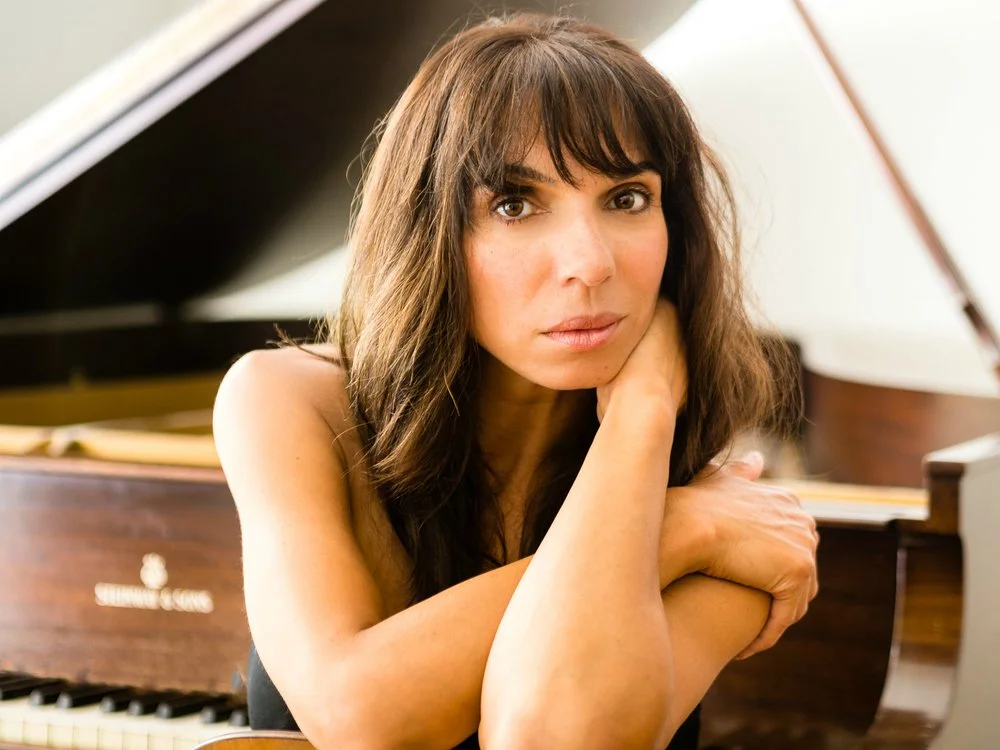
The Sphinx Organization announces Lara Downes as a recipient of the 2016 Medal of Excellence and $50,000 Artist Grant.

The Sphinx Organization announces Lara Downes as a recipient of the 2016 Medal of Excellence and $50,000 Artist Grant. Sphinx is a Detroit-based national organization dedicated to transforming lives through the power of diversity in the arts. The organization's annual awards honor outstanding artists of color who demonstrate artistic excellence, outstanding work ethic, a spirit of determination, and great potential for leadership. Lara Downes joins soprano Julia Bullock and cellist Gabriel Cabezas as 2016 honorees. For more information, visit http://sphinxmusic.org/sphinx-medals-of-excellence.html.

Strings Magazine: Shanghai Symphony Orchestra Announces Isaac Stern Violin Competition
In September, the Shanghai Symphony Orchestra announced the launch of the large-scale competition, which will offer $100,000 to the first-prize winner, making it the single largest monetary award for a violin competition.

Strings Magazine
By Stephanie Powell
"It has taken a little bit of time," David Stern, son of violinist Isaac Stern, modestly says of launching the Shanghai Isaac Stern International Violin Competition (SISIVC) that he will be co-chairing. In September, the Shanghai Symphony Orchestra announced the launch of the large-scale competition, which will offer $100,000 to the first-prize winner, making it the single largest monetary award for a violin competition. "I have to say that my father, in his lifetime, was not a great proponent of competitions," Stern says over the phone from Paris. "He didn’t believe in competitions very much and he didn’t believe in the concept of competing in music."
This was a belief that, when Long Yu (artistic director and chief conductor of the China Philharmonic Orchestra and music director of the Shanghai Symphony Orchestra) approached David and his brother Michael with the idea of developing a competition to honor their father’s legacy and commemorate his relationship with China, left the pair of brothers in a quandary. "There’s the whole feeling that we are responsible for his legacy," David says, "and we want to do it as carefully as possible."
The brothers knew that China was a significant part of their father’s life. From Mao to Mozart, the Oscar-winning documentary highlighting Stern’s 1979 travels to China shortly after the end of the Cultural Revolution marked the beginning of a long love affair with the country and its musical community. In many ways, the trip served as the initial bridge between Western and Eastern music.
With their father’s ethos in mind—"thinking ahead, being on top of things, and not just doing what everyone else does"—the brothers decided to move forward with the competition. They were helped by an all-star cast, including advisor to the festival Yo-Yo Ma, whom David mentions during our call, "It’s his birthday today! I have to call him."
"We thought about today’s society and how difficult it is for young musicians to get themselves heard," David says, "and we thought if we could infuse this competition with aspects that reflected my father’s legacy and his principals, then it would not just be another competition.
"There will be a round where [finalists] will have to perform with a pianist and cellist and perform in a trio. That just tells you so much about the musician that a concerto doesn’t necessarily. Chamber music was so important to my father’s being." The competition will also include a Mozart round, where finalists will have to improvise their own cadenzas.
"As long as we maintain as much as possible that it’s not your ordinary competition," David says, "then we will be doing service to him. I feel like I’ve been connecting to him on a daily basis. Yu Long and the Chinese musical community have shown such understanding and respect for what my father stood for, and they speak about him in such a wonderful way," David adds, "I feel like we’re doing the right thing."
The application period is open now, for international violinists ranging in ages from 18 to 32, through January 31, 2016, and the competition is scheduled to run from August 14 through September 2, 2016, in Shanghai. A prize of $50,000 will be awarded for second place, and $25,000 for third with two additional awards available for the best performance of a Chinese work and the Isaac Stern Humanitarian Award.
For more information on the competition, visit shcompetition.com.

GQ Germany: Lang Lang Named "Man of the Year"
Lang Lang was named one of GQ's "Men of the Year" for his active and innovative social media presence.

Lang Lang was named one of GQ's "Men of the Year" for his active and innovative social media presence.
See a related Süddeutsche Zeitung article by clicking here.

South China Morning Post: Chinese conductor Long Yu to get top honour for bridging East-West gap
Maestro Yu who recently set up Shanghai Orchestra Academy to receive prestigious prize from Atlantic Council next week alongside Henry Kissinger, Mario Draghi and Colombia's president.
South China Morning Post
By Kevin Kwong
Maestro Yu who recently set up Shanghai Orchestra Academy to receive prestigious prize from Atlantic Council next week alongside Henry Kissinger, Mario Draghi and Colombia's president.
Chinese conductor Yu Long is to receive the prestigious Global Citizen Award in New York on October 1. Yu, who is principal guest conductor with the Hong Kong Philharmonic Orchestra, will be honoured alongside veteran US statesman Henry Kissinger for his contributions to bridging the East-West gap through classical music.
“In 2008, for the first time in history, the China Philharmonic Orchestra performed under the baton of Maestro Yu Long at the Vatican in the Paul VI Auditorium. The concert was attended by Pope Benedict XIV and marked a giant step in bringing Eastern and Western cultures closer together,” says the Atlantic Council, a US think tank on international affairs, which gives out the annual awards.
Born into a musical family in Shanghai, Yu, 51, received his early musical education from his grandfather and composer Ding Shande and went on to study at the Shanghai Conservatory of Music and the Hochschule der Kunst in Berlin. A musician with vision as well as a strong network around the world, Yu wears many hats and is the artistic director of the Beijing Music Festival and the China Philharmonic Orchestra, music director of the Shanghai and Guangzhou symphony orchestras, and the co-director of the MISA Shanghai Summer Festival.
Recognising the need for specialised orchestral training in China, Yu founded the Shanghai Orchestra Academy in September 2014 to offer a focus on ensemble work in Chinese musical education and training. The academy offers a number of courses that give students a chance to work with overseas orchestras such as the New York Philharmonic, Sydney Symphony Orchestra and North German Radio Symphony Orchestra. This collaboration further cements relationships between aspiring young Chinese musicians and their counterparts in the West.
"I can't say enough about our partners in the Shanghai team. Yu Long had a vision. [He is] incredible, amazing to work with,” Matthew Van Besien, president of the New York Philharmonic, said earlier this year.
Also being honoured at the event will be Mario Draghi, president of the European Central Bank, and Juan Manuel Santos, president of Colombia. Past Global Citizen awardees include actor Robert De Niro, Mexican President Enrique Peña Nieto and the first prime minister of Singapore, Lee Kuan Yew, who died in March 2015.

SSO to Mark Anniversaries in Performance at the UN General Assembly
For the UN concert on August 28, artists from all the major Allied powers of WW2 will be represented, performing music by Beethoven, Tchaikovsky, John Williams and a new work by Zou Ye

In one of the largest concerts ever held at the General Assembly of the United Nations, August 28 will see Maestro Long Yu assemble his Shanghai Symphony Orchestra to represent China in a musical celebration to mark 70 years since both the ending of World War Two and the establishment of the UN itself. All of the chief Allied WW2 powers will be represented in the concert, which also will include America's MasterVoices choir (formerly the Collegiate Chorale, the choir which performed at the official opening of the UN building), Russian-born violinist Maxim Vengerov (playing Schindler's List), 12-year-old Chinese piano prodigy Sirena Wang, and singers Ying Huang (China), Sarah Fox (UK), Aurhelia Varak (France), Vadim Gan (Russia), David Blalock (USA) and Christopher Magiera (USA). The concert is part of a tour of the Americas by the orchestra, and will also take in two venues in Rio de Janeiro, Brazil (Aug 30, 31), and one in Buenos Aires, Argentina (Sept 2).
"It is a concert in which the music we play is about memories and about new beginnings" says Long Yu, "World War Two was of course a great tragedy, as well as a victory over evil, which must be remembered, while the birth of the UN from out of the wreckage of that war was a new beginning for the world. So Tchaikovsky's Andante Cantabile is contemplative, healing, Barber's Adagio is a piece of hushed mourning, as of course is John Williams's Theme from Schindler's List. Then Beethoven's Choral Fantasy is a work of genesis, one that eventually culminated in the magnificent Ninth Symphony and its 'Ode To Joy' - but in this exuberant early work we can hear the seeds of that utopian vision, which is very appropriate for a forum created around the ideal of nations talking and collaborating, rather than fighting." The new work, Shanghai 1937, is by the Chinese composer Zou Ye (Long Yu recently initiated the Compose 20:20 project, to bring new Western works to China, and new Chinese works to the West).
Nor does the sense of history that attends this event elude its conductor. "Speaking for myself and the players as well as the management of the Shanghai Symphony Orchestra, to be able to represent our country in the spirit of the great things achieved by the allies and the founders of the United Nations seven decades ago, is an immense privilege. To be part of a cultural message from artists of China, the US, UK, France and Russia that we hope represents the renewal of those ideals is an honor to be cherished. And it also feels appropriate that this concert is part of our wider tour of the Americas - as much as we are bringing in artists from different nationalities to our concert halls, we musicians are also ourselves physically travelling from country to country, to help strengthen the bonds that bind nations, and people, together."
The orchestra will also be joined by nine students from the Shanghai Orchestra Academy, an initiative created with international cooperation with the Shanghai Symphony Orchestra and the New York Philharmonic Orchestra.
Notes for Editors:
* The Shanghai Symphony Orchestra is China's oldest symphony orchestra, founded in 1879 as the Shanghai Public Band (under conductor and flautist Jean Remusat). Between these years and the end of World War Two, some European musicians came to the orchestra as section leaders, bringing with them their knowledge of European performance styles - after World War Two, however, the Europeans gradually left creating opportunities for the most talented Chinese musicians. In 1956 the orchestra, already informally known as "the best in the Far East", renamed itself the Shanghai Symphony Orchestra. Xieyang Chen took over the artistic leadership, creating and filling the role of music director. He was succeeded by the current incumbent, Long Yu.
The SSO has performed around the world. It was the first Chinese orchestra to play Carnegie Hall, in 1990, the first to play the Berlin Philharmonie (2004), the first to give a concert in New York's Central Park (2010). Last year, it inaugurated its new, world-class concert venue in Shanghai, Symphony Hall, ingeniously built underground for urban planning reasons. And it also recently created a major new popular classical music festival - MISA (Music in the Summer Air) - with joint artistic directors Long Yu and Charles Dutoit.
In 2014 the SSO and the New York Philharmonic Orchestra launched the NYPO's Shanghai Orchestra Academy and Residency Partnership, a joint endeavour of both orchestras that included the founding of the Shanghai Orchestra Academy (SOA) which opened in September 2014, and the NYPO's four-year performance residency in Shanghai.
* Maestro Long Yu is Music Director of the Shanghai Symphony Orchestra, also of the Guanzhou Symphony Orchestra, the Artistic Director and co-founder of the China Philharmonic Orchestra, and Principal Guest Conductor of the Hong Kong Philharmonic. He is also Founding Artistic Director of the Beijing Music Festival, co-founder of the Shanghai MISA Festival and incoming Principal Guest Conductor of the Hong Kong Philharmonic Orchestra.
He helped spearhead the establishment of the New York Philharmonic's Shanghai Orchestra Academy and Residency Partnership (see above) and is an honorary member of the International Advisory Board of the New York Philharmonic. Other China ‘firsts’ include bringing the first-ever performances of Wagner’s Ring cycle in the country, presenting its first-ever Mahler cycle, releasing the first album of Chinese music on a major recording label (Dragon Songs, alongside Lang Lang, for DG), and bringing the first-ever Chinese orchestra to play at the Vatican. Last year, he led the China Philharmonic as the first Chinese orchestra ever invited to play at the BBC Proms. The Shanghai Symphony under his baton was the first orchestra other than the New York Philharmonic to perform on Central Park's Great Lawn.
He has commissioned new works from many of today’s leading composers, among them Tan Dun, Krzysztof Penderecki, Philip Glass, John Corigliano, Guo Wenjing and Ye Xiaogang and has created a five-year initiative, Compose 20:20, to bring new Chinese works to the West and new Western works to China.
He was recently awarded the Chevalier de la Légion d'honneur from the French governnment, only the third Chinese national ever to receive it. This award marked a highlight of an impressive 2014 season for Maestro Long Yu. Last July, starry concerts in Shanghai and Beijing coincided with his 50th birthday, and colleagues including Lang Lang, Alison Balsom and Maxim Vengerov performed, with new works composed by Tan Dun, Qigang Chen and John Williams. At the same time, he led the Shanghai Symphony into their new home, a state-of-the-art venue built mostly underground, acoustically designed by Yasuhisa Toyota.
Long Yu regularly conducts important orchestras and opera houses in the West such as the New York Philharmonic, Los Angeles Philharmonic, Orchestre de Paris, Chicago Symphony, BBC Symphony, Teatro La Fenice, Hamburg Staatsoper and Philadelphia Orchestra. He was previously honored to be appointed a Chavelier dans L’Ordre des Arts et des Lettres in France, and a L’onorificenza di commendatore from the Republic of Italy.
In August 2015 he led the China Philharmonic on a tour of the old Silk Road trade route, taking in coutries such as Athens, Turkey and Iran - making China the first of the P5+1 negotiating partners to send an orchestra to Tehran following the much-discussed nuclear agreement (they played Dvorak's New World Symphony, among other repertoire).

BBC Music Magazine: An American Adventure
Editor of BBC Music Magazine, Oliver Condy, travels to the majestic mountains of Wyoming for the Grand Teton Music Festival

BBC Music Magazine
'Welcome to Jackson Hole', says the sign at the exit to the airport, 'The last of the old west.' Driving through the wide open plains of the Grand Teton National Park framed by the majestic Teton Range, calls to mind Jerome Moross's evocative music to the opening minutes of the 1958 film, The Big Country. You can still see genuine cowboys at work here, who share the spectacular landscape with bison, elk, moose, eagle, bear (black and grizzly) and the odd peckish mountain lion, who add a frisson of excitement to any hill runner's morning constitution.
Just down the road from Jackson Hole (in American terms, that is – it's a three-hour drive) is Yellowstone National Park, packed full of thrilling geological wonders, the most famous being the Old Faithful geyser that spouts a gigantic column of boiling water almost 200 feet into the air every hour and a half, and the otherworldly, primordial Grand Prismatic Spring that reflects the entire spectrum of colours around its rim accompanied by warm, eggy gusts of sulphurous steam.
The Teton area, by winter, is one of the finest places to ski anywhere on earth, but by summer, its mountains and valleys, now devoid of snow, seduce lovers of cycling, climbing, kayaking, bird watching, fishing, and hiking. It also plays host to one of the oldest and best classical music festivals in America.
Since 1962, Jackson Hole has been the backdrop to a seven-week celebration of orchestral and chamber music, the Grand Teton Music Festival, at the heart of which is the festival orchestra, a super-ensemble comprising the finest players from America's orchestras, from Atlanta to Louisiana, Dallas to Pittsburgh. And the conductor of this staggering group of musicians is none other than Donald Runnicles, musical director of the Deutsche Oper, principal guest conductor of the Atlanta Symphony Orchestra, and, until September 2016, principal conductor of the BBC Scottish Symphony Orchestra, after which he becomes conductor emeritus. 'It’s a testament to this place that the players keep coming, year in, year out'. Runnicles has been the festival's musical director since 2006.
The players themselves, some of whom stay for a couple of weeks, some for the entire seven, see it as a chance to renew their vows with orchestral music, as it were, among friends and away from the stresses of unions, orchestra politics and the school run. ‘Each and every musician is here because they want to be’, Runnicles explains. ‘There’s no compulsion to be here – their focus is on this bucolic experience and great music-making. And many of their absolute best friends were made here. They can’t wait to get back.’
The festival audience benefits from this unique chemistry through exciting, fresh, often revelatory performances in the stunning 800-seat Walk Festival Hall, although the real challenge, Runnicles admits, is finding repertoire that will fascinate his group of musicians but that will still attract audiences. The final two concerts of this year's festival featured Vaughan Williams's Symphony No. 3, a work that Runnicles had never conducted before, and which only two members of the orchestra had played before. ‘So many musicians have thanked me for bringing this repertoire to the festival – that’s beautiful,’ he smiles, ‘and each of these musicians will return to their institution and share their new love of Vaughan Williams.’
The GTMF closed with a stupendous performance of Respighi’s breathtaking Pines of Rome – a grand ending to the Grand Teton. The festival traditionally allows its players to stay for one more day following the final concert, easing them gently back into the real world. Just about enough time for a decent mountain hike and one last moose encounter…

Financial Times: Overtures that Bridge East and West
How one of China's top conductors, Long Yu, is extending the appeal of his country's music.
Financial Times

Photo: Yao Xu
Put together a pair of anniversaries as far-reaching as those falling this year — the end of the second world war and the founding of the UN in 1945 — and it is fitting that as many nationalities as possible are involved. On Friday the UN marks the double anniversary with a special invitation-only concert, with soloists from each of the major Allied powers, together with the Shanghai Symphony Orchestra and Chinese conductor Long Yu.
It is the start of a tour of the Americas by the orchestra, and will be repeated in Rio de Janeiro and Buenos Aires.
One element of the concert may be unexpected: the inclusion of a new work by a Chinese composer, Shanghai 1937 by Zou Ye, part of a project called “Compose 20:20” and a sign of how much the world of classical music has changed since 1945. Look to the future and it is likely to be found in Asia — thanks not only to the hordes of young pianists following in the footsteps of Chinese superstar Lang Lang, but also to new and interesting composers.
There is what Long Yu calls a “cultural bridge” between east and west waiting to be crossed. Any composer who wants to make the journey from the Chinese classical tradition to the concert halls of the west needs an uncommon degree of ingenuity, and nobody understands this better than China’s leading conductor. In recent years he has been successful in bringing a string of new Chinese works to the west (UK music-lovers will recall Qigang Chen’s Joie éternelle when the China Philharmonic made history as the first Chinese orchestra to visit the BBC Proms in 2014).
“Actually, it’s more than a hunger,” says Long Yu. “It is an absolute need, if we are to keep the cultural fires alive. We have seen so far a wonderful fascination in China for western classical music, and the same coming the other way from the west. But this frenzy of energy has too often been somewhat diffuse and without shape. Now is the time that we can start using it to explore and to experience in a curated way.”
That “curated way” is “Compose 20:20”. Between now and 2020, Long Yu will present 20 new works by Chinese composers in the west and 20 contemporary works by western composers in China. “Some of the composers are good friends, like Qigang Chen and [Polish composer Krzysztof] Penderecki,” says Long Yu. “Some, like Philip Glass, I have already commissioned; others not, such as John Adams and Bright Sheng. If ‘Compose 20:20’ can provide the motivation to generate commissions, I will count it a success.”
A nation coming out of the cultural revolution needed its own version of Britain’s inimitable Thomas Beecham, serial founder of orchestras and, in Long Yu, China has found him. Among the exhausting array of positions he holds are artistic director and co-founder of the China Philharmonic Orchestra, music director of the Shanghai and Guangzhou Symphony Orchestras, founder of the Beijing Music Festival and the Shanghai MISA Festival.
It might seem a challenge to introduce a programme of new Chinese music in the west, but Long Yu argues that audiences across the world are equally suspicious of what they do not know.
“In China, the taste in music varies hugely between different areas,” he says. “For example, people in Beijing love Wagner. Our Götterdämmerung there didn’t finish until one in the morning, but the audience stayed for many curtain calls. Contrast that with a concert we did of extracts from Wagner’s operas in the south, where there just wasn’t the same enthusiasm. For a long while China stuck with Tchaikovsky and endless repeats of La traviata and La bohème. But more recently there have been so many premieres — Stravinsky, Ligeti, Britten’s Peter Grimes and War Requiem, even Berg’s Lulu, as far back as 2002, and that was tough. Half the audience left the theatre at the end of the first act. You have to keep fighting to bring forward new works.”
This is part of the picture that Long Yu paints of a country that has moved on from laying the foundations for a new artistic life after the cultural revolution. The previous generation, he says, had to work out what the best system for the arts might be in China, what the professional structures would look like. The present generation, he says, has to build on that.
“I am very committed to moving on to the second-level cities in China and encouraging their development,” he says. “People are critical of China for building new concert halls and theatres, as the buildings are nothing more than symbolic unless there is content. Now we are working on the next part of that. Music is something you can’t see, can’t touch. It comes from creativity, and we have to show the younger generation that music is not just about giving a concert or having a career. It is about freeing the imagination.”
From his unique position of influence Long Yu is able to take the long view. “What matters to me now is that one generation passes on the fire to the next. We have this one-child policy in China and every parent wants his kid to become a star. People talk about 50m Chinese children learning the piano, but do we really think all 50m will find a job as a musician? There isn’t too much space for stars.
“I would be quite happy if those 50m grow up to become music-lovers, the people who buy tickets and support music in the future. That would make me happier than seeing the kids struggling to perfect their harmony every day. If only their parents could see that what is important is how to bring joy through music to their children.”