

Strings Artist Blog: Cellist Julian Schwarz on Destiny—Tied with a Bow
For a string player, a great instrument is only half the equipment battle. A phenomenal bow is the other half, providing finesse, tone, and various articulations.

Strings Artist Blog
For a string player, a great instrument is only half the equipment battle. A phenomenal bow is the other half, providing finesse, tone, and various articulations. Bows are not only vital to phrasing and color, but sometimes suited to particular playing styles. Therefore it is common for an instrumentalist to own many bows to facilitate stylistic shifts. A bow collection is also much more affordable for string players than an instrument collection.
I find it interesting to try bows of various origins, weights, and styles, regardless of my intent to buy. This brings me to my story—one that starts with neither an intention to try, nor to buy, a bow.
One day I found myself at the Tarisio auction house in New York City (a premier auction house for stringed instruments and bows based in NYC and London) to return an instrument I had been trying that week. There was an auction only a few days away and the office was bustling with eager buyers. One such buyer was a Russian man who noticed me carrying a cello case. As I was making my way out he asked, “Are you a cellist?” I replied in the affirmative. He continued, “Would you consider helping me by trying the various cellos so I can hear how they sound?”
That afternoon I had neither appointments nor engagements, and I thought this exercise could be fun, not to mention a good deed!
So we went to a room and he brought me the first of many cellos to try. I sat down and realized an obvious obstacle—I had no bow! As I was just returning an instrument, I hadn’t bothered to bring one. As the auction had many cello bows as well as cellos, the gentleman agreed to fetch me a bow from the auction. He did so in haste—he was very considerate and appreciative of my aid and time. So I began.
As this was for his benefit, I played the same few excerpts on each cello, not aiming to draw conclusions myself. He took notes on each instrument’s unique sound, and asked for my thoughts occasionally. Turns out he was sent by another Russian man to examine the offerings of the auction. This other man was a collector, and relied heavily on the advice of my new friend.
As I played, I began noticing one common characteristic: the bow was a superb implement. I took a look at it. The tip looked like a Dodd (a very well-known English bow maker with a distinct style). I was fascinated by the bow as I stared it up and down. It was beautiful.
While trying more instruments, I started to simultaneously try the bow with more intent. I chose excerpts based on challenging bow techniques to see how well it responded.
It was absolutely brilliant.
After a few more cellos, my curiosity got the better of me and I just had to know what kind of bow it was. I assumed it was something very expensive—a Dodd of the highest order. I was guessing an auction estimate of $15,000–$20,000. I asked my friend to look up the lot number in the catalog. He showed me the entry. It was described as an “English bow with a stick attributed to James Brown and an unknown frog. Estimated $2,000–$5,000.”
My jaw dropped. It was not by a famous maker, did not cost an arm and a leg, and was a composite (meaning that circumstances required part of the bow be remade by another maker at a later date). This was not a bow for a collector. This was a bow for a player, and I loved it.
Elated, I sincerely asked the gentleman to refrain from bidding on the bow when the auction itself opened. He was glad to oblige. “This is your bow!” he exclaimed.
The day of the auction arrived and I was ready. I had never bid on a bow or instrument before. Auctions had always fascinated me, as I was dragged to many as a child—all to furnish my childhood home with antiques—but I had never participated myself.
I created my Tarisio account and realized that the auction had already finished.
What? Really?
It was 4 o’clock pm and I figured that I would get in before a 5 o’clock closing. But 5 o’clock pm in London is 11 am in New York. I was 5 hours late. There it was, my opportunity to get a great bow—a great steal—gone. I was disappointed, to say the least. Out of sheer curiosity I examined the lots to see at what price points various items closed. Out of over 300 lots, 298 sold. That left me a shred of hope. I went through hundreds of lots before landing on cello bows.
My dream bow had not sold. I got on the phone right away, spoke to the auction house, and the bow was mine. Hallelujah! What were the odds? The only cello bow not to sell was the only one I desired.
Not only did I purchase the bow for the minimum accepted bid, but I received a reduction in the buyer’s premium, as I was the first in and first out. What fortune! What luck! I was on cloud nine. My Russian friend had been true to his word. Bless his heart.
To add more joy to the situation, I removed the frog after picking up the bow from the auction house only to find a stamp on the inner part of the frog that read “Paul Siefried.” Paul Martin Siefried is one of the most respected bow makers in the world, and made my first full-size bow my parents bought me when I was 10 years old. Not only was it a welcome surprise, as I had been playing a Siefried for 14 years, it also increased the value of the bow.
A few months passed and I still loved the bow. I played all my spring and summer concertos, recitals, and chamber performances with it. It had everything—projecting tone, subtlety, and color to spare. One night I was set to have dinner with my parents and the widower of my cello teacher from high school. Toby Saks was a remarkable cellist and a remarkable woman. She was hard on me, that’s for sure, but she believed in me and gave me immeasurable tutelage of the highest order. She was a huge inspiration, and I always sought her approval and appreciation. She was a huge part of my musical life, and I am so lucky to have known her and studied with her. Our close relationship made it all the more difficult for me when she passed away suddenly in the summer of 2013. She left behind an amazing husband Marty, and I was set to have a meal with him and my parents in New York.
We met at my parents’ apartment and began to catch up. I always liked him, and it was good to see him since I had had little contact with him following Toby’s passing. Eventually the conversation turned to Toby, and it was very meaningful to me. I was able to express to him how much she meant to me both personally and professionally. He affirmed that, though demanding of me, she was proud of what I had accomplished in her lifetime.
Then I felt I had to ask the question I had been meaning to ask for two years but felt ashamed to ask in the face of such tragedy. “So…” I hesitated, “what happened to the bows?”
Toby had a superb collection of fine French, American, and English bows that she never allowed me to either see or play. She would not even divulge how many bows she had or who made them. All I knew is that it was an important collection.
Marty replied flippantly, “I sold them all.”
I was in disbelief, and retorted sarcastically, “Thanks for calling me!” and followed it up with a huff. He was shocked at my reaction. “I would have jumped at an opportunity to buy one of Toby’s bows,” I said.
Silence followed.
After a few moments, he said (with much sincerity), “I am so sorry.” There was nothing else to be said. He had to sell the bows. I knew that. Toby had children from a previous marriage and her assets had to be liquidated. I understood that, but I was emotional. I wanted a piece of Toby for the ages. She left this earth much too soon and I missed her. I wanted to feel a connection, albeit to something inanimate.
I calmed down. The air became less tense and I inquired as to where the bows went, to whom, and who made them. He went through the list, which was quite impressive, and went through who had a part in selling various parts of the collection. He concluded, “All the rest of the bows that weren’t sold I put in the Tarisio auction this past May.”
Wait . . . it couldn’t be. My mind started racing. “Did all the bows sell?” I uttered, as I tried to reign in my potential excitement.
“There was one bow that didn’t sell,” he replied, “but then someone bought it later in the day, which was great because I don’t know what I would have done with it.”
Paul Siefried made the frog. The lot numbers matched.
I bought Toby’s bow.
Cellist Julian Schwarz made his orchestral debut at the age of 11 playing the Saint-Saëns Concerto No. 1 with the Seattle Symphony with his father, Gerard Schwarz, on the podium. He has performed with symphonies and in chamber-music festivals throughout the United States and internationally. He was awarded first prize in the professional cello division of the inaugural Alice and Eleonore Schoenfeld International String Competition in Hong Kong, and received his bachelor of music degree from Juilliard, where he studied with Joel Krosnick. He is pursuing his master of music degree, also at Juilliard. Schwarz performs on a cello made by Gennaro Gagliano in 1743.
Boston Globe: Watertown bow maker practices musical alchemy
“It’s just amazing,” says Lowe, the BSO concertmaster. “Some people look at a note or phrase of music on the printed page and ask, ‘Oh, how does it do that to my heart?’ For me, it’s the same thing, but I look at a tree and think, ‘How does Benoit turn this into a bow?’ ”

Boston Globe
By Jeremy Eichler
Yo-Yo Ma remembers preparing to be diplomatic. His wife had just surprised him with a newly commissioned cello bow for his 60th birthday.
Such a lovely gesture, he thought, while at the same time feeling slightly skeptical. He already played on a 19th-century bow by the most revered maker in history.
Ma’s friends, who had gathered last fall for a festive birthday dinner, zealously insisted that he give the new bow a try. So he did.
“In a few seconds,” Ma recently recalled, “I switched from being polite, to being like, ‘Oh.’ ”
His friends reached for their cellphones.
“We were all just floored by the clarity and projection and the color this new bow was producing,” said David Perlman, a friend of Ma’s who was present at the dinner and had helped engineer the gift. “There was just something electric about it, something that was totally unique.”
Benoit Rolland, the maker of this mysterious new bow, was not present on this occasion. But, curiously enough, neither was he far away.
Born in Paris, Rolland learned his art in the French town of Mirecourt, the storied center of the French instrument-making tradition. You might expect to find him now in a well-appointed shop on a leafy side street in one of Paris’s more elegant districts.
In person, Rolland, 61, exudes an air of calm and a keen intelligence that seems to concentrate behind his warm, watchful eyes. He is quick to apologize for his English, but nonetheless speaks with a streamlined eloquence about his personal approach to his art. “The violin makes the sound,” he likes to say, “but the bow makes the music.”
A trained violinist, Rolland asks to hear a musician play before beginning a new commission. Listening carefully, he then forms what clients describe as an almost eerily insightful picture of a musical personality: one that can encompass the specific expressive contours of a performer’s style, and perhaps even hidden potentials waiting to be unlocked by the right bow.
“He has a great gift of watching and sensing,” says Mutter, by phone from Austria. “It’s more than only knowledge.” The Boston-based Kashkashian concurred: “I don’t know anyone who hasn’t felt that he captured what they needed,” she said.
To match bow to player, Rolland works meticulously to select wood with the right density and sensitivity to vibration; he then tapers, shapes, and cambers the stick according to a particular balance he deems right.
Most recently, however, Rolland has been channeling his mental, physical, and spiritual resources for a client more discerning than most: himself. Rolland in December began the bow — his 1,500th creation — that he sees as a kind of personal celebration.
For it, he has used an uncommonly beautiful and resonant piece of Brazilian Pernambuco wood he had been saving for years, and the rarest ebony from the island of Mauritius, given to him by his teacher, Bernard Ouchard, almost a half-century ago.
In the new bow’s frog — the rectangular part at the base of the bow that moves to control its tension — he placed mother of pearl he harvested himself from a French island off the coast of Paimpol. The frog has been adorned with two diamonds and a delicate gold inlay inspired by a painting of a swallow by his wife, the painter and poet Christine Arveil.
This bow, he explained, would also be a celebration of their partnership. “For me, it is a way to gather all of the ideas I have so far about bows, and to put everything in one bow: this bow.”
When Rolland first elaborated on his plan and the delicacy of work entailed, with adjustments measured in hundredths of a gram and inlays that would require him to construct an entirely new set of tools, it seemed like an almost quixotic quest — as if a leading writer was fearlessly announcing that his next novel would be written on a grain of rice. But he seemed coolly undaunted.
He also spoke of his initial journey into this career and of his early years as a student, when the wood was “so hard, so hard” and it would cut into his sensitive violinist hands. Many times he considered abandoning the profession.
“In a way,” he said, “this is a celebration of a victory over myself.”
It is a strange fate to be a master of an art at once so essential and hidden from view. The public often hears of Stradivarius instruments; bows, by comparison, are rarely discussed. If you are not a string player or married to one, chances are you cannot name a single bow maker, living or legendary.
But without the bow, and its way of keeping a tense string in a state of perpetual excitement, the violin resembles a small, handsomely varnished guitar. “The bow is a very old concept,” Rolland offered one afternoon, sitting at his large oak workbench. “I don’t know, but I think it was born with the first human being, and the first wish to reproduce the human voice through an instrument. There is no way to do that without a bow.”
Yet this undisputed master of bow making has been quietly plying his trade for the last several years from a brightly lit home studio in a certain north-bank arrondissement of greater Boston, one that is perhaps better known as Watertown.
If you attend concerts in the area, chances are you’ve heard a player performing with one of Rolland’s creations. Recognized in 2012 with a MacArthur “genius grant,’’ he has made bows for several leading soloists on the circuit today — including violinist Anne Sophie Mutter and cellist Lynn Harrell — and for 20th-century legends such as Yehudi Menuhin and Mstislav Rostropovich.
He also keeps Boston’s own string players well cared for. In just one typical example, on Monday at New England Conservatory’s Brown Hall, a Music for Food benefit performance will feature no fewer than four prominent string players — violists Kim Kashkashian and Paul Biss, violinist Miriam Fried, and cellist Marcy Rosen — who rely on Rolland’s bows. So do about a dozen Boston Symphony Orchestra string players, including concertmaster Malcolm Lowe.
Yet to actually create a bow from scratch is to practice an odd type of alchemy, transforming what is essentially a hunk of wood and the hair from a horse’s tail into the conduit for the most sublime thoughts of composers through the centuries — and of the players who translate and interpret them.
“It’s just amazing,” says Lowe, the BSO concertmaster. “Some people look at a note or phrase of music on the printed page and ask, ‘Oh, how does it do that to my heart?’ For me, it’s the same thing, but I look at a tree and think, ‘How does Benoit turn this into a bow?’ ”
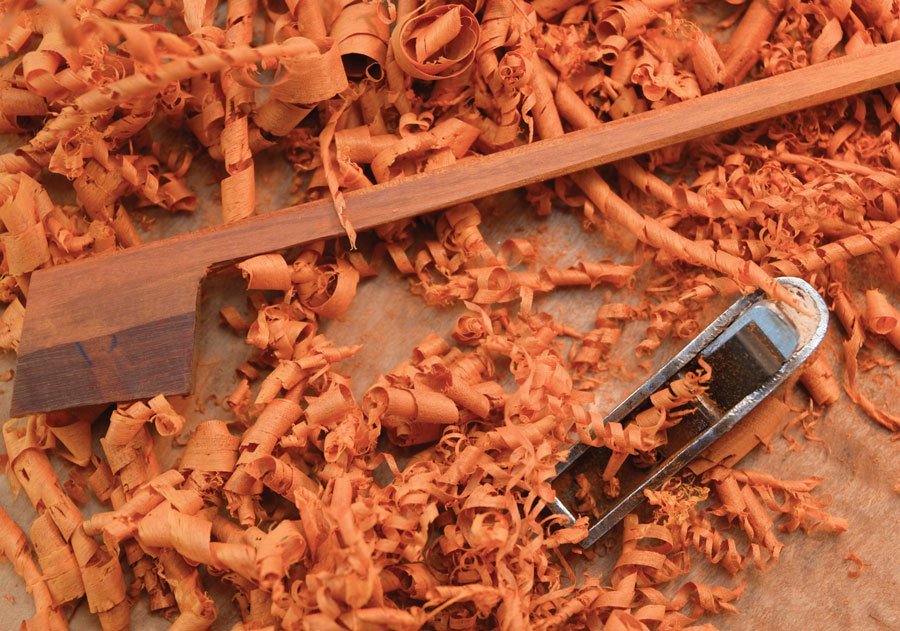
“Slowly” might be the first answer. Rolland works in an airy studio, his desk placed at an angle below a skylight. He uses many tools he built himself about four decades ago (“They don’t sell bowmaking tools in Home Depot,” he jokes) and others that he inherited from his teacher.
The French school of bowmaking, he explains, prizes physical contact with the wood itself. No power drill or vice is ever used. Rolland grips the bow with his strong left hand, often passing it over the length of the stick to feel its qualities but also, surprisingly, to listen.
“When you work, all the senses must be awake,” he said. “The sound of the wood will tell you if your plane is well-sharpened, if your wood is docile or rebellious, and if the wood is good for transmitting vibrations.
“This one has a very clear sound,” he continued, holding up the deep auburn stick that was to become No. 1,500. “It conveys vibration very fast, so it will produce a very bright sound.”
As for the basic physics of the bow, as Rolland explains it, the horsehair sets the string in motion, and the vibration is transmitted to the instrument. But the vibration then returns through the bridge back to the wood stick, creating a kind of closed feedback loop of sound creation.
Rolland says the ideal bow requires the harmonizing of opposing goals: strength and flexibility. It should also feel completely natural in the hand, “as if a piece of wood has been transformed into an extension of your own muscle.” In other words: countless hours of his work are invested in the creation of an object that, if he has achieved his goal, will effectively disappear.
Being invisible, however, should not mean taken for granted. “Composer, interpreter, and maker: they form three corners of a triangle,” Rolland says, his eyes brightening just before he turns back to his workbench. “Without any one of them, there is no music.”

GQ: An Orchestra Is Mashing Up Kanye West’s Hits with Beethoven’s to Create “Yeethoven”
Los Angeles's Debut Orchestra of the Young Musicians Foundation is taking a bold approach to their Great Music Series, performing some of Beethoven's classic works alongside Kanye West's Yeezus to create the perfectly titled "Yeethoven." I'm sure it tickles Kanye's fancy to be put alongside someone as musically revered as Beethoven, but it actually works. While it seems a little strange, partially because the best part of Kanye's music is frequently, you know, Kanye rapping, when you listen to the preview, it makes sense.
GQ
By Nicole Silverberg

It's pretty epic
Los Angeles's Debut Orchestra of the Young Musicians Foundation is taking a bold approach to their Great Music Series, performing some of Beethoven's classic works alongside Kanye West's Yeezus to create the perfectly titled "Yeethoven." I'm sure it tickles Kanye's fancy to be put alongside someone as musically revered as Beethoven, but it actually works. While it seems a little strange, partially because the best part of Kanye's music is frequently, you know, Kanye rapping, when you listen to the preview, it makes sense.
Yeezus and hits by Beethoven, including "Egmont Overture" and "String Quartet No. 14 (op. 131)," are played alongside each other and reveal some striking similarities. The conductor Yuga Cohler explains that both Beethoven and Yeezy make music with a "brashness creating wild contrast, thrashing juxtapositions within a single bar of music," which isn't exactly what I think of when I'm listening to "I Am a God," but now that Cohler said it, I'm like, Oh, yeah!
Cohler said he chose Kanye and Beethoven because they both have a "willingness to ruthlessly abandon tradition, and their influence on that larger culture can't be overstated." Seeing as Yeezy is getting his own orchestral arrangements, I'm gonna have to agree. Just one question: Does this mean I have to start wearing gowns and pearls to his concerts?

Rolling Stones: 'Yeethoven' Concert to Juxtapose Music of Kanye West, Beethoven
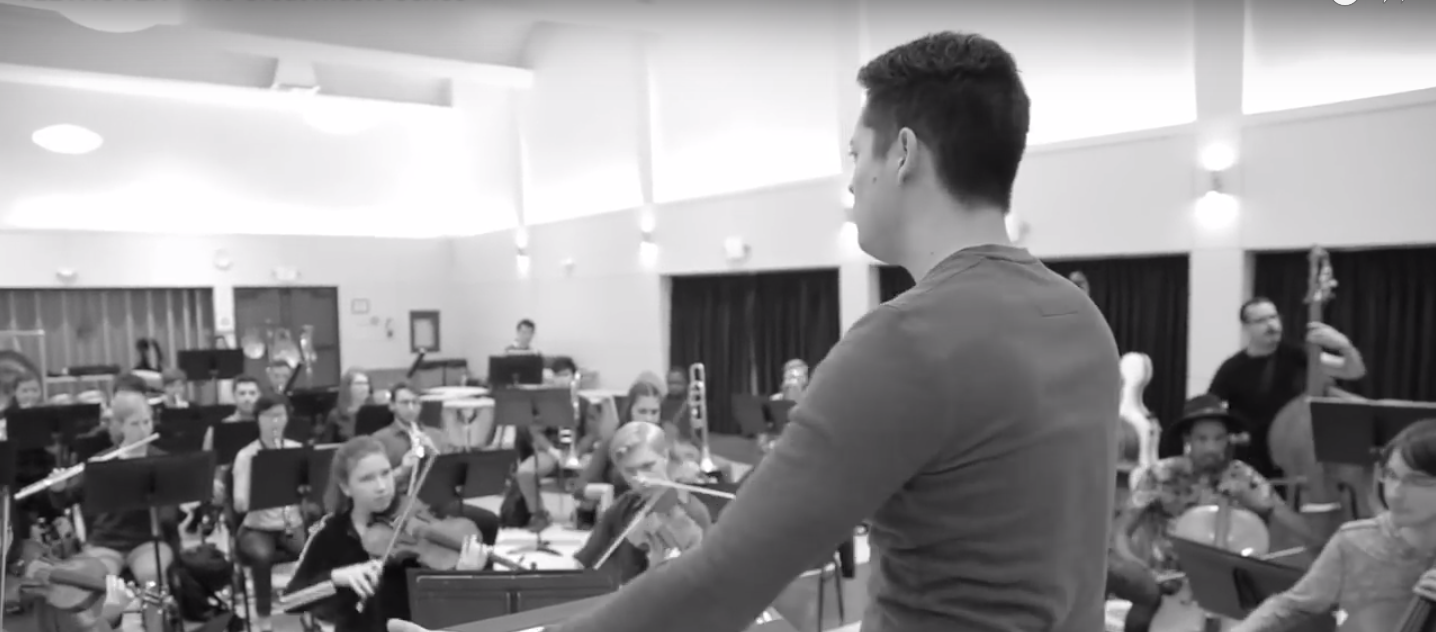
On April 16th, Beethoven will meet Kanye West when a 70-piece orchestra mashes up and reimagines the work of the two artists. The program is part of the Great Music Series hosted by the Young Musicians Foundation.
Rolling Stones
By Brittany Spanos
The music of Kanye West and Beethoven will be compared and spliced up by a 70-piece orchestra during a Los Angeles concert.
On April 16th, Beethoven will meet Kanye West when a 70-piece orchestra mashes up and reimagines the work of the two artists. The program is part of the Great Music Series hosted by the Young Musicians Foundation.
Co-curated by conductor Yuga Cohler and arranger Stephen Feigenbaum, "Yeethoven" aims to show the commonalities between the seemingly dissimilar artists. "Obviously, they work within very different traditions," a voiceover reflects in the promotional clip for the concert. "Their willingness to ruthlessly upend tradition and their influence on the larger culture can't be overstated."
The concert will feature six works by Beethoven and six works from West's Yeezus that will be "juxtaposed" and "spliced together" by the orchestra live. It will be put on for free at the Aratani Theatre — Japanese American Cultural & Community Center in Los Angeles.
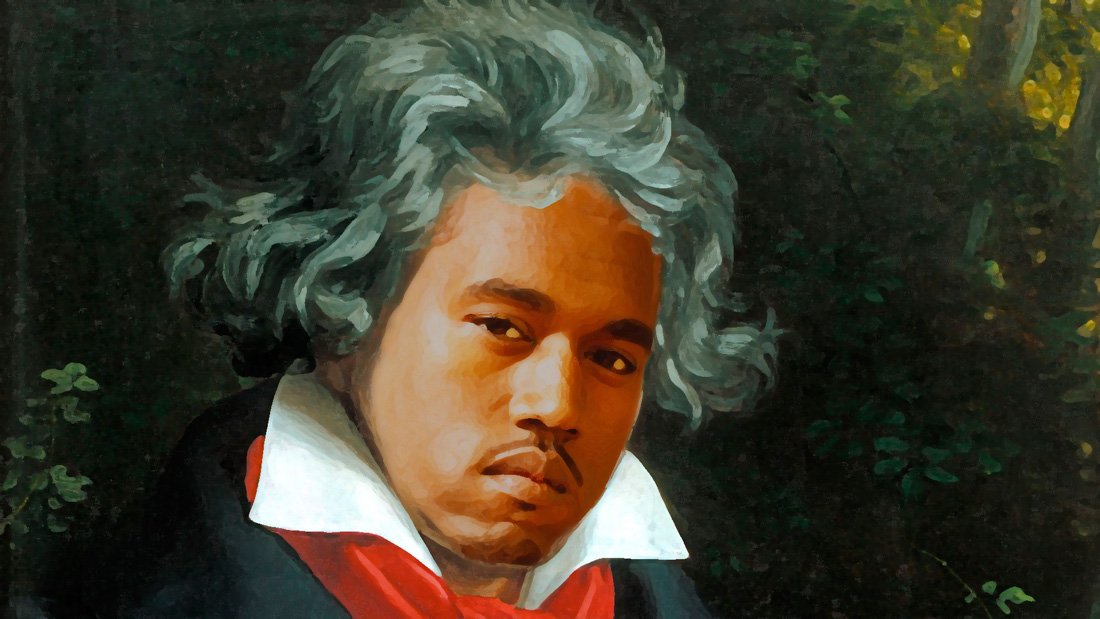
In 2012, a year before West released Yeezus, he compared himself to the classical composer during a concert in Atlantic City. "I am flawed as a human being. I am flawed as a person. As a man, I am flawed, but my music is perfect," he began. "This is the best you're gonna get ladies and gentlemen in this lifetime, I'm sorry. You could go back to Beethoven and shit, but as far as this lifetime, though, this is all you got."
Los Angeles Times: Kanye meets Beethoven: How young musicians are mixing classical with pop
It wasn't quite Little Coachella in Little Tokyo. But as if out of nowhere, more than 1,000 hip-hop fans, some wearing Kanye West T-shirts, descended on the Aratani Theatre. A few had arrived as early as noon on Saturday and waited in the hot sun for a 7:30 p.m. concert.
Photo: Kanye: Flickr/David Shankbone. Beethoven: Shutterstock
The Los Angeles Times
By Mark Swed
It wasn't quite Little Coachella in Little Tokyo. But as if out of nowhere, more than 1,000 hip-hop fans, some wearing Kanye West T-shirts, descended on the Aratani Theatre. A few had arrived as early as noon on Saturday and waited in the hot sun for a 7:30 p.m. concert.
Once the crowd had taken over San Pedro Street, the police came by to see what was going on. It was no big deal, they were assured, simply a queue for free tickets to the Young Musicians Foundation Debut Orchestra's Beethoven concert.
Make that Yeethoven, short for "Yeezus" (West's 2013 album) and Beethoven.
Meanwhile, not far away in Glendale, the Los Angeles Chamber Orchestra sandwiched between the tame "Classical Symphony" of Prokofiev and "Clock" Symphony of Haydn a new cello concerto by Mason Bates, who has one foot in electronica and moonlights as a DJ.
Is something going on? Yes and no.
Every generation genre-bends, each in its own way. They always have and, no doubt, always will. Eyebrows go up and they go back down. But by now it has gotten pretty hard to shock.
What does seem new is the lack of controversy. One almost longs for the days when Parisians rioted the premiere of Stravinsky's "Rite of Spring," the Viennese practically threw Mahler out of town for smudging the sacred symphonic art form with street music, and the 1950s avant-garde horrified the establishment with pursuits that redefined the definition of music.
I heard the Sunday night repeat of LACO's program at UCLA, and for both this and the YMF event Saturday, the musical and social welcoming mat easily co-opted rebellion. Still, it is hard to complain about attaining, through music, a unifying feel-good mood in our otherwise divisive feel-bad times. "Yeezy season approachin'," West tells us. Could that be the revolution we need?
What made "Yeethoven" especially engaging was its unmistakably sincere musical roots. The Debut Orchestra, a training ensemble for instrumentalists and conductors founded in 1955, happens to boast among its alumni André Previn and Michael Tilson Thomas, famed for their groundbreaking mixing of symphonic and pop worlds. The 26-year-old Juilliard-trained YMF music director Yuga Cohler is in their mold, a self-proclaimed hip-hop fan since childhood who does not see that and Beethoven as worlds in opposition.
A young composer of like mind, Stephen Feigenbaum, served as "Yeethoven" arranger and co-curator. Six Beethoven scores were paired with songs from "Yeezus," each grouping given a theme — Form, Contrast, Harmony, Rhythm, Gesture and Will — representing qualities Cohler and Feigenbaum find shared across centuries and cultures by Beethoven and West.
Introducing the pairings, Feigenbaum noted the chaotic, over-the-top nature of Beethoven's "Egmont" Overture and West's "New Slaves" or the heroic yet ambiguous character of the snappy second movement of Beethoven's Seventh Symphony and "Hold My Liquor." These are, of course, all general enough qualities that you could make the same case for any number of composers.
In fact, dissimilarities could be more striking than similarities, beginning with an informal pop crowd that little resembled the formal musicians on stage. Neither do Beethoven and West sound alike. And while West does profess some of Beethoven's democratic ideals and confidence, there are also major differences, such as the pop star's attitude toward women so radically opposed to Beethoven's idealized "Immortal Beloved." And, of course, orchestra and pop concert settings have little in common.
Yet "Egmont" and "New Slaves" are, each in its own way, transgressive arguments for freedom. Putting West in orchestral dress and removing the vocals meant avoiding anything offensive. Were his language to be used in a traditional classical concert (or this newspaper, for that matter), there really would be trouble.
All but two of the pairs were mash-ups. Beethoven seldom upgraded West, rather West infected Beethoven with contemporary funk and spunk. The final mash-up mattered most. An orchestral arrangement of the last movement of the Opus 131 string quartet undercut Beethoven at his most spiritually transformative with the raunchy side of West in "On Sight." Cohler and Feigenbaum's theme was Will, but it could just as easily have been Impurity. Beethoven kept earthy, and West's music rose spiritually higher than you might have otherwise expected.
For the enthusiastic crowd (200 or more were turned away), every recognizable West hook got a shout out and Beethoven got respect. Cohler conducted with surety and security. The orchestra, though looking a little dazed in these surroundings, played with a joyful sense of making a history.
The crowd at Royce Hall on Sunday night was more standard issue for LACO, with but a few more young people than normal in attendance. (I wonder what would happen with audiences at UCLA if the school eliminated its $12 parking fee for concerts.) Much of the interest here focused on Matthew Halls, the British conductor who became music director of the Oregon Bach Festival two years ago and whose strong showing makes him a credible candidate in LACO's music director search.
An all-around early music guy whose recording of Bach harpsichord suites is a knockout, Halls also happens to be big on 19th century opera, symphonic blockbusters and contemporary music. He went for boldness in both Prokofiev and Haydn, getting some of the loudest playing I've heard from the orchestra.
But he put most of his attention on Bates' new Cello Concerto, which had its premiere earlier this year with the Seattle Symphony (conducted by Mirga Grazinyte-Tyla). It was written for Joshua Roman, who has his own street cred. The popular young cellist will, for instance, be playing at Amoeba Music on Wednesday, and he showed up at Royce in a showy print suit reminiscent of '60s Carnaby Street.
Bates is everywhere. The new composer-in-residence of the Kennedy Center (a first), he will have his next premiere streamed next week on the San Francisco Symphony Facebook page (believed to be a first for a major orchestra). He has lively orchestral imagination excellent for evoking specific sonic environments (such as primordial life or a future colony in Iceland) by adding beats and electronica effects to snappy melodies.
The Cello Concerto is more traditional. It includes instances of lightweight jazziness and commercial pop. It exploits Roman's flowery virtuosity and offers the cellist diverting light touches — such as bouncing the bow on the strings and plucking them with a guitar pick. But with Roman's propensity for cuteness, this concerto becomes less the transgressive expansion of our musical vocabulary than a contrivance suitable for taming the "monster about to come alive again" that West unleashes in "Yeezus" and Cohler cavorts with in "Yeethoven."

Washington Post: Anne Akiko Meyers: Violinist breaks a leg — or rather, a foot.
“Break a leg” and “the show must go on” are among the most overused injunctions in the performing arts. On Friday, Anne Akiko Meyers joined the lists of performers who have obeyed both.
The Washington Post
By Anne Midgette

“Break a leg” and “the show must go on” are among the most overused injunctions in the performing arts. On Friday, Anne Akiko Meyers joined the lists of performers who have obeyed both.
To be exact, she didn’t break a leg. She broke her foot. But it didn’t stop her from performing Mason Bates’s challenging violin concerto with the National Symphony Orchestra on Friday and Saturday nights (after Thursday night’s unhampered performance).
“I thought I just completely sprained my foot,” the violinist said by phone from her home in Austin, Texas on Monday afternoon. “It was black and blue. But I didn’t know it was broken. I have never broken anything in my body.”
On Friday night, all that was evident was a slight limp – and slightly unconventional footwear, sturdy platform sandals. (“They’re like wearing sneakers,” Meyers said.) Sitting in the audience, I might not have noticed either had I not been tipped, off the record, before the concert, that Meyers had had a bad fall in the afternoon. That explained the placement of a stool on stage; but in the event, Meyers walked out, did not use the stool, and played the difficult concerto with aplomb.
By Saturday morning, the foot had ballooned. For Saturday night’s performance, Meyers used a wheelchair to get on stage – but still played standing up.
“You cannot sit and play Mason’s music,” she said on Monday. “It doesn’t work.” Besides, she added, “If I had sat, I would never have gotten up.”
The accident itself was relatively benign, or perhaps “domestic” is a better term: Meyers was pushing a stroller with her two daughters, ages four and five, while checking her e-mail on a smartphone, and didn’t see the curb at the edge of the sidewalk.
“It happened at like two o’clock,” she said. “I had a soundcheck at four.” There wasn’t time to go to the doctor, and besides, she was pretty sure what a doctor would say: “You need to ice it, and elevate, and medicate: three things I couldn’t do at that moment.”
It wasn’t until she got home to Austin on Sunday that she went to the emergency room and discovered that she had played with a broken foot.
Her misadventure is reminiscent of the time in 2009 that the mezzo-soprano Joyce DiDonato fell on stage and broke her leg during a performance of “The Barber of Seville” at Covent Garden. DiDonato finished the performance, on crutches, and then went to the hospital. She sang the next performance in a wheelchair.
But opera staging involves so much physical activity that people are apt to get hurt once in a while. (I remember a night when the stage knife failed to retract when Don Jose stabbed Carmen, drawing blood from the mezzo-soprano Elena Zaremba. Fortunately he only hit her arm.) Generally speaking, the concert stage tends to be a less perilous place.
Meyers is not cancelling any performances. Next on her schedule is a recording in London of a new piece by the Finnish composer Einojuhani Rautavaara, Szymanowski’s violin concerto, and Mortin Lauridsen’s arrangement of his popular “O Magnum Mysterium.” At least no one will see her footwear for that.

Huffington Post: Yeethoven Is The Kanye And Beethoven Mashup You’ve Been Waiting For
The Young Musicians Foundation Debut Orchestra, led by conductor Yuga Cohler and composer Stephen Feigenbaum, is bringing hip-hop and classical music together.
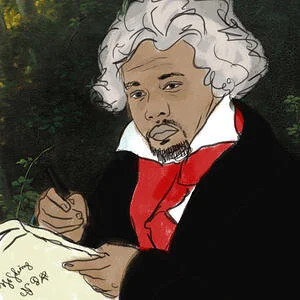
Photo: Priscilla Frank
The Huffington Post
By Priscilla Frank
The Young Musicians Foundation Debut Orchestra, led by conductor Yuga Cohler and composer Stephen Feigenbaum, is bringing hip-hop and classical music together.
When Kanye West released his sixth solo album, titled “Yeezus,” in 2013, he —with a single turn of phrase — fused his identity with that of the central figure of Christianity. The connection between Ye and JC was more than just an egotistical outburst from a narcissistic rock star, but a message about power, sacrifice, influence and vision, albeit a bombastic one.
Now, three years later, Ye has received another rather complimentary comparison. On April 16, at the Artani Theater in Los Angeles, the Young Musicians Foundation Debut Orchestra will perform “The Great Music Series: Yeethoven,” comparing Mr. West to Ludwig van Beethoven, and thus exploring the overlap between classical and hip-hop, 18th-century poofy collared shirts and 2013-era leather pants.
Yuga Cohler is directing the performance, along with project co-creator and composer Stephen Feigenbaum. The two, natives to the classical music world and longtime fans of Kanye’s work, have played music together since high school.
The Young Musicians Foundation Debut Orchestra is made up of 70 Los Angeles-based musicians between 15 and 25 years old. Cohler was appointed director last year. “I knew one of the things I wanted to do was make classical music engage with music of today, music that is very widely heard and massively popular,” Cohler explained to The Huffington Post.
From the beginning, Cohler and Feigenbaum were interested in “Yeezus,” the dark, grating, vinegary album that at once feels like a protest, a divine revelation, a nightmare and an industrial rave. “There are a lot of things in the album more reminiscent of classical than pop or hip-hop,” Feigenbaum said. “We tried to examine that and make that case that the commonalities across genres are more interesting than genre barriers.”
With “Yeezus” as a starting point, Cohler and Feigenbaum set out to find an unlikely musician whose sound reverberated with Ye’s. And if said musician happened to have an extremely punnable name, so be it. “We quickly came to Beethoven as someone similarly controversial in his time, someone brash and aggressive,” Cohler said. “Beethoven was rough around the edges. He’s one of the earliest examples of modernity, and often the audience really didn’t like it.”
They then began matching up Yeezus songs with analogous pieces from Beethoven’s oeuvre. For example, Kanye’s “New Slaves,” an epic harangue encompassing everything from systemic racism to fashion addiction, showed similarities to “Egmont Overture” in its dark, tumultuous energy. “In both songs, the endings are bizarrely uplifting, it almost feels bitter,” Cohler explained.
At first, the concert will juxtapose songs by Kanye and Beethoven to illuminate the comparisons aligning them. As the concert continues, the artists’ work will become ever more integrated, until the line between them becomes jagged and molten. “I think the boundaries we set up [in music] are necessarily artificial and don’t need to be adhered to,” Cohler said. Feigenbaum added: “We’re interested in getting out of the box that classical music puts us in.”
Although Cohler and Feigenbaum stress that their project is less concerned with the personas of the artists at play, and more concerned with their work, it’s hard to ignore the fact that, like Kanye, Beethoven was also something of an egoist. When a review of his “String Quartet No. 13” declared the work “incomprehensible, like Chinese,” he responded indignantly and without a hint of self-doubt, calling his audience “Cattle! Asses!” One of his most iconic quotes, “There are many princes and there will continue to be thousands more, but there is only one Beethoven,” sounds similarly familiar.
The show concludes with a comparison of the last movement of Beethoven’s “String Quartet No. 14” and Kanye’s “On Sight,” which opens his album. “If you don’t know the pieces you would have no idea where one piece starts and the other ends,” Cohler described. “It’s so emblematic of the artistic embryo that characterizes both Beethoven and Kanye — that propulsion, impulse and drive.”
Not everyone is psyched about the performance. Pitchfork Senior Editor Jayson Greene called the project “spectacularly ill-conceived.” Greene, who writes about both classical and hip-hop music, sees little connection between the two artists beyond a catchy conjoined nickname, and described the effort as a lazy attempt to bridge high and low culture that underestimates both artists and their audience.
“Lumping things on two sides of a room and drawing a line is less difficult than figuring out where each individual element belongs in a space,” Greene wrote. “And if you are going to start mixing and matching — say, by establishing a parallel between a rapper and a composer that leaps over genre boundaries, countries, and hundreds of years — for god’s sake, think hard about what you’re doing.”
Whether or not you like the resulting Yeethoven mashup, after speaking with briefly with both Cohler and Feigenbaum, it’s difficult to deny that they’ve put quite a lot thought into the pairing. This concert has been in preparation for about a year. And while Greene posits Igor Stravinsky as a stronger parallel to West, his argument is based as much upon the artists’ characters and visions as the actual content, which Cohler and Feigenbaum privilege.
As someone who knows far less about classical music, I cannot confidently comment on the solidity of the parallel between Ye and Be, at least not until the show takes place on April 16. However, I fully support the mission of a free, instructive concert performed by an orchestra of young people, illuminating bridges between unlikely artists that can be embraced or rejected by the audience as they see fit.
Rather than insulting their audience, Cohler and Feigenbaum invite people to participate in an imperfect experiment, one that can illuminate the tenuous nature of boundaries and categories confining all art forms. “The more young musicians that realize they can learn Bach and also improvise and play in a band and [learn that] those don’t have to be totally separate,” well, these are all good things, right?
Besides, the potential for “Yeethoven” to result in outrage, disagreement, slippage, disharmony and even misguided overconfidence sans apologies seems quite appropriate for the subject matter, no?
“The Great Music Series: Yeethoven“ takes place Saturday, April 16, at 7:30 p.m. The event is free, but tickets are required, available first-come first-serve starting at 6:00 p.m.

DC Metro Theater Arts: Pianist Bruce Levingston Presents ‘Creating An American Citizen’ at Georgetown University
On Wednesday, April 6, 2016, a captive audience was treated to a performance by acclaimed pianist Bruce Levingston, in Georgetown’s stunning Gaston Hall, the setting sun streaming through the stained glass windows. Without bravado, Levingston has a powerful stage presence that never distracts from the music. Some artists seem to demand their audience’s attention with frenetic energy. But it takes a special artist like Levingston to invite his audience on a journey – in which one’s attention is given freely. He has a special ability to captivate not only the ears of his audience, but their hearts as well.

Pianist and author Bruce Levingston in front of Marie Hull’s ‘Pink Lady.’ Photo: Rick Guy
On Wednesday, April 6, 2016, a captive audience was treated to a performance by acclaimed pianist Bruce Levingston, in Georgetown’s stunning Gaston Hall, the setting sun streaming through the stained glass windows.
Levingston, a Mississippi native, exudes southern charm. An elegant performer, he was passionate and intense in an unobtrusive way. Without bravado, Levingston has a powerful stage presence that never distracts from the music. Some artists seem to demand their audience’s attention with frenetic energy. But it takes a special artist like Levingston to invite his audience on a journey – in which one’s attention is given freely. He has a special ability to captivate not only the ears of his audience, but their hearts as well.
After each piece Levingston would stand for our thundering applause and give us a friendly smile, a humble bow of his head, and sometimes a bashful shrug. His programming and selections are tailored perfectly for him; I couldn’t see any other artist performing the pieces quite as well, with the same power, yet sensitivity.
As discussed recently in a moving and informative DCMetro TheaterArts interview, Levingston was invited to Georgetown University to present the DC Premiere of An American Citizen, commissioned by Composer Nolan Gasser, inventor of the Musical Genome Project. The piece pairs the musical composition with a film directed by Jarred Alterman who used works from Mississippian Artist Marie Hull to tell a series of stories and explore issues the politics of race.
Levingston is also the Founder and Artistic Director of the music foundation Premiere Commission, Inc., which has commissioned and premiered over 50 new works, and celebrated its 15th anniversary this year.
Levingston started the program with two contrasting pieces by Philip Glass; “Etude No. 2” and “Etude No. 6”. “Etude No. 2” was a magical and flowing piece, with rolling chords and deep bass notes. It moved along as if cresting on waves, getting more and more intense and then pulling back. With a sensitive touch, the music seemed to flow through Levingston.
He moved directly into “Etude No. 6” which started on a fast clip. It was high in emotional intensity with a more pronounced melody in comparison to the bass heavy “Etude No. 2.” Levingston’s dynamic variations and increasing tempo towards the end of the piece left me breathless.
Levingston took time to share the story behind his third selection, A Musical Portrait of Chuck Close II. Chuck Close, a famous artist, suffered from paralysis after a sudden rupture of a spinal artery after which time he learned to paint with a brush between his lips. Eventually he gained movement of his arms and began to paint more freely again. Close later painted a portrait of his long-time friend, composer Philip Glass.
Levingston had an opportunity to meet with Glass at an exhibition of Close’s works and asked if Glass would consider making a “portrait” of Chuck Close, using sound. Glass replied “If you’ll play it, I’ll write it.” A Musical Portrait of Chuck Close II was just as Levingston described it would be: soaring – bittersweet, yet triumphant. It evoked the sentiments of a personal struggle. It quickly shifted moods throughout, yet it all tied together.
A Philip Glass novice, I felt immediately grateful for the exposure to these three pieces. A lover of Bach and Mozart, the works of Glass added something dramatic and enriching to my usual listening experience. The pieces had all of the finesse and structure of Mozart with the added romance of later composers. I felt that I was taken on a journey – the pieces were evocative without taking a heavy emotional toll.
Levingston then enchanted the audience with Frederic Chopin’s “Nocturne in B-flat minor, Op. 9, No. 1.” Played with beauty, I found myself holding my breath, wanting to be held in time so the transcendent experience would not stop.
Finally, we heard the DC Premiere of Nolan Gasser’s An American Citizen, based on the famous 1936 painting of the same name by Marie Hull, which depicts Mississippian John Wesley Washington, a man born into slavery, as well as a number of Hull’s other subjects.
The accompanying film by Jarred Alterman was perfectly paced to the composition, contrasting between portraits and landscapes, darker parts of the music highlighting the intensity in the eyes of one sharecropper, and lightening up when falling upon the dancing eyes of John Wesley Washington; sharpening when focused on the gnarled hands of one man, and then mellowing as the film zoomed in on a landscape. Alterman took his time with the frames and the pacing, making creative choices with zooming, focus, and lens movement. The combination of film and music made the experience truly unique and I find it difficult to imagine the composition having the same emotional impact on the viewer without the accompanying film.
Georgetown University President John J. DeGioia joined Levingston onstage to discuss An American Citizen, as well as art, race, politics, and the artist Marie Hull. He asked exciting questions about Levingston’s knowledge of Marie Hull and her portrait subjects. For instance, Levingston shared that one portrait subject highlighted in An American Citizen has a living daughter in her 90’s, named Eva, with a fantastic memory.
Levingston arranged for her family to see the actual portrait of her father, a sharecropper. Eva took art lessons from Marie Hull, and recalled that her father was proud and didn’t want to be called a sharecropper, yet Marie Hull asked him to put on overalls and play the part for the portrait; she was trying to capture something. The subject asked if Marie Hull would give his daughter art lessons in return for sitting for the portrait. He wanted better for his family; there was humanity in these subjects. Levinston believes that Marie Hull’s story is important for people to hear and this led him to write a stunning biography about the artist – Bright Fields: The Mastery of Marie Hull.
President DeGioia opened the floor for questions. Elizabeth Baker, Georgetown Senior and classical musician, asked for suggestions on bridging the generational gap and bringing classical music to younger generations. Levingston mused that if Mozart lived in this era, he would be a great film composer because it is the medium of our time. He went on to say that "Music is a visual thing now, particularly with social media and YouTube – take advantage of what is great in our era and sense what is coming next – be daring and take some chances – package it in a way to reach everyone."
Elizabeth “Lizzie” Brevard, a Georgetown graduate (2014) from Mississippi, made a final comment that really got to the heart and soul of the evening. Having watched the film, listened to the music, studied Marie Hull’s art, Brevard was moved by the dignity within the subjects, saying, "What an incredibly poignant experience that these individuals, who very likely had limited education, are being given a voice…their story is being heard in 2016 at Georgetown University in Gaston Hall."
With misty eyes, Levingston strode across the stage to give Lizzie a warm embrace.
Haley Reeves Barbour, the 62nd Governor of Mississippi, (2004-2012), was also in attendance and finished by saying that Mississippi is very proud of Levingston.
I was indeed fortunate to go on this fascinating journey with Levingston and he has an appreciative following waiting with bated breath for his return to DC!

BBC Music Magazine: Musical Peaks in the Old West
The international renowned Grand Teton Music Festival springs up each year in one of the earth's most beautiful and awe-inspiring landscapes, as Oliver Condy discovers.
BBC Music Magazine
By Oliver Condy
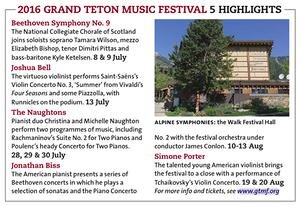
Tucked into the northwest corner of Wyoming sits the majestic Teton mountain range, its peaks rising 2,000 meters either side of the vast, flat valley floor, known as Jackson Hole. In winter, the Tetons host world-class skiing, but come summer, the lush grassland, forests, lakes and rivers of Jackson Hole teem with wildlife, including eagle, elk, moose and grizzly bear, along with thousands of tourists who head there for kayaking, walking, rafting, fishing, horse riding... Jackson Hole styles itself as the 'Last of the Old West' and there are still ranches where you can see cowboys at work.
But if, like me, you don't catch so much as a whiff of a moose or bear, you can console yourself with the sight and sounds of one of America's most impressive music festivals. Located in the ski resort of Teton Village, the Grand Teton Music Festival (GTMF) is, at over 50 years old, almost as well established as the geyers in nearby Yellowstone Park. Scottish conductor Donald Runnicles, who's often seen sporting a stetson, has been the festival's music director since 2006, bringing the GTMF to a wider international audience and attracting world-class soloists and conductors. Most of the concerts take place in the 600-seat Walk Festival Hall, built in the 1970s. 'A lot of people think this is an outdoor location.' Runnicles says over a coffee at one of Jackson Hole's ranches, 'but they're astonished to find we have this jewel of a hall.'
And playing in it is a jewel of an orchesta, an unpaid, crack team of players made up of members of the finest orchestras across the US. Many of them have been coming to Jackson for over 10 years (one or two for almost 30) and most of them stay for at least two or three weeks during the summer - over the course of the festival's five weeks, hundreds of musicians pass through Jackson Hole. Simply playing for the joy, they say, is a chance for them to 'renew their vows' with orchestra music, to remind themselves why they play music, without the crushing pressures they're up against at home. 'It's not a gig,' says Utah Symphony Orchestra's Ralph Matson, festival veteran of 20 years. 'Everyone's here because they want to make music together' chips in Seattle Symphony violist Susan Gulkis Assadi, who has made Jackson Hole something of a second home during the summer. 'It's the most collegial orchestra in the world.' 'Each member of the orchestra is reminded what a privilege it is to be performing great music with great musicians,' says Runnicles. 'There are moments during performances that I'm viscerally aware of who I have in front of me.'
Runnicles faces the challenges of not only pleasing his faithful audiences but also the orchestra - feeding them repertoire that doesn't make them feel they're on a busman's holiday. 'I'm not going to attract people from Chicago, Philadelphia, Dallas or The Met if I programme Tchaik Five, Rach Two...They've done those sorts of pieces. I see the music we play as nutrition - they have to do something where they're challenged.'
2015's curveball was Vaughan Williams's Symphony No. 3, a work that most of the musicians, plus Runnicles himself, hadn't performed before. The previous year it was Vaughan Williams's Fifth Symphony, also well received. 'Every one of our players will return to their orchestras and share their new love of Vaughan Williams. So many of the musicians have come up to me and thanked me for introducing them to this music.'
Jackson Hole's elevation also presents its demands: the dryness and lack of humidity makes playing a reed instrument a lot trickier. And singers, who have to take more frequent breaths than usual during performances, are advisde to acclimatise by arriving a few days earlier. Not that they need any encouragement to spend more time in Jackson Hole...

Strings Magazine: Julian Rachlin Among 4 Soloists Who Talk About Stepping Up to the Conductor’s Podium
While conducting schools and academies still turn out the greatest number of new conductors, there is an accelerating trend among young virtuoso string players to leapfrog the traditional process on their way to the podium.
Strings Magazine
By Laurence Vittes

While doing a little research during the conducting finals of the 2015 Gstaad Menuhin Festival & Academy, I discovered a pattern. Basic training for most conductors begins at the piano. However, a number of notable string players, too, have traded in their instruments for the baton with great success. Lorin Maazel started out as a violinist; Carlo Maria Giulini, a violist; Arturo Toscanini and John Barbirolli, cellists; and Serge Koussevitzky and Zubin Mehta, double-bassists.
Violinist Itzhak Perlman took the step with some success, and violinist Joshua Bell was named music director of the Academy of St. Martin in the Fields in 2011. While conducting schools and academies still turn out the greatest number of new conductors, there is an accelerating trend among young virtuoso string players to leapfrog the traditional process on their way to the podium.
In order to find out what makes young soloists want to become conductors, I spoke to violinists Julian Rachlin and Gemma New, and cellists Eric Jacobsen and Han-Na Chang.
Julian Rachlin
As a violinist, violist, recording artist, and educator, Julian Rachlin has established close relationships with many of the world’s most prestigious conductors and orchestras. In September 2015, he took up his new position as principal guest conductor with the Royal Northern Sinfonia at the Sage Gateshead concert hall, and has been guest conducting around the world. Rachlin plays the 1704 “ex Liebig” Stradivari, on loan courtesy of the Dkfm Angelika Prokopp Privatstiftung, and a 1791 Lorenzo Storioni viola. He uses Thomastik-Infeld strings.
What inspired you to conduct?
I’m not the type who plays the Tchaikovsky and Brahms concertos, then sits down until the next time. For me, the violin is not as important as it might seem; it’s not even my favorite instrument. But whether I play violin or viola, teach, or conduct, it’s all about a life in music—being curious, and staying inspired and fresh.
What is your favorite instrument?
I always wanted to be a cellist like my father, and a recording by Rostropovich was the very first piece of music I listened to when I was two, sitting with an umbrella, which I pretended was a cello with a stick as my bow.
[Editor’s Note: According to a 2015 violinist.com interview, Rachlin was “tricked” into playing violin by his grandparents, who gave him a violin at age two and a half, and claimed it was a cello.]
What were your first experiences as a conductor?
My life as a conductor started around 2005 when I was asked by the Mahler Chamber Music, the Academy of St. Martin in the Fields, and the English Chamber Orchestra to come in and play concertos without a conductor. At first, I just stood there, but when players asked me if I wanted to say something, if I had any ideas, I was surprised. Nobody had ever asked me to say anything. When I saw that the players took my ideas seriously, that they found something in what I said and what I transmitted through my body language, I began to take the idea of conducting more seriously.
How did you start developing your conducting skills?
Before I took lessons, I talked to many conductors, asking their opinion, and Zubin Mehta, Mariss Jansons, and Daniele Gatti all encouraged me. In fact, Mariss told me to take lessons from my mom—Sophie Rachlin, a graduate of the St. Petersburg Conservatory in choir conducting—together with Valery Gergiev, Semyon Bychkov, and Jansons. Of course, I didn’t want to take lessons from my mom at first, but I took one lesson and was so impressed that I’ve been studying with her now for six years.
How have you approached building repertoire as a conductor?
I’m learning one symphony a year, to make sure I will know each of them inside out. So far, my repertoire consists of Tchaikovsky 4, Beethoven 7, Mendelssohn 4, and Mozart 35, 39, and 40. My priority is still my violin, but I’m doing more and more guest conducting, including my debut at the Musikverein in Vienna, conducting Mozart’s Marriage of Figaro Overture, and Mendelssohn’s Violin Concerto and Fourth Symphony.