

Newly Appointed NY Phil Conductor to Lead Closing Concert in Beijing
The Beijing Music Festival (BMF) will culminate this Saturday, October 29, in a closing concert by the Hong Kong Philharmonic under the baton of famed Dutch conductor Jaap van Zweden.
The Beijing Music Festival (BMF) will culminate this Saturday, October 29, in a closing concert by the Hong Kong Philharmonic under the baton of famed Dutch conductor Jaap van Zweden. The soon-to-be Maestro of the New York Philharmonic, van Zweden comes to Beijing as the final of three city appearances in mainland China this week, returning to the country after a highly acclaimed tour in 2014 with the Hong Kong Philharmonic. The program will feature a solo performance by Chinese violinist Tianwa Yang, recent winner of the prestigious ECHO Klassik Instrumentalist of the Year Award.
A New Commission and a Star Violinist
The eclectic program will open with “Quintessence”, a new worked by Hong Kong composer Fung Lam, commissioned by the Hong Kong Philharmonic with the generous support of The Robert H. N. Ho Family Foundation. Next will be Mozart’s Violin Concerto No. 4 in D, K218, featuring virtuoso Tianwa Yang. Closing the evening will be Mahler’s Symphony No. 1 (“Titan”).
The program makes its way around mainland China this week in Shanghai and Tianjin before coming to Beijing.
The closing concert will mark the end of a highly successful three-week music festival with a record turnout and many spectacular firsts, including a 3D mini-opera production and a brand new Don Giovanni featuring state-of-the-art theatrical effects. President and Artistic Director Long Yu said of this bitter-sweet close: “We’ve come a long way and there’s still a long way to go. So I’d like to say thanks to all the people who have supported us for so many years.”
Currently Jaap van Zweden is Music Director of the Dallas Symphony Orchestra, and has been Music Director of the Hong Kong Philharmonic Orchestra since 2012. In that year he was named Musical America's Conductor of the Year.
The HK Philharmonic is recognized as Asia’s premiere classical orchestra, performing over 150 concerts per year. Recent guest artists have included Vladimir Ashkenazy, Ning Feng, Matthias Goerne, Lang Lang, Yu Long, Yundi Li, the late Lorin Maazel, Anne-Sophie Mutter and Yuja Wang.
About the Beijing Music Festival
Held over 4 weeks every October, BMF is the most important cultural event in China. The Festival and its Founder and Artistic Director, Maestro Long Yu, pioneer China’s unique musical voice. The festival has presented numerous historical performances such as the China premiere of Gustav Mahler's Symphony No. 8 (2002), the Asian premiere of Alban Berg's opera, “Lulu” (2002); Guo Wenjing's operas, “Ye Yan” (2003) and “Wolf Club Village” (2003); and the China premiere of Richard Wagner's complete Ring Cycle (2005). BMF’s co-commission with Opera Boston, “Madame White Snake,” was awarded the 2011 Pulitzer Prize.

19th Beijing Music Festival Opens to Record Crowds
The Beijing Music Festival (BMF) opened its annual classical music festival last Sunday with a concert by the National Center for the Performing Arts (NCPA) Orchestra and Chorus under the baton of Maestro Lü Jia. This marked the first collaboration between BMF and NCPA.
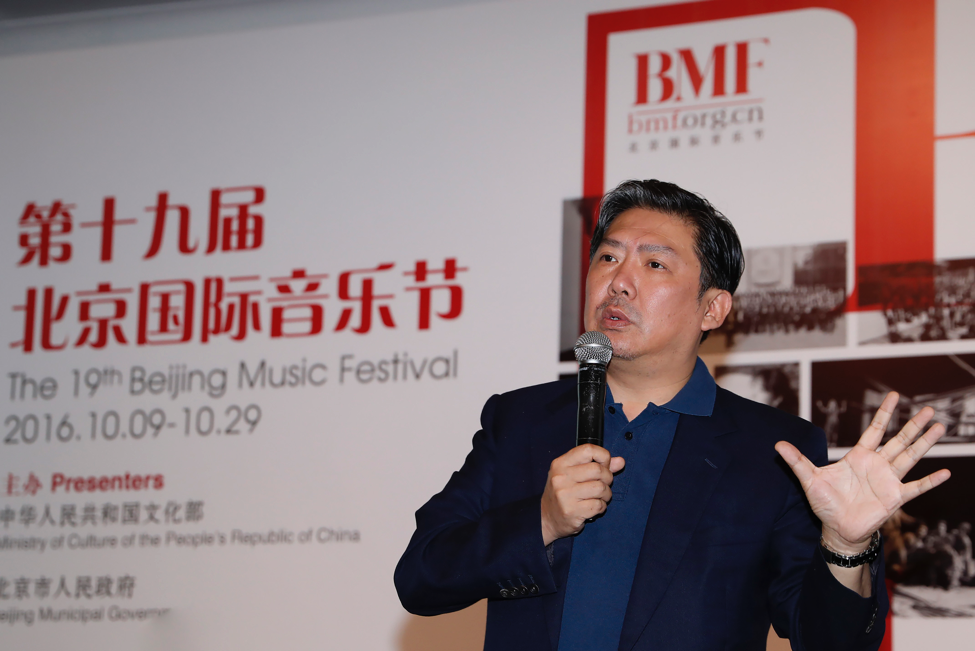
Long Yu, President and Artistic Director of the Beijing Music Festival (BMF) Announces 19th Season. Photo: Beijing Music Festival
The Beijing Music Festival (BMF) opened its annual classical music festival last Sunday with a concert by the National Center for the Performing Arts (NCPA) Orchestra and Chorus under the baton of Maestro Lü Jia. This marked the first collaboration between BMF and NCPA. The concert, which featured symphonies and choral works by Brahms and Shostakovich, elicited several standing ovations from the sold-out crowd.
Festival to Celebrate “Musical Legacy and Innovation”
After nearly two decades as China’s leading cultural event, the 19th BMF will present 30 shows covering a wide range of music genres such as opera, symphony, ethnic music, crossover, and more. As in previous years, there will be public activities that include children's musical, urban musical, Chinese music concert, as well as music-themed seminars, lectures and dialogues. The festival runs from October 9th to 29th.
Music of Old Masters Performed by New Artists
Highlights of the 19th BMF include the China premiere of Britten’s opera “A Midsummer Night’s Dream” on October 15th and 16th (the first production in a 5-year partnership with Festival d’Aix-en-Provence), a 3D-chamber opera “Blank Out” by Dutch composer Michel van der Aa (October 20th and 21st), Mozart’s operatic masterpiece “Don Giovanni” featuring site-specific immersive theatrics and technology (Oct. 12 to 14th), and multimedia performances of Schubert’s song cycle “Die Winterreise” (October 26th to 28th).
Other highlights include the complete Tchaikovsky symphonies conducted by Vladimir Fedoseyev (October 26th to 28th), concerts with the West Australian Symphony Orchestra (October 10th) featuring French pianist Jean-Yves Thibaudet, Czech Philharmonic Orchestra (October 23rd and 24th), Guangzhou Symphony Orchestra and Youth Orchestra (October 22nd), virtuoso organist Cameron Carpenter (October 25th), and a closing concert with the Hong Kong Philharmonic led by Dutch conductor Jaap van Zweden (October 29th).
About the Beijing Music Festival
Held over 4 weeks every October, BMF is the most important cultural event in China. The Festival and its Founder and Artistic Director, Maestro Long Yu, pioneer China’s unique musical voice. The festival has presented numerous historical performances such as the China premiere of Gustav Mahler's Symphony No. 8 (2002), the Asian premiere of Alban Berg's opera, “Lulu” (2002); Guo Wenjing's operas, “Ye Yan” (2003) and “Wolf Club Village” (2003); and the China premiere of Richard Wagner's complete Ring Cycle (2005). BMF’s co-commission with Opera Boston, “Madame White Snake,” was awarded the 2011 Pulitzer Prize.

Strings: Conductor Long Yu, Cellist Yo-Yo Ma, and Sheng Virtuoso Wu Tong Tour the Gobi Desert
This September, conductor Long Yu, cellist Yo-Yo Ma and sheng virtuoso Wu Tong embarked on a four-city tour of China. The tour kicked off with the Hong Kong Philharmonic’s season opening concerts on September 9 and 10. The three then traveled to Xi’an for an open-air concert at the old city wall on September 12 and reprised the work on September 15 at Lanzhou’s Jincheng Theatre and on September 17 at Ürümqi’s People’s Grand Hall.
Maestro Long Yu provided Strings magazine with an exclusive look and commentary on the tour, which marked the first time many of these cities had ever seen Yo-Yo Ma perform in person.
Strings Magazine
This September, conductor Long Yu, cellist Yo-Yo Ma and sheng virtuoso Wu Tong embarked on a four-city tour of China. The tour kicked off with the Hong Kong Philharmonic’s season opening concerts on September 9 and 10. The three then traveled to Xi’an for an open-air concert at the old city wall on September 12 and reprised the work on September 15 at Lanzhou’s Jincheng Theatre and on September 17 at Ürümqi’s People’s Grand Hall.
Maestro Long Yu provided Strings magazine with an exclusive look and commentary on the tour, which marked the first time many of these cities had ever seen Yo-Yo Ma perform in person.
September 9/Hong Kong: The first concert of the tour with the Hong Kong Philharmonic (opening concert of the 2016/17 season). Yo-Yo Ma joined the HK Phil and myself for Dvorak’s Silent Woods, and then took the stage with sheng virtuoso Wu Tong for Zhao Lin’s Duo.
Inspired by the Chinese epic Journey to the West, Duo was composed for sheng player Wu Tong and Ma. It is a partnership of two lyrical instruments with liquid, expressive sounds.
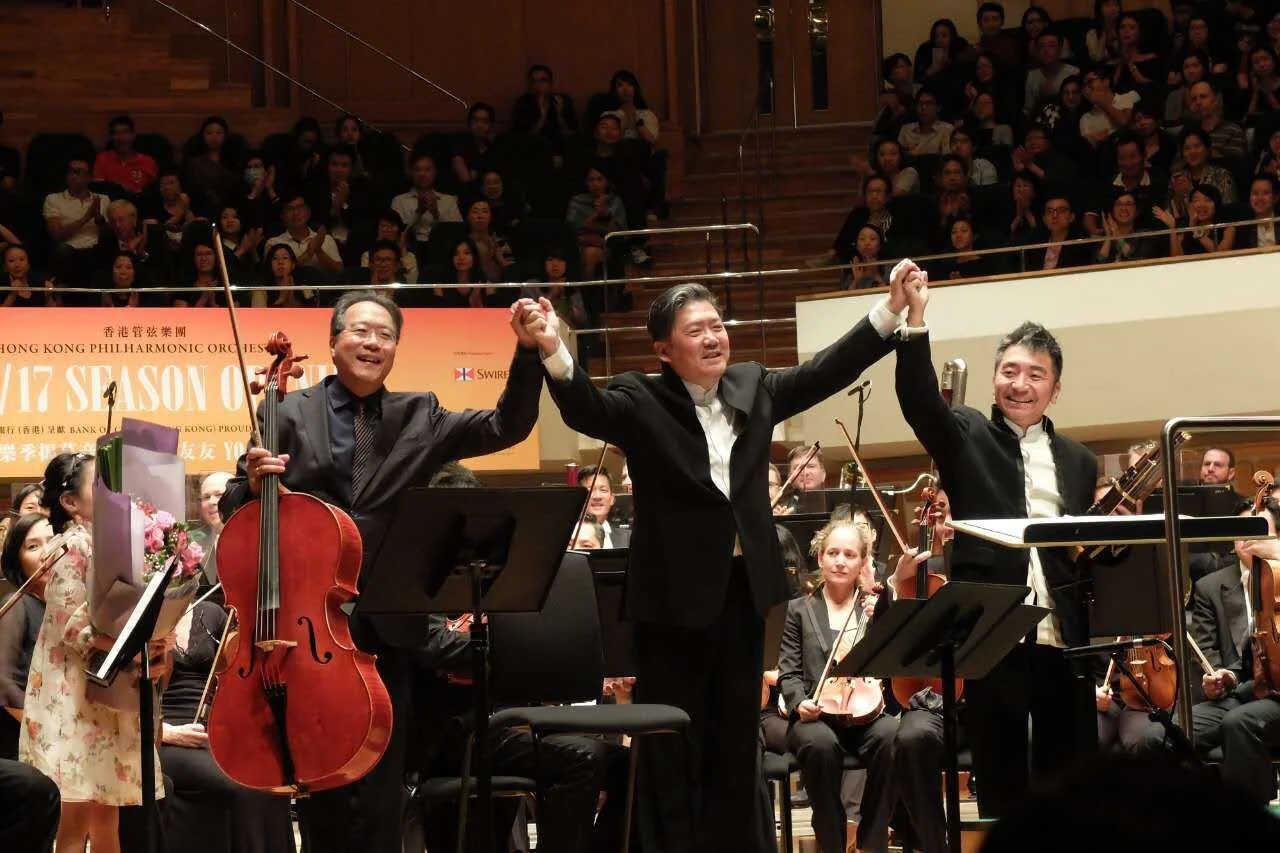
September 11 / Xi’an: Rehearsal at the historic “South Gate” at the Old City Wall in Xi’an in Central China. Xi’an marks the Silk Road’s eastern end and was home to the Zhou, Qin, Han and Tang dynasties’ ruling houses.

September 12 / Xi’an: Everyone is preparing their own Yangrou Paomo (flatbread soaked in lamb soup).
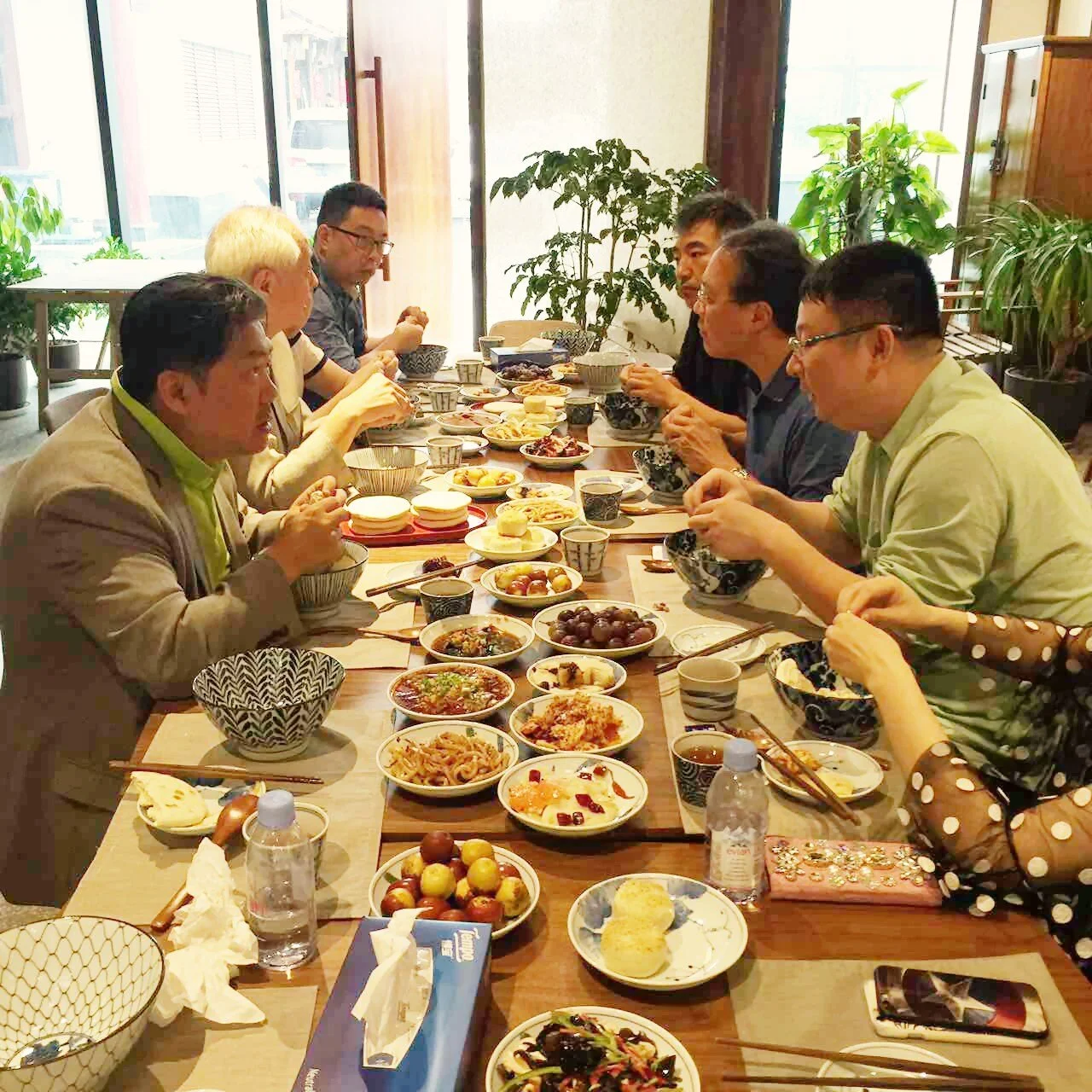
September 12: / Xi’an: Oh no! It’s raining! We hold an emergency meeting to decide whether to cancel the outdoor concert.

September 12: / Xi’an: 40 minutes later, the rain stopped and things are just perfect!

September 13 / Dunhang (Gansu Province): We’ve traveled to the edge of the Gobi Desert to the city of Dunhang. Once a frontier town on the Silk Road, the area is known for its caves, cliffs, and Buddhist statues.


September 13 / Mingsha Shan (Singing Sands Mountain) in Dunhuang: Mingsha Shan is about 5 miles from Dunhuang. Seen from afar, the mountain is just like a golden dragon winding its way over the horizon. At first, the sand under your feet just whispers; but the further you slide, the louder the sound until it reaches a crescendo like thunder or a drum beat. Some say that the sand is singing, while to others it is like an echo and this is how the mountain gets its name. We wore these bright orange “boots” to keep the sand out from our shoes!

September 14 & 15 / Lanzhou: A wonderful concert with the Lanzhou Symphony Orchestra. The audience was so appreciative of the playing and we were so appreciative to be here! Wu Tong performed an encore afterward and Yo-Yo and I sat and watched. As you can see, Yo-Yo didn’t want to stop listening!

September 16 / Ürümqi: We traveled more than 2,000 miles today from Lanzhou to the Northwest city of Ürümqi—another former major hub on the Silk Road. Upon arrival, we rehearsed with the Xinjiang Philharmonic Orchestra. The XPO was founded in 1996 and is made up of many ethnic groups, including Han Chinese, Uyghurs, Hui, Kazaks, Tajiks and Xibe. So many different languages and cultures but they come together through music in complete harmony!

September 17 / Ürümqi: Final concert of the tour. It’s hard to say goodbye to dear friends like Yo-Yo and Wu Tong but we ended on a high note and look forward to making music again soon.


Inaugural Olga Kern International Piano Competition
The inaugural Olga Kern International Piano Competition launches in Albuquerque, New Mexico November 13-30, 2016. Chosen from more than 100 applications, 24 contestants will compete for a total of $30,000 in cash prizes in addition to international concert engagements and a professional recording.

The inaugural Olga Kern International Piano Competition launches in Albuquerque, New Mexico November 13-30, 2016. Chosen from more than 100 applications, 24 contestants will compete in front of eight international jury members for a total of $30,000 in cash prizes in addition to international concert engagements and a professional recording.
Over the past summer, the selection panel listened to very talented pianists from all over the world and selected the following 24 participants representing 15 countries for the week-long competition:
Nino Bakradze, Georgia
Sung Chang, Korea
Guang Chen, China
Junhui Chen, China
Willem de Beer, South Africa
Anna Dmytrenko, Ukraine (US)
Mehdi Ghazi, Canada
Shino Hidaka, Japan
Kyohei Imaizumi, Japan
Elizaveta Ivanova, Russia
Richard Octaviano Kogima, Brasil
Seong-Hyeon Leem, South Korea
Steven Massicotte, Canada
Francisco Montero, Spain
Liana Paniyeva, Ukraine
Joshua Rupley, US (NM)
Wenting Shi, China
Marie Sumnikova, Czech Republic
Stefan Weiler, Germany
Yumin Wu, China
Rui Xu, China
Yundi Xu, China
Fahrettin Eren Yahsi, Turkey
Yevgeny Yontov, Israel
Our 2 Alternates are:
Solomon Eichner, US (MD)
Anastasiya Naplekova, Ukrane (US)
The competition will take place every 3 years in Albuquerque, New Mexico, and is open to pianists 18 to 32 years old.

Klara Min on WWFM Radio, The Classical Network
This past May Klara Min was featured in a Radio Showcase/Interview on WWFM.org - Between the Keys with Jed Distler.
This past May, Klara Min was featured in a Radio Showcase/Interview on WWFM.org - Between the Keys with Jed Distler.
Listen to the podcast below.


New Zealand Herald: Brief encounter - violinist Anne Akiko Meyers
Violinist Anne Akiko Meyers joins the New Zealand Symphony Orchestra for its Bold Worlds concert at the Great Hall, Auckland Town Hall on Friday, October 7.

Photo: Molina Visuals
You describe yourself as a modern classical musician - why is this an important definition for you?
I think it is important for performers to embrace technology to connect with today's audience. In addition to traditional concerto, recitals, chamber music and recordings, I reach a wider fan base by collaborating with a diverse group of musicians (including Wynton Marsalis, Il Divo, Michael Bolton, Ryuichi Sakamoto and Isao Tomita), embracing technology and social media. I also love supporting and commissioning composers to expand the violin literature. All these diverse musical ideas make me a much better musician.
Mason Bates Violin Concerto was composed for you - how does it feel to have a concerto composed especially for you?
Working closely with living composers always gives me a greater understanding of music from prior periods and makes me ask questions. Was it a muse or situation that inspired the composer to create a work that lives on for generations? I don't really think of the concerto as written for me, it's more a piece for the world. Over time, any great music needs to attract lots of performers who add the piece to their repertoire.
It's about a pre-historic dinosaur taking flight - were you a big dinosaur fan as a kid as so many young ones are?
There are many descriptive sound effects in the concerto; one where I am supposed to be the actual dinosaur trudging through swampy lakebeds with a sensual quality - that takes an active imagination! My children and their cousins love dinosaurs - it makes you always aware that humankind came from a very prehistoric place. Mason Bates, the composer, also has young children, and I think they are huge dinosaur fans.
If you could travel back in time to any concert, meet any composer - who would it be and why?
I think this would have to be Beethoven conducting his Symphony No.9. It's impossible to imagine that he composed that stone cold deaf.
What's the greatest threat to the future of classical music?
I think classical music has a wider audience than ever before due to technology. I am shocked to see videos I have put on YouTube have been played millions of times. My family and I "attend" performances of the Berlin Philharmonic and Detroit Symphony Orchestra streamed into your home. This is amazing and incredible and will build the audience in younger generations. I wish I had that kind of access to recordings when I was in my 20s!
What makes you want to work with the NZ Symphony Orchestra?
I am super excited to see and experience New Zealand for the first time. My dad actually motorcycled around the country and sent photos of places I thought only existed in heaven. It will also be the first time I work with Fawzi Haimor [conductor] and the orchestra and it will be so much fun to bring Mason Bates' violin concerto to life together.
Why is this work important - and why should people want to come and see/hear it?
Mason Bates is a dynamic and extremely popular young American composer who is composer-in-residence with the National Symphony at the Kennedy Center and was also composer-in-residence with the Chicago Symphony. A leading composer of his generation, his music is inventive, colourful and highly expressive, not to mention incredibly challenging. Audiences always clamour for more and I am thrilled to bring his first violin concerto to New Zealand!
• Violinist Anne Akiko Meyers joins the New Zealand Symphony Orchestra for its Bold Worlds concert at the Great Hall, Auckland Town Hall on Friday, October 7.
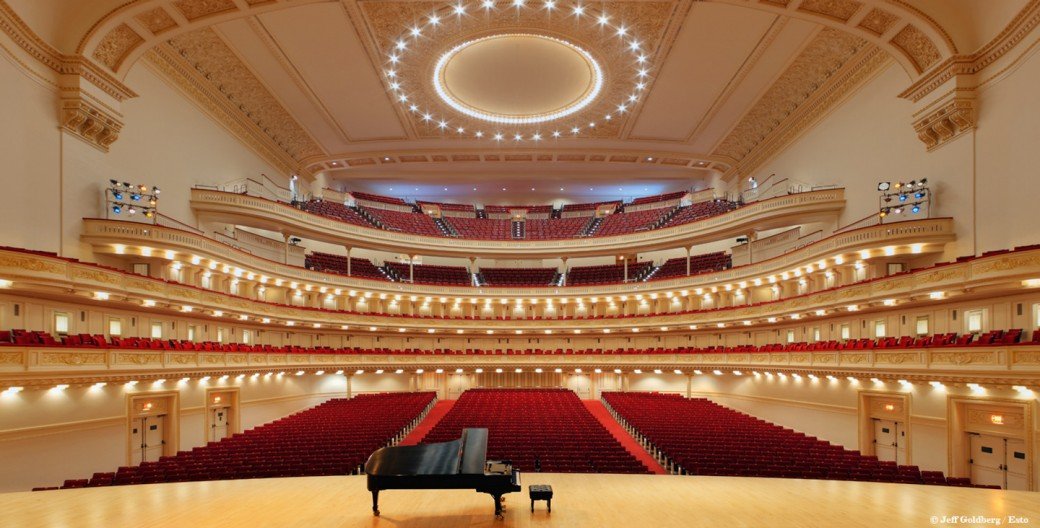
New York Concert Artists (NYCA) Accepting Applications for 2017 Worldwide Debut Auditions for Pianists and Violinists
Learn more about applying to the New York Concert Artists 2017 Worldwide Debut Audition. Application deadline is December 1, 2016.
Learn more about applying to the New York Concert Artists 2017 Worldwide Debut Audition, with prizes including Berliner Philharmonie + Carnegie Hall Debut Recitals, performance with Fairbanks Symphony, CD recording with Steinway & Sons Label, and more by clicking here. Application deadline is December 1, 2016.


Violinist: Anne Akiko Meyers releases 'Fantasia,' a last violin work by Einojuhani Rautavaara
The work Anne Akiko Meyers commissioned, called "Fantasia," was among the last pieces Einojuhani Rautavaara wrote. She recorded it in May with the Philharmonia Orchestra and Kristjan Järvi. Due to his recent death, she has made it available as a single on Amazon. It will be the title track on her upcoming album Fantasia: The Fantasy Album, to be released in spring 2017.
Violinist
By Laurie Niles

Anne Akiko Meyers and Einojuhani Rautavaara
Back in the 1990s Anne Akiko Meyers discovered a recording that stopped her in her tracks: Cantus Arcticus, by the Finnish composer Einojuhani Rautavaara.
"I was always flipping through CDs and sheet music at stores, trying to discover new works that were under the radar," Meyers told me last week over the phone. "That's how I came across the 'Concerto for Birds and Orchestra.' I was blown away by the sheer beauty of the music, and the way Rautavaara incorporated nature into a symphony. He actually went into a preserve and recorded birds chirping and singing, and that became an organic part of music. I listened to the recording many, many times on repeat."
The more she explored Rautavaara's works, the more she loved the music.
"I'm a lifelong fan," she said. "I've always been very enamored with these mystical, mythical composers like Arvo Pärt and Rautavaara."
In fact, last year she worked with Arvo Pärt to record his Passacaglia -- it made her think once again about Rautavaara. Might he like to compose a piece for her?
"It was always a dream of mine," she said. "I wondered, what is he up to, these days? I sent an e-mail to (his publisher) Boosey and Hawkes. You can risk getting a 'No' from a composer; it's always worth asking. I've commissioned many composers recently, and found that timing is crucial." The list of composers that Meyers has worked with and commissioned works from is long, and includes Mason Bates, Jakub Ciupinski, John Corigliano, Jennifer Higdon, Samuel Jones, Wynton Marsalis Somei Satoh, and Joseph Schwantner.
"I've become more tenacious about it," she said. Her tenacity paid off: "Immediately I got the response: 'He would love to write something for you. How long of a piece would you like?'"
Rautavaara had already written a violin concerto, "so I thought, what would pique his curiosity and be stylistically up his alley? That's when I came up with the idea of a 15-minute fantasy," Meyers said. "He sent me the music at the end of the summer, handwritten on manuscript paper. I was just smitten. Immediately I could sense overtones of Cantus Arcticus, and also his Symphony No. 7, the Angel of Light."
That was in 2015. If she'd waited any longer, their collaboration may never have happened; Rautavaara died in July 2016, at the age of 87. The work Meyers commissioned, called "Fantasia," was among the last pieces he wrote. She recorded it in May with the Philharmonia Orchestra and Kristjan Järvi. Due to his recent death, she has made it available as a single on Amazon. It will be the title track on her upcoming album Fantasia: The Fantasy Album, to be released in spring 2017.
Though Rautavaara did not live to hear the work in concert, he heard Meyers play it in person. After sending her the work, "he invited me to come to Helsinki," Meyers said. "I was so excited to go. I flew out in December 2015 and played the piece for him.
The second I finished, he turned to me, smiled so brightly and said, 'Wow, did I write some beautiful, beautiful music!' (She laughs) I thought that was the sweetest thing ever! Because it really is so deeply spiritual, poetic and beautiful."
"We played it again, and I expected him to say, 'Oh, this note, I'm not so sure...' I was also nervous about the bowings that I had changed, because his bowings were very specifically marked," she said. "The bowings really change the direction and meaning of the phrases."
Rautavaara liked it, though. "He said immediately, 'I love what you did, I don't have much confidence in myself with markings, especially bowings. I think you really brought out the phrasing to make it sing as much as possible, so let's use all your bowings.' That was that! No dynamic changes, no note changes, nothing," Meyers said. He knew what he wanted.
Though his health may have been in decline, Rautavaara was at the height of his composing powers, she said. "There's just so much experience and a rich, vast wisdom that he had, right in his fingertips. I think it's one of the most beautiful pieces ever composed."

WQXR: Ethan Hawke Cameos in Pianist Bruce Levingston's Philip Glass Survey
Bruce Levingston, no stranger to the music of Philip Glass, has finally issued an in-depth, two-disc survey of Glass's piano music, and the result is a surprisingly passionate and spontaneous portrait of the composer. Dreaming Awake (Sono Luminus) is a boldly individual approach to the keyboard works of an American master.

'Bruce Levingston: Philip Glass | Dreaming Awake' (Orange Mountain Music)
WQXR
By Daniel Stephen Johnson
Bruce Levingston, no stranger to the music of Philip Glass, has finally issued an in-depth, two-disc survey of Glass's piano music, and the result is a surprisingly passionate and spontaneous portrait of the composer. Dreaming Awake (Sono Luminus) is a boldly individual approach to the keyboard works of an American master.
Interpreting the piano music of Glass offers a unique dilemma to the pianist. The construction of the music is often severe and mathematical, the materials lucid to the point of total transparency in order to better showcase the clockwork operation of the rhythms. Instead of plunging forward through a series of contrasting episodes, the music coolly repeats its cadences as if displaying itself in a mirror, allowing the listener to examine the same material from multiple angles.
But at the same time, the harmonic language of the music is undeniably steeped in affect. While the music's transparency and poise pull back towards restraint, the substance of those cadences push forward into warm-hearted sentiment. Should the pianist treat the score like a strict MIDI grid, metronomically obeying every rhythm in order to heighten the transparency of the music? Or should the performer take a cue from those ecstatic harmonies?
From the almost impulsive opening of this record, those first few notes of Glass's magnificently subtle Etude No. 2, it becomes clear that Levingston has given himself over to feeling. This is Glass the Romantic.
In addition to a generous helping of the Etudes, arguably the composer's most substantial solo works, Levingston also offers the rarer title track, his own arrangement of Glass's tuneful film music for The Illusionist, and the earlier Allen Ginsberg hymn Wichita Vortex Sutra.
Even Levingston's stellar choice of collaborator fits the bill. Instead of sampling Ginsberg's own delightfully idiosyncratic reading of "Wichita," Levingston recruits thespian Ethan Hawke, Hollywood's Gen-X embodiment of Romanticism, and Hawke's breathless delivery is absolutely of a piece with the almost cinematic heroics of Levingston's vision for these pathbreaking works.

The New York Times: Shanghai Violin Competition Celebrates Isaac Stern’s Legacy in China
The inaugural Shanghai Isaac Stern International Violin Competition concluded on Friday after nearly three weeks of intensive performances by 24 young violinists from around the world. Mayu Kishima of Japan was awarded first place, taking home the grand prize of $100,000, the largest single award for an international violin competition.

The Japanese violinist Mayu Kishima was awarded the first prize at the inaugural Shanghai Isaac Stern International Violin Competition on Friday. Credit: Shanghai Isaac Stern International Violin Competition
The New York Times
By Amy Qin
More than 35 years after the violinist Isaac Stern made a groundbreaking visit to China, his legacy there lives on.
The inaugural Shanghai Isaac Stern International Violin Competition concluded on Friday after nearly three weeks of intensive performances by 24 young violinists from around the world. Mayu Kishima of Japan was awarded first place, taking home the grand prize of $100,000, the largest single award for an international violin competition.
“We were looking for the kind of spark and commitment to music that our father would have embraced,” David Stern, co-chairman of the jury committee, said in a telephone interview from Shanghai.
That Isaac Stern, who died in 2001, now has a competition bearing his name is somewhat ironic given his aversion to such events.
So when the conductor Yu Long, a towering figure in classical music in China, raised the idea of holding a competition about two and a half years ago, “it was not the easiest idea for the three of us to approach,” Mr. Stern said, referring to his brother, Michael, and his sister, Shira. “Our father did everything he could to mentor young musicians in order to avoid competitions.”
Isaac Stern’s dedication to training young musicians was perhaps most vividly captured in the 1979 documentary “From Mao to Mozart: Isaac Stern in China.” The film, which won an Academy Award for best documentary feature, chronicled Mr. Stern’s two-week trip to China for a series of concerts and master classes.
That visit, which came just as China was emerging from decades of self-imposed isolation and political tumult, is credited with having influenced a generation of young Chinese musicians, including Mr. Yu, who recalled sitting in the audience as a teenager during one of Mr. Stern’s performances in Shanghai.
“During the Cultural Revolution, we didn’t have many opportunities to play Western music,” Mr. Yu, now conductor of a number of ensembles including the Shanghai Symphony Orchestra, said in a telephone interview. “Then, in that moment in 1979 when Maestro Stern came, we suddenly felt the difference in how we could understand music.”
Since 1979, classical music in China has grown tremendously, with gleaming concert halls being built around the country and some 40 million young Chinese studying the violin or the piano.
Still, Mr. Yu said, “The problem in China, and Asia more broadly, is that the players are more concerned about technical issues.”
So when it came to this new project, both the Stern family and Mr. Yu agreed that they wanted to make a more comprehensive competition that would reward musicians not just for technical ability, but also for all-around dedication to music.
After two years of discussions and planning, the Stern family and the Shanghai Symphony Orchestra came up with a competition structure that David Stern said his father, even with his distaste for competitions, probably would have approved. This meant including elements that were important to Isaac Stern, like chamber music and Chinese music.
For example, contestants in the semifinal round were required to perform two concertos: “The Butterfly Lovers,” a popular Chinese concerto composed in 1959 by He Zhanhao and Chen Gang, and Mozart’s Violin Concerto No. 3 with a chamber orchestra (with original improvisation during the cadenza section). They also had to play a violin sonata, as well as the first movement of piano trio by Schubert or Brahms.
The 24 contestants represented several countries, including China, France, Germany, Japan, South Korea and the United States. In addition to the prize money, Ms. Kishima will also receive performance contracts with several international symphony orchestras.
Sergei Dogadin of Russia was awarded the second prize of $50,000, and Sirena Huang of the United States took home the third prize of $25,000. The violinists Zakhar Bron of Russia and Boris Kuschnir of Austria were among the 13 who sat on the jury.
The competition also presented an Isaac Stern Human Spirit Award of $10,000 each to two noncontestants: One, to Wu Taoxiang and Du Zhengquan, who founded the Einstein Orchestra, a middle-school ensemble in China, and the other to Negin Khpalwak, who directs an orchestra for women in Afghanistan, for “their outstanding contribution to our understanding of humanity through the medium of music.”
Most of the funding for the competition, which will be held every two years, came from corporate sponsors, according to Fedina Zhou, president of the Shanghai Symphony Orchestra. The symphony has been expanding in recent years, forging a long-term partnership with the New York Philharmonic and, in 2014, unveiling a new hall where the competition was held.
For many musicians and music lovers in China, the competition represents further validation that China is well on its way to becoming a heavyweight player in the classical music world.
“At last the Chinese people finally have an internationally recognized competition of their own,” said Rudolph Tang, a writer and expert in Shanghai on the classical music industry in China. “It has everything that a top competition should have, like a top jury, great organization, and high prize money.”
“It is like a dream come true,” he added.