
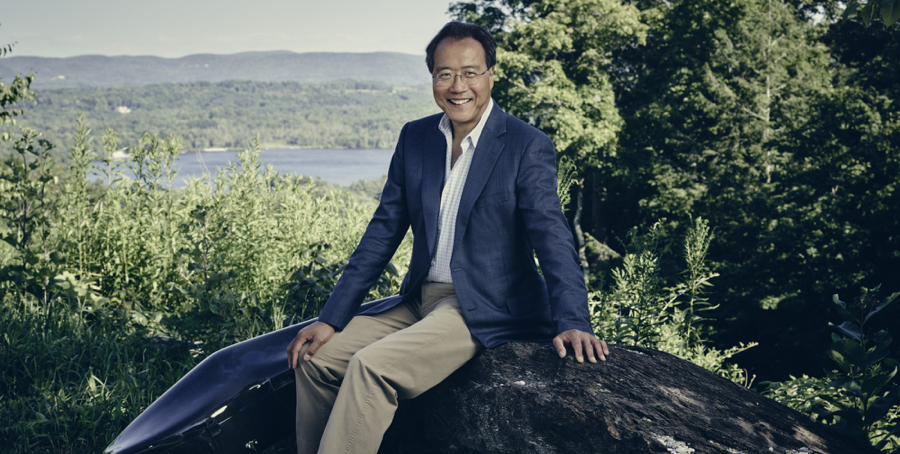
The Strad: Cellist Yo-Yo Ma launches youth music programme in China
Youth Music Culture Guangdong (YMCG) is an annual two-week training programme for young musicians in Guangzhou, China, spearheaded by [Yo-Yo] Ma.

Youth Music Culture Guangdong (YMCG) is an annual two-week training programme for young musicians in Guangzhou, China, spearheaded by Ma.
The Strad
Leading cellist Yo-Yo Ma is to launch Youth Music Culture Guangdong (YMCG) on 7 January 2017 – an annual two-week training programme for young musicians in Guangzhou, China. The new event is the brainchild of Ma, who will serve as its artistic director.
Presented by the Department of Culture of Guangdong Province and organised by the Guangzhou Symphony Orchestra and Xinghai Concert Hall, the programme will include concerts, masterclasses, workshops and cultural exchange events, culminating in a performance on 15 January by the YMCG Orchestra and Ma. Included on the faculty will be Michael Stern of the Kansas City Symphony, who will serve as conductor and music director.
Open to musicians between the ages of 18 and 35 from China, Hong Kong, Macao, and Taiwan, YMCG is designed to promote ‘virtuosity and musicality, cultural awareness and personal artistic development’. All selected students will receive a full scholarship covering tuition and expenses.
‘I believe that any musician or artist should not only be technically proficient, but also be mindful of the power of their art and the need for it in the world,’ said Ma.
The Strad: Postcard from Shanghai - Competing with the Traditional
The SISIVC is one of a number of music competitions to have sprung up in Asia over the past few years; with a $100,000 first prize, its inaugural edition this August [2016] attracted high-level performers from 26 different countries.

The Strad
December 2016 issue
By Pauline Harding
"All around me, bamboo-like slates rise up to a ceiling made from giant, woven strands of what looks like flax; horizontal strips of wood demarcate different floors. I could be sitting in a giant dim sum basket - but in fact it is Shanghai's Symphony Chamber Hall, where I am awaiting the first contestant in the final section of the Shanghai Isaac Stern International Violin Competition (SISIVC) semi-final. And indeed, things are about to heat up, as 18 contestants prepare to perform Mozart's Third Violin Concerto, all with their own cadenzas...."
Purchase The Strad for the full article, here.

Classical Music Magazine: Winds Without Borders to perform for refugees in Germany
The Yale School of Music is collaborating with Classical Movements on a series of concerts for refugees in Germany. The concerts, which will take place in June 2017, will see wind, brass and percussion players travel to Germany and perform under Thomas C. Duffy, Yale professor and director of bands.
Classical Music Magazine
By Katy Wright
The Yale School of Music is collaborating with Classical Movements on a series of concerts for refugees in Germany.
The concerts, which will take place in June 2017, will see wind, brass and percussion players travel to Germany and perform under Thomas C. Duffy, Yale professor and director of bands.
The project was inspired by a performance which the Yale Concert Band gave under Duffy at the Eleonas Refugee Camp in Athens, Greece in June 2016.
The ten-day, eight-night tour will take place during the last few weeks of June 2017. It will begin in Berlin and continue to two additional cities, most likely Dresden and Düsseldorf; however, due to the constantly changing nature of the refugee situation, the exact cities and dates will be determined at a later date.
Duffy said: ‘We say over and over that music is a fundamental right, so shouldn’t music be something of great, if not critical, value to those who are in camps; who find themselves away from the aesthetic experiences that define their culture; who see the days stretching before them with no aesthetic spiritual stimulation? Let’s meet them and bring them music!’
Guangdong invites Yo-Yo Ma to create a new cultural highlight in the province
After nearly two years of planning, the inaugural Youth Music Culture Guangdong (YMCG) festival will take place in Guangzhou from January 7 to 15, 2017. This festival, which is scheduled to become an annual event, will be a major cultural highlight for Guangdong province in the years to come.
Guangdong invites Yo-Yo Ma to create a new cultural highlight in the provinceYouth Music Culture Guangdong launches on January 7, 2017
After nearly two years of planning, the inaugural Youth Music Culture Guangdong (YMCG) festival will take place in Guangzhou from January 7 to 15, 2017. This festival, which is scheduled to become an annual event, will be a major cultural highlight for Guangdong province in the years to come.
Presented by the Guangdong Provincial Department of Culture, YMCG is organized by the Guangzhou Symphony Orchestra (GSO) and the Xinghai Concert Hall. Celebrated conductor and GSO Music Director Long Yu was instrumental in inviting world-renowned artist Yo-Yo Ma to become YMCG’s Artistic Director. In fact, preparations for YMCG have already attracted much attention. On September 7, Yo-Yo Ma and Long Yu both took part in the press conference announcing the inaugural festival, which will feature a dazzling array of public events including two symphonic concerts, four chamber concerts and five “Music + Dialogue” sessions, as well as improvisation workshops and open rehearsals. The main site of these activities—Guangzhou’s Ersha Island—will transform itself into a full-time “cultural hotspot.”
Yo-Yo Ma: A musical icon for the Silk Road
Yo-Yo Ma is a musical genius whose name is revered around the world. He holds a Bachelor’s Degree in Anthropology and an Honorary Doctorate from Harvard University; he currently serves as a U.N. Messenger of Peace; to date, he has won 17 Grammies … but all these are mere labels. Yo-Yo Ma rose to prominence and achieved success as a musician, but he has extended his sights far beyond musical horizons. In 1998, he launched the Silk Road Project and Silk Road Ensemble, organizations dedicated to artistic, cultural and educational activities. Its inspiration originated from the ancient Silk Road from China, where diverse cultures and beliefs collide and interact. Its mission is to generate encounters among artists from around the world, breaking through geographical distances to establish a dialogue across time and space.
Anyone attending a concert by Yo-Yo Ma leaves the hall with a fresh perspective: that classical music performance doesn’t have to be serious! Since the legendary Leonard Bernstein, few classical musicians have such attributes in adding a human dimension and passion to the music. Although renowned as a classical musician, Yo-Yo Ma has proven himself supremely adaptable, winning accolades in other Grammy categories, most recently “Best Folk Album” (2013) in collaboration with like-minded artists. Ma has also recorded music for film, including Ang Lee’s Crouching Tiger, Hidden Dragon. Precisely because his music crosses cultural and ethnic barriers, in September 2006, the United Nations named Yo-Yo Ma a Messenger of Peace. In short, the name “Yo-Yo Ma” epitomizes an open-minded and all-embracing attitude to music; he is a living icon for dialogue and communication.
Born in France and raised in the United States, Yo-Yo Ma retains much of the humility and reserved nature typical of Chinese ancestry. Amidst diverse cultures, he freely wields his musical creativity as an exemplary “global citizen.” From his perspective, the core value of YMCG is the exchange and melding of cultures East and West. To him, the realization of his artistic ideals in Guangzhou—a major port along the coastal Silk Road—is all the more meaningful. Yo-Yo Ma, a man with a treasure-trove of artistic experience and at the pinnacle of international fame, will inject his diverse and innovative artistic concepts into shaping YMCG.
Eminent artists establish an open and all-embracing international platform
Artists engaged for the inaugural YMCG include core members of the Silk Road Ensemble and principals of major American orchestras. Some people have posed the following question: with Yo-Yo Ma’s celebrity status and the world-class orchestras that engage him, why would he devote so much energy to the Silk Road Ensemble? To Ma, the Silk Road is a symbol of how different cultures connect. In other words, the Silk Road Project is akin to a “cultural laboratory” that extends and expands our imagination and our embrace of the world.
Yo-Yo Ma also explained his personal selection of instructors—each with a unique global vision—for the inaugural YMCG. For example, New York Philharmonic principal oboe Liang Wang was born in China in the 1980s. Wang had served as principal oboe for a number of renowned orchestras before joining the New York Philharmonic. At present, he is the only Chinese-born principal wind player in one of the world’s top orchestras. Also, Ma could not contain his enthusiastic praise for Mike Block: “An artist who is far more creative than me! And he plays music from around the world. You’ll see him leading a dozen players improvising without any written score, which is fantastic!”
The team of instructors assembled for Guangzhou spans different instruments and different areas of expertise, but they are all leaders in their respective musical or educational fields. All of them are at the forefront of cross-cultural communication, daring to break through traditions, reveling in their ability to meld differences. More importantly, these instructors are all highly creative artists, which is why Yo-Yo Ma invited them to Guangzhou. They are normally based in Europe, America, West Asia and China. In Guangzhou, they will spark creative ideas with young musicians from different locations too. Although instructors and participants stem from different backgrounds, they gather to make new music, to add even more depth and breadth in their communication and exchange and to generate even more possibilities in understanding the diverse cultures behind the music.
Currently, the Chinese government is pursuing a “One Belt One Road” strategy, and culture is the foundation of all exchange and co-operation. Among the many cultural and artistic genres, music truly exists without borders, and the team of international instructors assembled by Yo-Yo Ma will dedicate themselves in building bridges to connect countries and regions on the cultural front. Ultimately, diversity engenders exchange, exchange nurtures fusion, and fusion leads to progress.
Focus on the younger generation nationwide and abroad who are keen to engage
The YMCG festival is focused on the younger generation, sharing musical skills as well as encouraging personal growth. Participants not only deepen their knowledge of classical music through exposure to different styles of music, but also learn to be open and flexible in their approach. The main vehicle to put the philosophies of the festival into practice is the YMCG Orchestra—comprising musicians under the age of 35. This ensemble, specially set up for the festival, promises to be filled with vitality, befitting the energy of Guangdong province at the forefront of China’s reform and open-door policy. Here, friendships will be made through music and a large, extended family will be fostered by cultural fusion and exchange. American conductor Michael Stern will serve as Music Director of the inaugural YMCG Orchestra.
Following the suggestion of Yo-Yo Ma, the inaugural YMCG festival is open to young musicians of Chinese descent from around the globe. It is Ma’s wish that this new festival taking place in China begins with a gathering of Chinese musicians. Future YMCGs will shift their emphasis on Asia-Pacific countries such as Japan, Korea and Australia.
Since the official announcement of the YMCG Orchestra in October, we have attracted more than 600 applicants from nearly 100 conservatories, arts organizations and professional institutions across three continents. These applicants are based in America (New York, Philadelphia, Boston, Los Angeles, Cleveland, Cincinnati), Canada (Vancouver, Fredericton), Germany (Berlin, Dresden, Nuremberg, Münster), England (London, Birmingham), Moscow, Vienna, Singapore, and such Chinese cities as Beijing, Shanghai, Shenzhen, Urumqi, Lhasa, Hohhot, Hangzhou, Xian, Kunming and Qingdao, as well as Hong Kong, Macao, Taipei, Taichung, Tainan and Kaohsiung. Also on the list are applicants from the host city—young musicians from the Guangzhou Symphony Orchestra. An artistic committee led by Yo-Yo Ma will select 80 musicians to participate in the inaugural festival, with the hope of including musicians from as many cities and countries.
The team of instructors led by Yo-Yo Ma will work with the YMCG Orchestra during the festival, establishing creative exchanges and conducting inspiring rehearsals; they will participate in “Music + Dialogue” sessions and concerts together. It is Yo-Yo Ma’s wish that participants will not only have a wonderful musical experience but also be inspired by new technical skills and fired by new ideas.
Working closely with Yo-Yo Ma is conductor Jing Huan, who, as a representative of China, was elected to serve on the executive committee of Jeunesses Musicales International last July. She looks forward to YMCG, because this festival isn’t just about individual and ensemble coaching, improvisation or “Music + Dialogue” sessions. “Today, classical music is no longer limited to modes of the past. Improvisation is probably unknown to many young Chinese musicians. How do young musicians in the future ‘play music’?” Artistic Director Yo-Yo Ma also hopes that these young musicians can ponder three core issues—content (how to understand music), communication, and reception (whose needs does music meet)—answers to these philosophical questions will provide benefits for a lifetime.
Helping Guangdong Province further its position in culture and the arts
Standing at the forefront of China’s economic reforms for three decades, Guangdong Province has made significant contributions to the growth of the overall Chinese economy. But while urban centers enjoy rapid economic growth, progress in cultural life is a challenge that the whole world must face.
When devising the program for YMCG, Artistic Director Yo-Yo Ma emphasizes “the power of culture.” From his perspective, music, sciences and the arts all form the core of culture, which is society’s tool to discover truths, establish trust and share meanings. When people perform, sing, write or ruminate, not only are they creating something beautiful with their knowledge, but they are also searching for solutions as we all confront the future.
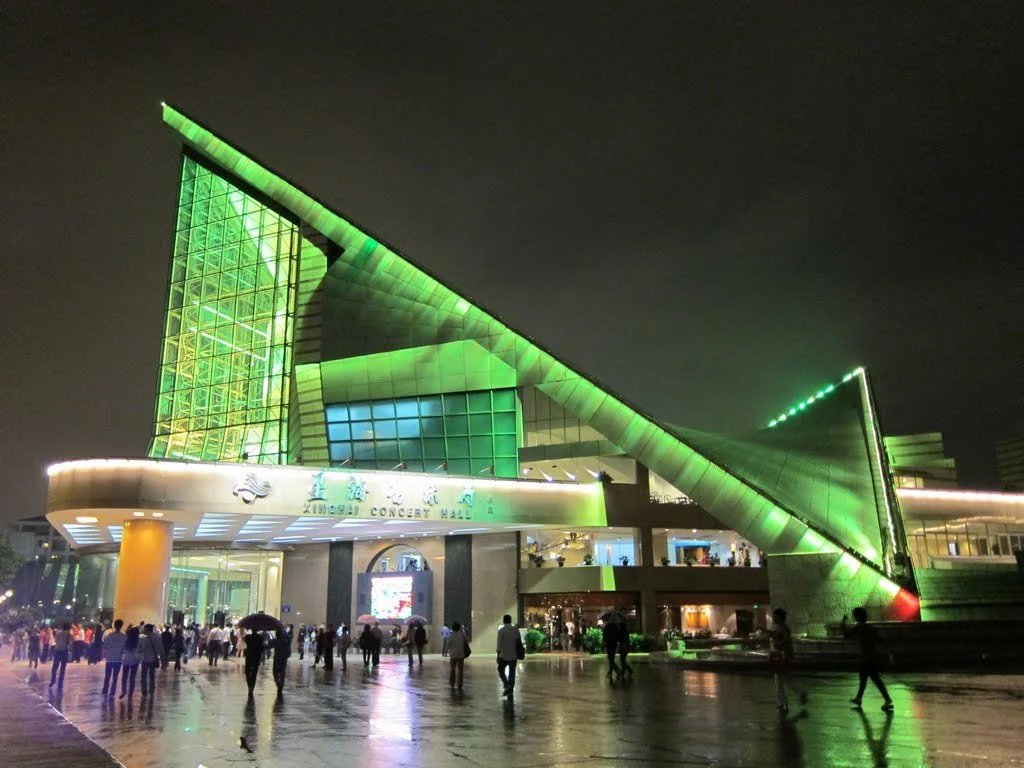
The main activities and performances of the inaugural YMCG will take place in the state-of-the-art facilities of the Guangzhou Symphony Orchestra (1 Haishan Street, Ersha Island, Guangzhou) and Xinghai Concert Hall, which has been renowned as the hall built by the Chinese with the best acoustics. There will also be a multi-function “music tent” set up on the lawn outside the Guangzhou Symphony Orchestra’s headquarters. Many Guangzhou natives have fond memories of this site that has long infused their lives with music: outdoor concerts, concerts on the lawn, choruses of a thousand have all been held there. The “music tent” will be used this January as a student and media center during the day, but it will transform into an unconventional performance space in the evenings, including “Music + Dialogue” sessions devised by Yo-Yo Ma. Not only will Ma and the instructors gather to discuss music, culture and art, but they will engage the audience to connect these issues and to search for answers, using our imagination as a “key” to open the doors not only to art but to the entire world.
YMCG gathers resources from around the world. It is a symbol of how Guangdong Province is fostering cultural development. Plans are underway for YMCG to take place on an annual basis.
Concert Details:
Youth Music Culture Guangdong (YMCG) 2017—Jing Huan, GSO and GSYO
January 7, 2017
20:00
Xinghai Concert Hall
Performers: Guangzhou Symphony Orchestra, Guangzhou Symphony Youth Orchestra
Conductor: Jing Huan
Cello: Mike Block
Sheng: Wu Tong
Program:
Tan Dun Passacaglia: Secret of Wind and Birds
Zhao Lin Duo (for cello, sheng and orchestra) (GSO co-commission, 2011)
Ottorino Respighi Pines of Rome
Youth Music Culture Guangdong (YMCG) 2017—Yo-Yo Ma and Michael Stern
January 15, 2017
20:00
Xinghai Concert Hall
Performers: YMCG Orchestra
Conductor: Michael Stern
Cello: Yo-Yo Ma
Program:
Maurice Ravel Valses nobles et sentimentales
Ludwig van Beethoven Symphony No. 8 in F Major
Antonin Dvořák Cello Concerto in B minor (2nd and 3rd movements)
Igor Stravinsky Firebird Suite (1919)

Strings: Violinist Anne Akiko Meyers on a First and Final Commission from Rautavaara
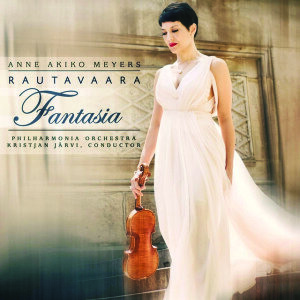
Anne Akiko Meyers called her new CD Fantasia after the transcendent 15-minute-long concerto that Finnish composer Einojuhani Rautavaara wrote for her, which turned out to be the last [composition for violin] he composed before his death in July 2016 at the age of 87. Meyers will give the world premiere of Fantasia in March with the Kansas City Symphony conducted by Michael Stern; the recording was made in London with the Philharmonia conducted by Kristjan Järvi
Strings
By Laurence Vittes
Anne Akiko Meyers called her new CD Fantasia after the transcendent 15-minute-long concerto that Finnish composer Einojuhani Rautavaara wrote for her, which turned out to be the last [composition for violin] he composed before his death in July 2016 at the age of 87. Meyers will give the world premiere of Fantasia in March with the Kansas City Symphony conducted by Michael Stern; the recording was made in London with the Philharmonia conducted by Kristjan Järvi.
Due out early in 2017, the new CD will also include Ravel’s Tzigane, Szymanowski’s Violin Concerto No. 1, and new orchestrations of Arvo Part’s Spiegel im Spiegel and Morten Lauridsen’s O Magnum Mysterium, by the composer himself. I spoke to Meyers who had just moved to the Pacific Palisades with her husband and two daughters, aged four and six. She was off for an extraordinary roundtrip to Krakow, 15 hours each way, to play the Szymanowski Concerto and the world premiere of Jakub Ciupinski’s The Wreck of the Umbria, precisely scheduled so she would be back in time to take her older daughter to her first day of school.
—Laurence Vittes
Tell me about Einojuhani Rautavaara and Fantasia.
Fantasia means a lot to me. I had known Rautavaara’s music for a long time, since I was a kid who found his music browsing through the CD bins. It became a dream of mine that he would write something for me.
Was Rautavaara the ultimate composer you were after for a commission?
No. I’ve always gone after and harassed composers. I’m always thinking historically: Oistrakh, Auer, Joachim, Heifetz—they were muses for composers. They inspired such great music; just imagine if we had a concerto by Gershwin or Ravel or Rachmaninoff.
I would have just bugged the crap out of Rachmaninoff to write a violin concerto. Of course, plenty of composers say no and run the other way when they see me coming after them, but I’m tenacious.
How did the commission happen?
On a sudden impulse, out of the blue, I contacted Rautavaara’s publisher, Boosey & Hawkes, who put me in touch with him. I wrote and told him I was a big admirer of his. I asked if he would write something for me, he answered with a resounding yes, and sent me the music almost instantaneously, after which I flew to Helsinki to work with him.
What did you ask Rautavaara for?
He was 87 and I didn’t want to tire him out, so I asked for something shorter, a fantasy.
Can you describe Fantasia?
It is music like his Cantus Arcticus, with its electronic birdsongs, and his Angel of Light Symphony [Rautavaara’s Seventh Symphony, written in 1994 to celebrate the 25th anniversary of the founding of the Bloomington Symphony Orchestra]: ethereal and mystical. It is a soulful surge of emotion. I cry each time I play it. It was shocking when he passed; this was his last [composition for violin].
How closely did you work with him?
I arrived in Helsinki to find out he hand wrote everything, and it was hard to read. We made many, many changes, but mostly technical things like fingerings. And we changed many of the bowings to make the phrases sing as much as possible; he admitted he never had much confidence in his bowings, which he had in common with a few other composers. Otherwise, there was not one change, not one note, nothing, that I wanted to change.
What did Rautavaara say when he heard it for the first time?
He said, “I wrote such beautiful music.” And I thought, “You really did.”
When did you record the album?
We recorded the whole CD in May, broken up into two sections. We did the electronics part at the DiMenna Center for Classical Music in New York City, and everything with the Philharmonia in London. English orchestras are all quick studies, each with its own soul for music.
How did the new orchestration of Morten Lauridsen’s big choral hit come about?
I had been begging Morten for years to write something, really begging him, and he had been saying, “No, no, no, I’ve got a million commissions.” Then he heard me play Vivaldi’s Four Seasons in Pasadena, and he said, “I would love to do a special arrangement of this piece for you.” I said, “I’ll take one of those.” And the result is gorgeous.
You’ve made so many successful recordings. What’s your secret?
We laid down the CD in one and a half days of sessions, which were really packed. The secret on all recordings is having a great conductor to manage the time and musical pressures that come with recording, and a wonderful producer to make sure things flow. On Fantasia it was the amazing Wolf Ears Silas Brown and Susan Delgiorno; both were a complete joy.
How do recordings compare to live concerts?
Recordings may be more adventurous; it’s certainly a very different medium and process, but it’s almost impossible to compare. I love to perform live: There’s an electricity, a short fuse—a half hour and it’s over. With a recording, you’re working six hours at a stretch with one 15-minute break. You have to pace yourself, let go, and trust the engineer and producer to create the sound you’ve been working for.

Youth Music Culture Guangdong (YMCG) launches in 2017 with renowned musician Yo-Yo Ma as Artistic Director
After nearly two years of planning, the Youth Music Culture Guangdong (YMCG) will launch in January 2017. Presented by the Guangdong Provincial Department of Culture, YMCG is organized by the Guangzhou Symphony Orchestra (GSO) and the Xinghai Concert Hall. The YMCG’s Artistic Director is none other than internationally renowned artist Yo-Yo Ma, who accepted the invitation by GSO’s Music Director Maestro Long Yu to lead this meaningful and multi-faceted project.
After nearly two years of planning, the Youth Music Culture Guangdong (YMCG) will launch in January 2017. Presented by the Guangdong Provincial Department of Culture, YMCG is organized by the Guangzhou Symphony Orchestra (GSO) and the Xinghai Concert Hall. This unique and meaningful project will become an annual highlight in China in years to come. In fact, the YMCG follows the footsteps of major musical and cultural events in Guangdong province over the past decade, including the Canton International Summer Music Academy (2005–2007) and the Canton Asian Music Festival (2010) that had shown the region’s potential to reach out to the world. The YMCG’s Artistic Director is none other than internationally renowned artist Yo-Yo Ma, who accepted the invitation by GSO’s Music Director Maestro Long Yu to lead this meaningful and multi-faceted project.
A world-famous musician and an old friend of the Guangzhou Symphony Orchestra, Yo-Yo Ma made his GSO debut in 2010 in the closing concert of the Canton Asian Music Festival under the baton of Maestro Long Yu and has since returned twice to perform with the orchestra. Mr. Ma has an unrivalled depth and breadth of artistic experience, and is among the most revered artists in the world today. With his versatility and all-embracing visionary zeal, the YMCG will bear the imprint of his unique ideas on the arts and beyond. The inaugural YMCG will surely launch on a high note.
The inaugural YMCG, scheduled between January 7 and 20, 2017, entails the founding of a youth orchestra comprised of young musicians and students under age 35 from mainland China, Hong Kong, Macao and Taiwan, brought together through by audition or invitation, working together during the two-week project. Celebrated American conductor Michael Stern will serve as the orchestra’s Music Director and Conductor. The orchestra will be coached by a distinguished 12-member faculty, each personally selected by Mr. Yo-Yo Ma. Faculty members include Lynn Chang, Mike Block, Liang Wang, Kinan Azmeh, Joseph Gramley, Tina Blythe, Reylon Yount and Wu Tong, among others. The YMCG Orchestra is founded on the overriding principle of gathering people from diverse backgrounds and fostering meaningful interaction. There will be a series of public activities in Guangzhou from January 7 to January 15. Orchestra members participate not only in performances, master classes, seminars and cultural exchange, but also extend their engagement beyond classical music into broader cultural spheres. Most performances will offer tickets to the public at low prices; some will even be free of charge. A brief tour of Hong Kong and Macao is also scheduled for the YMCG Orchestra during the project’s second week.
Artistic Director Yo-Yo Ma shared his thoughts on the YMCG’s missions and goals: “Music—like the other arts, humanities, and sciences—is at the heart of culture. And culture is the tool that our society uses to discover truth, create trust, and share meaning. When humans play, or sing, or write, or explore, we not only create beauty and knowledge, but we also help to develop solutions to our greatest challenges. I believe that any musician or artist should not only be technically proficient, but also be mindful of the power of their art and the need for it in their world. It is with this in mind that I invite people to participate in the first YMCG. Hosted by the Guangzhou Symphony Orchestra and staffed by faculty from around the world, this seminar aims to create trust and connect young musicians from China, Hong Kong, Macao and Taiwan. Our curriculum will address both musicianship and citizenship. It will be led by a distinguished group of faculty drawn from the worlds of music and education—from the Silk Road Ensemble to Harvard University and elsewhere. It will deepen the participants’ understanding of classical style, develop flexible thinking through participation in different genres of music, and ask them to practice core artistic values such as curiosity, connection, and collaboration. When combined with discussion of how music can respond to the needs of others, we hope that this approach will create powerful, memorable moments that will encourage empathy, hope, and understanding. We hope that the YMCG will leave participants not only with a wonderful musical experience, but also with new skills and inspirations about the powerful role that music and musicians can play in our increasingly complex 21st-century world.” Yo-Yo Ma hopes young musicians who participate in the YMCG project can ponder three core issues—Content (“How to understand music?”), Communication and Reception (“Whose need does music meet? Yourself, the audience or the composer?”). Answers to these philosophical questions will provide benefits for a lifetime.
According to YMCG project organizers, up to now, no other music festival in mainland China has been founded on addressing young people on an international level. Guangdong province has always been a pioneer on many fronts throughout history, and the founding of YMCG this year is most timely. Not only does the province enjoy one of the country’s strongest economies, but its cultural foundation and global connections are also enviable. Guangzhou ranks among China’s first-tier cities and enjoys one of the longest histories as a port open for foreign trade; it has been a business center in the region for more than a millennium. Guangzhou is also a major city along the coastal Silk Road with a deep and rich cultural heritage. The YMCG will open a door through which people can see both outside and inside China. As an annual arts and cultural project, the YMCG will provide a veritable platform for deepening understanding, increasing trust, and fostering cultural interaction among young people

Pianist Haochen Zhang returns to Fort Worth for Cliburn concerts
For 2009 Van Cliburn International Piano Competition gold medalist Haochen Zhang, the key to success as a musician is simple.
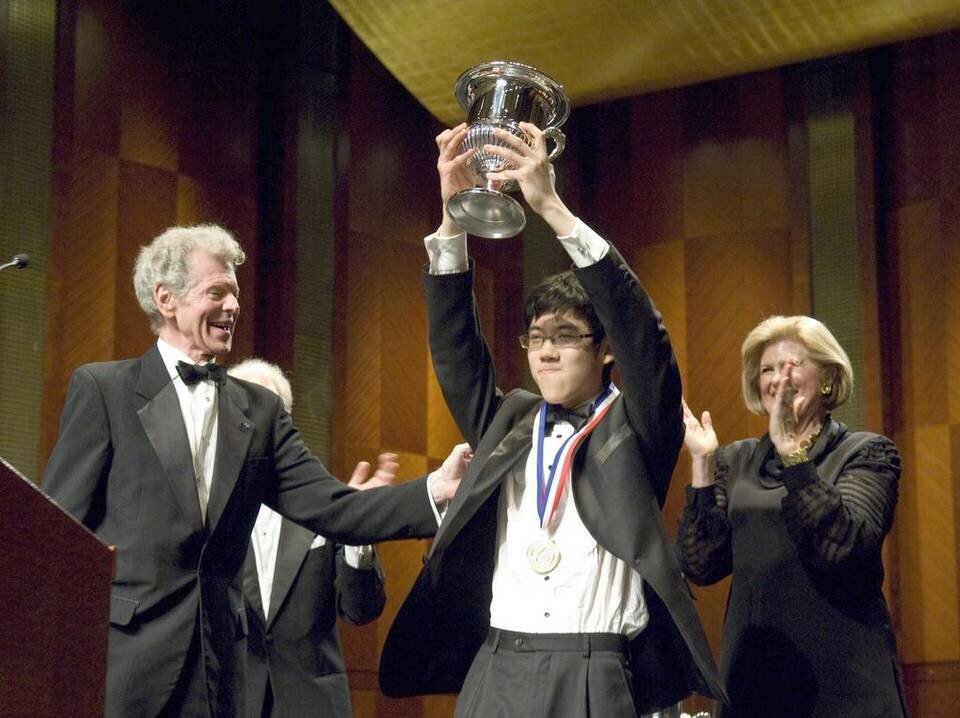
Van Cliburn, left, joins Haochen Zhang’s victory celebration in this 2009 photo. Credit: Anonymous, AP archives
Star-Telegram
By Punch Shaw
For 2009 Van Cliburn International Piano Competition gold medalist Haochen Zhang, the key to success as a musician is simple.
“Just open up your ears,” said Zhang, who will be performing with the Brentano String Quartet in concerts presented by the Cliburn on Thursday and Friday.
That seems pretty obvious. But it should be pointed out that the Chinese pianist has to keep his hearing in good shape for the performance hall, despite spending a staggering amount of time in airplanes, where ears can open and close during and after the flights.
The pianist makes his home in Philadelphia, where he graduated from the Curtis Institute in 2012. He chatted via Skype last week from a city near his native Shanghai, where he was performing. He had played in Tokyo the night before.
“I have used some tricks in the past, like taking jet lag pills or adjusting sleeping on the plane to the time zone I was flying into,” he said. “But I have learned that time is the best cure [for jet lag].”
Zhang, 26, has logged plenty of air miles since the 2009 competition where, at age 19, he was the youngest pianist to ever earn a gold medal in the Cliburn.
And he credits that competition, at which Japanese pianist Nobuyuki Tsujii also received a gold medal, as being a major springboard to his active career. He cited an international tour with the Munich Philharmonic and maestro Lorin Maazel as one of his career highlights since the Cliburn.
“It not just about getting a prize, but about getting all these opportunities that train you to be a professional soloist,” said Zhang, citing the three years of engagements that come with the Cliburn’s top prize. “Through the competition, I have matured so much, both as a musician and as a human being.
“Touring all these places, performing all the time and meeting people of different cultures has really opened up my vision of the world and of music.”
Zhang also credits the competition experience and resulting tours with making him more comfortable at the piano bench.
“I think I was somewhat shy in the beginning. So my attitude toward playing was a little contained,” he said. “And I am still an introverted person. I don’t approach performing in a very outgoing, extremely romantic way, like a lot of young pianists would.
“But now it seems so natural that I don’t have to prepare myself to play, psychologically, as much as I once did. I would say that I have definitely opened up more as a result of performing all the time.”
And when Zhang talks about “open ears,” it really has more to do with performance practice than cabin pressure — and especially chamber music performances.
“Pianists are naturally soloists. So we don’t usually have to compromise in any way,” he said. “But when you are too comfortable in that zone, then you have your ears entirely closed.
“The important thing for chamber music, though, is to always open up your ears. That’s why I wish that all pianists could have more opportunities to play chamber music more often.”
Zhang performed with the Takacs Quartet when he competed in the 2009 Cliburn. The Brentano String Quartet performed with the semifinalists at the 2013 Cliburn and will return for the 2017 competition.
During this week’s concerts, Zhang and the quartet will be performing Franck’s Piano Quintet in F minor. Zhang will play Chopin’s Piano Sonata No. 2 in B-flat minor , and the Brentano will perform Beethoven’s String Quartet in F major, Op. 135.
The chamber setting, Zhang said, requires a pianist who is used to performing alone or taking the lead in a concerto performance with an orchestra to be more of a team player.
“The key to chamber music is that there is no ego involved,” he said. “I think everyone puts their ego down to serve the music. If there is solo voice, that’s the voice everyone should be responding to. In other situations, you may need to be an accompanist or a collaborator. The only role you really have is to open your ears and listen to what the other people are doing, and react.”
The 2017 Cliburn competition will be webcast throughout China next summer, foundation officials have said — the first time a Cliburn competition will be webcast in the country.
Since Zhang was speaking from his native China, it seemed appropriate to seek his take on the state of classical music there.
“[Classical music] is still evolving and improving at a very fast pace,” he said. “Five years ago we were all still complaining about Chinese audiences not being mannerly enough. They made noise. They chatted. They would applaud between movements. There was no cultural understanding of how to behave at a classical concert.
“But every time I go back to play in China now, the audiences are behaving better, especially when I go back to big cities. So I think the outlook is optimistic for classical music in China.”
And it is, particularly, for the younger generations, he said.
“I would say that ages 20 to 40 are the central demographic,” he said. “A lot of college students and young professionals come to the concerts.”

Classical Movements at 24: Changing the World Through Music
Celebrating their 24th birthday, Classical movements reflects back on memorable tours.

Back in the U.S.S.R.: "Slava" conducts the National Symphony and the Choral Arts Society of Washington.
RUSSIA, 1993—Mstislav Rostropovich is invited back to his native Russia, having defected in 1974. In those two decades, both the cellist, and his homeland, had drastically changed. What a homecoming it was, then, when now-Maestro "Slava" and the National Symphony Orchestra returned with a chorus nearly 200-strong. With just two months’ notice, Blue Heart Travel (what would become Classical Movements) arranged a landmark tour for the Choral Arts Society of Washington, culminating in the first-ever concert broadcast from Moscow's Red Square.

Not pictured: President Zemin conducting that night's encore, a Sousa march.
CHINA, 1999—After playing Bernstein, Gershwin and Copland for Chinese President Jiang Zemin at the Clinton White House, at President Zemin's request, Classical Movements is honored to arrange for the Leonard Slatkin-led National Symphony to perform Dvorak, Schumann and Mussorgsky at the Great Hall of the People in Beijing. It's one of many stops on the NSO's 18-day tour of China and Japan.

The late NYPO music director, Kurt Masur.
TUESDSAY, SEPTEMBER 11, 2001 - Classical Movements has the entire New York Philharmonic on tour in Europe. Company president Neeta Helms recalls, “By the time they took off from Hanover and landed in Frankfurt, the travel world, as we knew it, had changed forever." For four long days, all flights in and out of the U.S. were grounded. By Saturday, September 15, every last member of the New York Phil was on the first flight home.

Maestro Leonard Slatkin pauses for a picture with both NSO and INSO musicians.
IRAQ, 2003—The U.S. State Department and the Kennedy Center invite the Iraqi National Symphony Orchestra to perform in Washington, alongside the National Symphony. With anti-aircraft missiles still lighting up the sky above Baghdad, flying the INSO out of Iraq proved difficult for Classical Movements. Moreover, many of the Iraqi musicians did not have basic travel documents; visas had to be issued in a country with no government. Military aircraft flew the orchestra to Jordan, and they landed in D.C. during a major blizzard.

The "Dude" leads Dr. José Antonio Abreu'sband.
VENEZUELA, 2007—Askonas Holt invites Classical Movements to organize the first U.S. tour for the 265-plus members of the Simón Bolívar Youth Orchestra, conducted by a then-27-year-old Gustavo Adolfo Dudamel. Venues include Carnegie Hall, Boston's Symphony Hall, Davies Hall in San Francisco and an eventual home for that charismatic leader: the Walt Disney Concert Hall in downtown Los Angeles, California. "Dudamel is absolutely revelatory," writes the L.A. Times.
"Broadcast yourself," indeed, with Classical Movements.
CYBERSPACE, 2009—Google, still Classical Movements' only for-profit client, contracts out all travel and logistics for the debut of its YouTube Symphony Orchestra, where musicians (and all of their instruments) from across the globe finally meet up at Carnegie Hall. It's such a successful venture for all parties, there's a reprise, two years later, at Australia's Sydney Opera House.
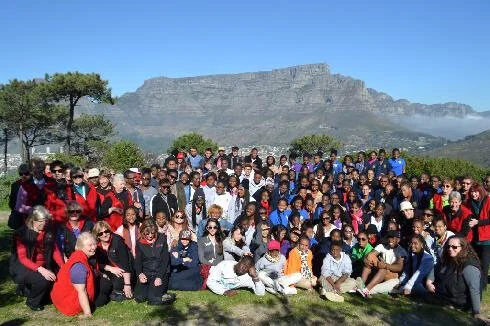
Combined Ihlombe! Choral Festival participants at the foot of Signal Hill in Cape Town.
SOUTH AFRICA, 2009—By 1994, with the election of Nelson Mandela and the full abolition of apartheid, Blue Heart Travel was officially touring to South Africa. To celebrate 15 years there, and especially since Classical Movements' Rhapsody! and Melodia! Choral Festivals had become such hits in Europe and South America, respectively, Ihlombe! (pronounced "Ish-LOM-bay") is launched. The Zulu word for "applause," Ihlombe! quickly becomes the largest international choral gathering in the country.

Tony Ross, Minnesota's principal cello, shares some techniques with a Cuban student.
CUBA, 2015—Likewise, Blue Heart had been taking sanctioned tours to otherwise forbidden countries like Cuba, Vietnam and Syria since President Clinton's first term. “We knew Cuba held such a singular place in American’s minds and hearts," remembers Ms. Helms. With little more than 100 days’ notice, the Minnesota Orchestra tells Classical Movements they want to go, too. Leveraging its well-established ties to bypass decades of diplomatic stalemate, the tour is a triumph, including two performances at the Teatro Nacional, as well as outreach workshops with Cuban music students. The concerts are broadcast live, around the world, a substantial achievement, itself.

The Violin Channel: Prizes Awarded at American Boulder International Duo Competition
Cellist Julian Schwarz and pianist Marika Bournaki have been awarded 1st prize at the 2016 Boulder International Chamber Music Competition

Violin Channel
American cellist Julian Schwarz and Canadian pianist Marika Bournaki have been awarded 1st prize at the 2016 ‘Art of the Duo’ Boulder International Chamber Music Competition, in Boulder, Colorado, USA.
Both graduates of the Juilliard School, Julian is a former 1st prize winner at the Alice and Eleonore Schoenfeld International String Competition.
The duo will receive US $7,000 – plus a number of important concert engagements throughout the Boulder area during the 2017/2018 season.
2nd prize was awarded to American cellist Coleman Itzkoff and Armenian pianist Alin Melik-Adamyan.
3rd prize was awarded to Japanese violin and piano duo Hiroka Matsumoto and Gaku Sugibayashi.

JULIAN SCHWARZ & MARIKA BOURNAKI | DEBUSSY CELLO SONATA | 2015 EASTERN MUSIC FESTIVAL

Antarctica Choir Tour - April Fools' Joke Turns to Reality
Classical Movements offers a truly once-in-a-lifetime opportunity to experience the magnificent beauty and adventure of Antarctica with other choral music enthusiasts for a 17 day, 15 night tour, December 29, 2017 - January 14, 2018, including New Year's Eve in Buenos Aires and 9 nights aboard the G Expedition cruise ship.

Antarctica Choir Tour
Concerts in Antarctica, Buenos Aires, Ushuaia, & Aboard Cruise Ship
December 29, 2017 - January 14, 2018 (17-day, 15-night tour)
What started as an April Fools’ joke has turned into a once-in-a-lifetime musical
experience. On April 1, 2014 Classical Movements sent what was intended to be a prank email to their choral clients, encouraging them to consider touring in Antarctica and announcing a made-up choral festival. To the company’s astonishment, interest from choirs, conductors, and enthusiastic individuals flooded in; this was just the tip of the iceberg. Two years later, what seemed like a harmless joke and impossible feat has become a reality.
At the end of December 2017, including New Year’s Eve, singers from all over the world are invited to meet in Buenos Aires, Argentina for two days of intensive rehearsals with Maestro Oscar Escalada. The group will then travel to Ushuaia, the departure point to Antarctica and the southernmost city in the world, often referred to as fin del mundo (end of the world). The first concert of the tour will take place in one of Ushuaia’s churches on New Year’s Day.
The next nine days will be spent on board a cruise ship, where the singers will give two concerts and a weather (and penguin) permitting performance on the mainland of Antarctica. Classical Movements will also facilitate any possible tours and explorations to view some of the continent’s stunning scenery and rare wildlife, and provide the opportunity to hear lectures by scientists, biologists, photographers, and other expedition staff.
The final three days of the tour will bring the group back to Buenos Aires for a final concert in one of the city’s historic churches, and will offer the chance for travelers to explore Argentina’s capital.
The cruise portion of the Antarctica Choir Tour will take place aboard the G Expedition, the signature ship of G Adventures, a partner company of National Geographic. Classical Movements chose G Adventures based on their excellent safety record and 25 years of experience “putting travelers on a first-name basis with the planet’s people, cultures, landscapes and wildlife”. The relatively small size of the G Expedition (134 passengers total), which was completely refurbished in 2009, will allow for a more personalized, intimate experience and enables access to areas not accessible by larger vessels. All cabins feature ocean-facing windows and en-suite facilities.
This is an exclusive Classical Movements offer with only 50 available places. They expect to sell out.
Learn more here.