

Strings Magazine: Yo-Yo Ma and Silk Road Ensemble Members Team Up with Maestro Long Yu for Inaugural Youth Music Culture Guangdong
Ma is in Guangzhou, historically a major terminus of the Silk Road in the Guangdong province of China, acting as the artistic director of Youth Music Culture Guangdong—a program in its first year designed to shake up 80 young musicians with a flurry of chamber-music coachings, Silk Road Ensemble–style workshops, panel discussions, and two final concerts, where participants perform as chamber-music groups and as an orchestra.
Strings Magazine
By Stephanie Powell
Music director Michael Stern fervently bounces along to Beethoven’s Symphony No. 8 as he leads the string section of the orchestra. Stern pauses to offer thoughtful direction to the violins on breathing with their bows and asks the violas to sing into the cello section—and, also, to lighten the mood. “It’s joy,” he says of the passage in the score, “and it’s also just noise, right?” Laughter erupts. About 45 minutes into rehearsal, someone slips in through a side door. The students are so focused on the repertoire at hand they don’t notice.
But I take notice of the tip-toeing man, with Jacqueline de Pré’s 1712 Strad in hand, headed toward the last seat in the cello section—it’s Yo-Yo Ma. He shares a music stand and dives right into the Beethoven.
Ma is in Guangzhou, historically a major terminus of the Silk Road in the Guangdong province of China, acting as the artistic director of Youth Music Culture Guangdong—a program in its first year designed to shake up 80 young musicians with a flurry of chamber-music coachings, Silk Road Ensemble–style workshops, panel discussions, and two final concerts, where participants perform as chamber-music groups and as an orchestra.
The program is the brainchild of Ma, who tapped veteran orchestra players and some of his fellow Silk Road Ensemble members to join him, and maestro Long Yu—a powerful, almost single-handed force in China’s
classical-music scene. He holds director-level positions in multiple orchestras across the country, is the founder of the Beijing Music Festival, and much more. The participants, who together make up the YMCG orchestra, are between the ages of 18 and 35, and are all of Chinese descent from Guangzhou or neighboring provinces, Europe, and the United States.

Violinist Johnny Gandelsman coaches a group of YMCG participants on Beethoven’s Septet in E-flat major, Op. 20. Photo by Liang Yan
The two-week-long program takes place at the Guangzhou Symphony Orchestra’s rehearsal hall, located idyllically adjacent to the Pearl River. The hall is surrounded by a jagged skyline of metallic skyscrapers and cutting-edge architecture, and the backdrop proves a perfect setting in which to explore the juxtaposition of new and ancient.
And exploration is exactly what Ma has set out to inspire. He’s not there to perform the Beethoven with the orchestra, which is billed on the final-concert program (though he can’t help but sit in and discuss the intricacies of the symphonic work with inquiring minds during rehearsal breaks). He’s there to take trained, technically proficient musicians on a journey to tackle the unfamiliar.
The faculty selected to help the students on that journey includes violinists Johnny Gandelsman and Shaw Pong Liu; cellist Mike Block; oboist Liang Wang of the New York Philharmonic; clarinest/composer Kinan Azmeh; trumpeter Bill Williams; percussionist and Silk Road associate artistic director Joseph Gramley; 22-year-old yangqin player Reylon Yount; singer/sheng virtuoso Wu Tong, and Harvard researcher Tina Blythe. Michael Stern, music director of the Kansas City Symphony and son of violinist Isaac Stern, takes charge as music director of the YMCG orchestra.

Yo-Yo Ma and Long Yu speak during a YMCG panel discussion. Photo by Liang Yan
With the upswing of growth in China’s classical-music scene, it’s no surprise this powerhouse team found its way here. From the inaugural Shanghai Isaac Stern International Violin Competition, which took place last January, to the opening of Juilliard’s first satellite campus in Tianjin in 2018, there is undoubtedly a driving force in China’s classical-music scene that feels like it’s only continuing to build momentum. Concert halls are popping up all around the country: Construction of the China Philharmonic Hall is set to finish in 2019, and will offer the country’s philharmonic its first permanent (and translucent) 11,600-square-meter home. It’s hard to ignore the buzz—but why Guangzhou? I ask Ma and Yu—and they each credit the other for the idea.
Guangzhou was the first Chinese port open to foreign traders and was a stop on the Silk Road—offering a convergence of cultures. “Guangzhou is a very interesting place,” Yu says. “It’s very open-minded and young people come here from all over China—from Beijing, Shanghai, Tianjin—not just the Guangdong province.”
This sense of diversity is central to the YMCG experience. “What’s interesting is that there are people here from all the different Chinese cultures, from all the provinces,” cellist Mike Block says, “so, there’s this internal energy. It seems like it’s important that the participants are all here together.”
Chinese conservatories have a reputation for producing musicians with razor-sharp technique, which is apparent during any rehearsal. But conservatories also tend to place a heavy emphasis on orchestral works—programming that YMCG challenges with daily chamber-music coachings and improvisation exercises. “Education in China is a valid [topic] to be discussed—not only in China, but all over the world,” Yu says. “For this program, the most interesting [aspect to me] is opening more windows in the mind. [Showing participants] different ways to see—how you could be; how big the possibilities are as a person. You can change yourself. That is more important than only playing onstage. We can find thousands of talented players who are technically perfect, which [can be important], but I don’t want to see a perfect, technical machine onstage—I want to see a person full of life.
“[Playing] music is like having a conversation with a friend, and if the [participants] are learning that—to have that joy, that conversation—that’s the reason that we are doing this. To understand more meaning in life. Yo-Yo has such a big heart; he brings all the young people to another world.”
“Are you a comet?” Yo-Yo Ma asks a group of wide-eyed violists after they play a passage of Bach’s Concerto for Violin and Oboe in C minor. He pauses. “Are you a planet? Are you an alien?”
The blank stares continue, and then some laughter, as he tries to elicit excitement from the violists after a technically sound performance that still seemed to lack full heart. “This is the viola’s revenge,” he assures them. “We, too, are stringed instruments! This is your moment!”
This is a typical exchange during Ma’s chamber-music coaching sessions—he uses out-of-this-world metaphors, swaying along with the music, occasionally demonstrating on instruments, communicating in confident Chinese (albeit needing occasional backup on a few words, like “sister-in-law”), and with his breathing and body language.
Ma is in fact so committed to effective communication that his body language almost betrays him during a rehearsal of the Dvorak Cello Concerto in B minor with the YMCG orchestra. Stern and the participants are lost in the moment, moving so quickly through the music that Ma, bowing up front on the podium, leans so far forward that Stern has to grab him to keep him from toppling over.
During my first day observing chamber-music sessions and Silk Road workshops, I can see bemusement in the participants’ eyes. This isn’t about perfecting intonation or achieving technical accuracy—it is about finding freedom in the music, and revealing a part of themselves. “Today I said to the section leaders, ‘Look, your job as section leader is to communicate energy, character, gesture,’” Ma says. “And you have your back to everybody, so your shoulders—you have to communicate through that frame. If you want to communicate life, you actually have to look at your body space for what it is—and then, you actually have to exceed it.
“Think of air and boiling water,” he says. “If you’re a pot with a lid on it, the water’s cold, the air takes up a certain amount of body, and once it heats up, [the lid] starts to pop—that’s what you have to do. You have to show what is expected of you, and then you actually have to go further.”
This is not a school, Ma says of YMCG, “but what I love about it is that it’s what a school could be.” The model is simple—start out with a diverse faculty with varied skillsets, but similar values. “We don’t say, ‘Oh, this is the way to teach,’ but through those values, we sign on to sort of say, ‘OK, how can we do a 360 on music? How can we acknowledge different styles of music in large-group playing, and how do you take it to small groups?’”
The results are transformative. The participants’ schedule is jam-packed—the day starts at 10 am with a three-hour orchestra rehearsal, which is usually punctuated with laughter in between demanding passages, thanks to Stern and Ma’s witty banter. Chamber-music rehearsal follows for two hours before a Silk Road workshop. A panel discussion that melds music, philosophy, innovation, and tradition caps off the day.

Yo-Yo Ma sits in the back of the cello section during orchestra rehearsal at YMCG. Photo by Li Lewei
“What I like about coaching is helping the participants figure out what’s in the music. It’s kind of like music archeology,” violinist and Silk Road Ensemble member Johnny Gandelsman says. “Sometimes, if you don’t have a lot of experience with playing chamber music or looking at the score, you might not realize how special something is, so I like working with the groups on details, and helping them discover things for themselves.
“And then, once there is that moment of recognition, of, ‘Oh, I get it!’ That’s really rewarding—they’re excited about the music,” he says. “And now they have tools to succeed: to know how to listen to each other, how to look for unified sound. Building trust and having these building blocks that they can then take into their lives when this is over.”
About a quarter of the participants are professional musicians, Gandelsman says, holding positions in some of China’s most well-respected orchestras. Others, Ma later tells me, aren’t necessarily studying music performance or have aspirations of becoming professional musicians. One works as a physicist, and had about three years of violin lessons in his youth. Since then, he’s been essentially self-taught (which seems impossible upon hearing him play) and more than anything, he always wanted the opportunity to perform Stravinsky’s Firebird Suite with an orchestra. YMCG is his chance.
The Silk Road workshops are unmistakable highlights for the faculty and participants. On the first day of the workshops, the students choose one of six Silk Road tunes as a place to start, and they then have to improvise. Walking through the GSO during the workshops, I hear music singing from each corner that sounds like it comes from both the center of the earth and the beginning of time.
Block, director of Silk Road’s Global Musician Workshop, heads the workshops at YMCG. “Apparently the way that classical music is taught [in China] is very regimented,” Block says, “and the same can be said about American classical teaching. The warnings that I got were that it was somehow even more regimented here. So we were unsure how the participants would react to the Silk Road–band opportunity, and I felt from the first session I had with them that they were really no different than American classical musicians. They had various walls that we wanted to break through, but across the board they rose to the occasion.”

Cellist Mike Block coaches a chamber group before a YMCG “Tomorrow Concert.” Photo by Liang Yan
Block has led similar workshops with Silk Road’s Global Musician Workshop across the United States—even at Tanglewood last summer. Leading workshops in such strict orchestral arenas, like YMCG, can be challenging, he says. Typically the workshops take place in an environment where the participants are choosing to be there because they want to improvise and want to be creative. “I’m coming into an orchestral environment where participants aren’t necessarily expecting or planning to improvise, and that’s a very different environment to do this work in,” he says. “Yo-Yo is very passionate about taking those values and bringing them to people who don’t know they need them, or don’t know they value them yet. So, that’s a big part of why I’m here—to have this experience with them.”
There are three nights of final concerts, two chamber-music and one orchestral, that demonstrate the transformative power of this program. The final orchestral performance is energentic and fearless—the orchestra members distinguish themselves with a performance delivered with a contagious sense of enthusiasm and confidence. It is an exhilerating evening, and what one might expect given the participants’ intensive orchestral training.

A chamber group takes in the audience’s response after a triumphant performance of a Silk Road–style arrangement during a Tomorrow Concert. Photo by Liang Yan
But throughout the program, students have also been preparing two sets of chamber-music works for YMCG’s “Tomorrow Concerts.” The concerts take place over two nights—dividing the participants into two sets of chamber groups. In the first half of each Tomorrow Concert program, chamber groups perform a piece of standard repertoire from Debussy to Bach to Steve Reich. In the second half, participants perform works they arranged and composed in the Silk Road workshops. After witnessing a handful of the workshops myself, I think I have a sense of what to expect.
I have, after all, watched the participants work through incorporating unnatural playing techniques and sounds into their compositions—like using the violin as a percussive instrument, fumbling awkwardly with unfamiliar instruments, and interspersing their arrangements with vocals and choreography. The participants’ skills and confidence grew, and it feels obvious. But the transformation that takes place overnight from rehearsal hall to the stage still manages to leave me, and the audience, speechless (figuratively).
During each half of the Tomorrow Concerts series, personality, humor, and confidence shine through the seven groups vibrantly. They take turns owning the stage, breathing together, looking at each other during passages that require dialogue between instruments, and leaning into one another during the standard-repertoire section. The Silk Road–workshop pieces deliver such freedom and variety that the faculty can’t help but shout, yell, stand, and clap after—and during—each performance.
The concerts demonstrate an assortment of explosive cello chopping, solid percussive techniques, stunning vocals, a little shimmying around the stage, and even Mission Impossible medleys.
A violist from the second group grabs the microphone and addresses the faculty, who are all sitting together in the audience. “This has been . . . ,” she says, and pauses, “so damn hard.” The faculty cheers. “We’re going to show you what is courage, what is brave, what is happy.” She then looks into the crowd for the participants who performed in the previous night’s Tomorrow Concert. “Group A—you asked for this,” she says before her group jumps into an electrifying performance.
The energy in the hall instantly changes from polite and attentive to a rowdy musical party. At the close of the final group’s performance, the faculty stands up to give a standing ovation, and you could sense that a door had opened for these students, and they had just started to walk through.
“I still remember the first day when all the [participants arrived],” Yu says. “I saw their eyes, their confusion—you know, they [didn’t] understand what was going on. [Many came] here because of Yo-Yo, but then they realize later that it’s not only Yo-Yo himself, it’s also the things that he brings to them . . . I saw all of their eyes onstage shining with a lot of confidence, a lot of fun, and they finally know why they [are playing]. Today, they became [alive].”
Despite coaching many of the groups, Block says, they still had the ability to surprise him. “For the performers who played during both halves [of the Tomorrow Concerts], it seemed like they were able to access different parts of themselves for the different types of music—and that is really exciting.”
Even Yu admits a slight bias for this project—after more than 20 years of advocating for and advancing the classical-music scene in China—and that says a lot. “YMCG will help the future generation,” he says. “Yo-Yo and I have both talked about this—he’s over 60 and I’m over 50—and for us, for the rest of our lives and careers, the most important [task] is how to help young people.
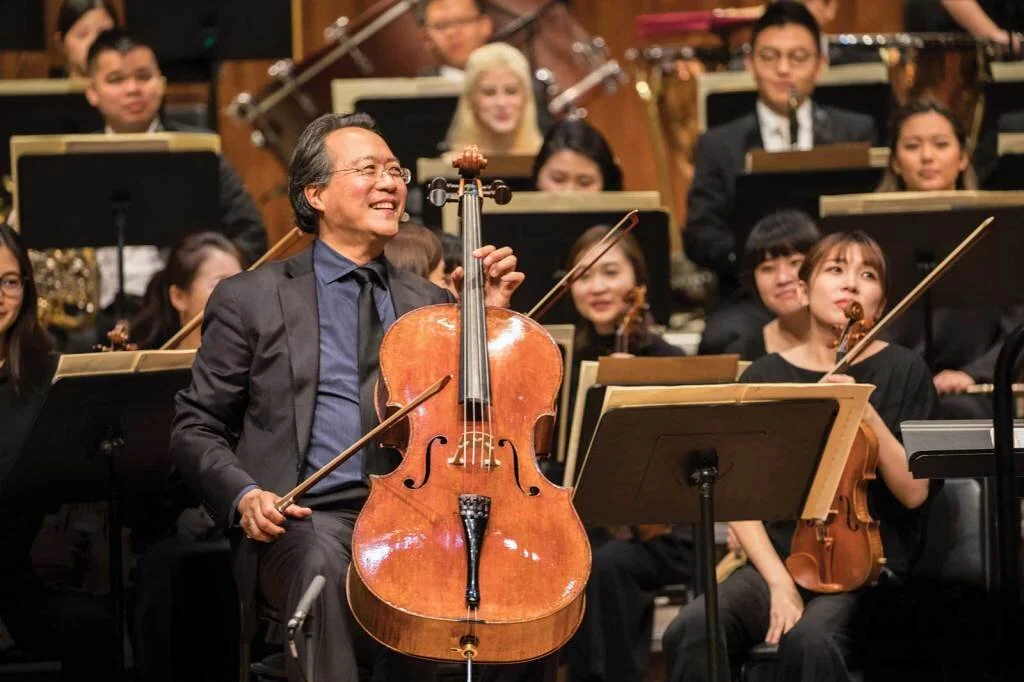
Yo-Yo Ma after a performance of Dvorak’s Cello Concerto with the YMCG orchestra. Photo by Li Lewei
“It’s my life—music is my language. I tried working for 20 years to help China make a lot of things happen, and a lot has worked. Today [classical music in] China [is] so different than when I came back from Europe. I’m very proud to say we’ve made huge musical changes. [With YMCG], Guangzhou has now opened a new window—[one] that we can now explore for other musicians in China.Creativity and imagination—those are two words that are now very important for young musicians in China.”
The passion is tangible, and (in my case) even tear-inducing. “I think there are as many ways to awaken passion as there are people because it’s so individual and you can’t just say, ‘I want passion!’ It’s something that happens I think when people are using all of themselves,” Ma says. “What makes people remember something forever? What happens I think is, when you are maximally open to something, and you meet a different world, you will maximize the moments with that passion.”
When I ask him for his final impressions of the participants’ Tomorrow Concert performances of their Silk Road arrangements, he replies, “That’s a big victory moment.
“They’ve self-identified. That’s what we hope for. Because you can build from that. Nobody’s going to ever forget what they did. They can forget all we’ve said—all the [orchestra and chamber music] we played—it doesn’t matter. But if they build from those performances they’re in good shape—[they can remember] ‘we used all of ourselves to say something that we really wanted to say.’”
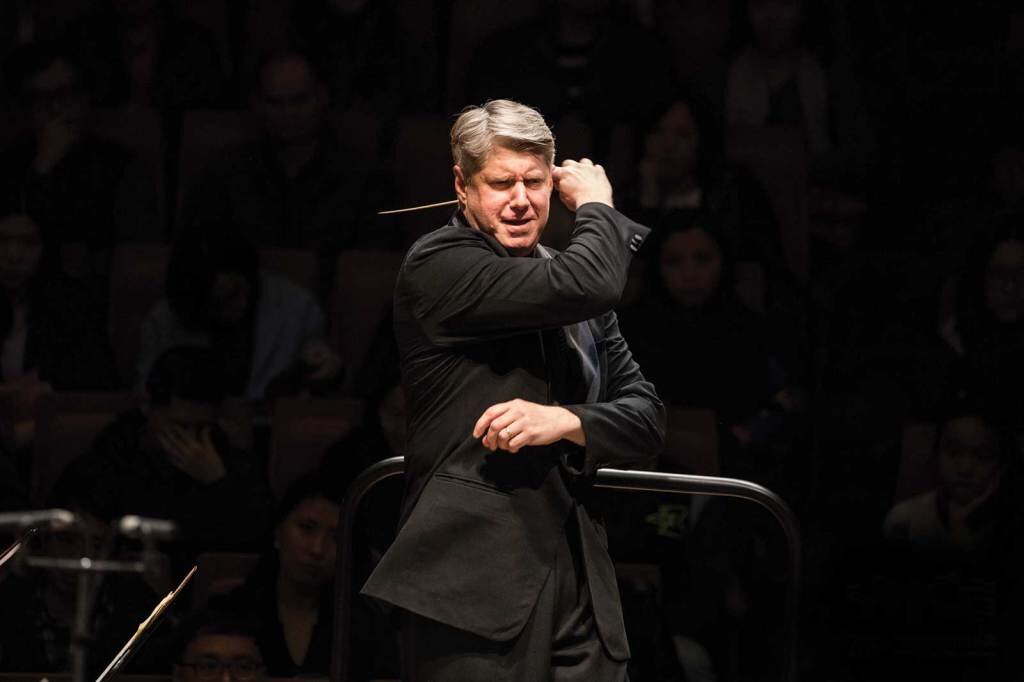
YMCG music director Michael Stern during the final orchestra concert. Photo by Li Lewei

Jewish Journal: Israeli Chamber Project sets sights small for UCLA program
When members of the Israeli Chamber Project take the stage at the Jan Popper Theater in UCLA’s Schoenberg Music Building on Feb. 26, their interactions may provide a timely, if unintentional, example for U.S. residents and elected officials to follow amid today’s divisive political culture.
Jewish Journal
By Rick Schultz
When members of the Israeli Chamber Project take the stage at the Jan Popper Theater in UCLA’s Schoenberg Music Building on Feb. 26, their interactions may provide a timely, if unintentional, example for U.S. residents and elected officials to follow amid today’s divisive political culture.
The ensemble’s leaderless music-making process — in the words of one of its pianists, Assaff Weisman — is comparable to the flexibility that successful politics demands.
“The ever-changing role of who leads a piece requires consensus and great respect for each other,” Weisman said. “When we’re on stage, we share in the duties of leadership to make a cohesive whole. Everybody contributes.”
Founded in 2008, the Project consists of distinguished 30-something musicians who get together throughout the year for chamber concerts and educational and outreach programs in Israel, the U.S. and other countries. It currently has 11 members, plus guest artists, who are deployed in different numbers and configurations depending on the program.
At UCLA, three Project members — Weisman, Carmit Zori on violin and Sivan Magen on harp — will take turns performing duets by J. S. Bach, Sebastian Currier, Carlos Salzedo, Claude Debussy and Béla Bartók.
Weisman, who offstage leads the group as its executive director, said “project” is the important word in its name. “We see our mission as ongoing, not finite,” he said. “We’re all about bringing music to as wide a public as possible.”
The UCLA concert, which will begin with Bach’s early 18th-century Sonata for Harpsichord and Violin in B Minor (BMV 1014), arranged for harp by Magen, follows the ensemble’s usual innovative programming of old and new music, except that this time it is traveling light.
“We’re doing a series of duos, which is unusual for us,” Weisman said. “We usually travel with a bigger group.”
Currier’s “Night Time” Suite for harp and violin from 2000, which follows Bach’s sonata, has a special place in the ensemble’s repertory — they performed it for their debut at Weill Recital Hall at Carnegie Hall in 2012.
“The suite’s five short movements traverse different stages of the night,” Weisman said. “They are restless, quietly introspective pieces full of mystery.”
Weisman said he is especially excited about Salzedo’s 1922 Sonata for Harp and Piano. Indeed, the program at UCLA should be a feast for lovers of that ethereal instrument. Salzedo, a French harpist, pianist, composer and conductor from a Sephardic family, who died in 1961, also founded the harp program at the Institute of Musical Art in New York, which became The Juilliard School.
“There are not many works for harp and piano, and this is one of the best,” Weisman said. “It hardly ever gets performed. We try to take risks, and whether we’re performing old or new music, we push the envelope when we can.”
The idea for the Project came from its founder, Tibi Cziger, an Israeli clarinetist who is now its artistic director. Cziger, like Weisman, began his music studies in Israel and continued them at Juilliard.
“There was little to no support for the arts in Israel, so Tibi saw another way for us to develop our careers and address the musical brain-drain at home,” Weisman said. “Our mission became to give back to the places where we started — Tel Aviv, Jerusalem and the Haifa area — and to address a situation where musicians are compelled to find a career path elsewhere.”
Weisman recalled the group’s first tour of Israel, during which the musicians found themselves performing a folk piece by Bartók in a small jazz club in the middle of the Negev Desert.
“Children came with their parents and grandparents, and they sat on the floor,” Weisman said. “There was an upright piano that didn’t function well, but I made do. We played Bartók’s ‘Contrasts,’ a trio for clarinet, violin and piano. They were engaged. We saw that as proof that even a challenging piece can go over well in the strangest places.”
As cultural ambassadors, the ensemble has worked with a diverse cross-section of Israeli society, including the Orthodox, Israeli Arabs and Russian immigrants. Its impact and excellence was recognized in 2011 when it was named the winner of the Israeli Ministry of Culture Outstanding Ensemble Award.
In addition to their performances, the Project’s members also give master classes throughout Israel, as well as in the U.S. and Canada. In 2016, the group made its debut in China.
Another part of the group’s mission is supporting the next generation of composers by commissioning new works. In June, it will perform the premiere of a clarinet quintet by Menachem Wiesenberg, and in 2018 it will debut a new work for harp, strings and clarinet by Gilad Cohen.
After its performance at UCLA, the ensemble is scheduled to travel to Israel for a series of concerts from March 21-25, to New York for concerts in April, then back to Israel for a tour in June.
Weisman said the focus of the ensemble’s work and discussions in Israel is usually centered on music, not politics.
“Our interactions with all segments of Israel’s diverse society have always been filled with mutual respect and understanding,” Weisman said. “I find people are happy to leave politics at the door. But by focusing on music, we can, at least momentarily, break down some of the barriers of cultural identity, language and religion.”
The Israeli Chamber Project performs Feb. 26 at 2 p.m. as part of the free Chamber Music at the Clark series at the Jan Popper Theater in the Schoenberg Music Building at UCLA, 445 Charles E. Young Drive, East. Tickets are awarded by lottery. For information on how to enter the lottery, go to 1718.ucla.edu/lottery-info.

The Philadelphia Inquirer: Classical picks - Portrait of a pianist
Haochen Zhang was a pianist about whom aficionados were whispering expectant superlatives as he came through the Curtis Institute of Music. The next Yuja Wang, perhaps? Now, the 2012 Curtis graduate has released a studio album on BIS Records of some ambition: Schumann's Kinderszenen, the Liszt Ballade No. 2 in B Minor, Brahms' Three Intermezzi, and Janácek's Piano Sonata 1.X.1905, "From the Street."

Haochen Zhang: "Schumann, Liszt, Janácek, Brahms"
The Philadelphia Inquirer
By Peter Dobrin
Portrait of a pianist. Haochen Zhang was a pianist about whom aficionados were whispering expectant superlatives as he came through the Curtis Institute of Music. The next Yuja Wang, perhaps? Now, the 2012 Curtis graduate has released a studio album on BIS Records of some ambition: Schumann's Kinderszenen, the Liszt Ballade No. 2 in B Minor, Brahms' Three Intermezzi, and Janácek's Piano Sonata 1.X.1905, "From the Street."
Some might recall the 2011 Curtis recital when he filled in for Wang after travel problems. Zhang, who won a Van Cliburn International Piano Competition gold medal in 2009, was 20 at the time of that recital, and many of the characteristics he displayed then are apparent in this recording: restraint and control - until a specific moment of arrival.
The Kinderszenen are lovely, and he alternates between a gauzy dream state and great heat in the Liszt. Janácek arrives with a finely shaped sense of quiet, questioning wonder. Zhang's love for Brahms was clear at that Curtis recital. So, too, here, where he uncovers ideas well beyond those apparent from just the written note.

The Fairfield Mirror: Cameron Carpenter Changes the Concept of Classical Music
After Cameron Carpenter’s performance, the organ should no longer be considered strictly an instrument used in churches, but a beautiful instrument that everyone should experience listening to in this manner at least once in their lives, with speakers blasting walls of sound at the audience. Carpenter played at the Regina A. Quick Center for the Arts on Saturday, Jan. 28 to a crowd so large that a screen was used so that people in the back rows could see both him and his one of a kind International Touring Organ.
The Fairfield Mirror
By James Della Rocca
After Cameron Carpenter’s performance, the organ should no longer be considered strictly an instrument used in churches, but a beautiful instrument that everyone should experience listening to in this manner at least once in their lives, with speakers blasting walls of sound at the audience. Carpenter played at the Regina A. Quick Center for the Arts on Saturday, Jan. 28 to a crowd so large that a screen was used so that people in the back rows could see both him and his one of a kind International Touring Organ.
Carpenter played a total of nine pieces, as well as a few sections of improvisation. Even though many of the pieces he played were not generally known, he still blew the audience away with his instrumental proficiency. So much so that they gave him a standing ovation and he came back to perform an encore before receiving another standing ovation.
Carpenter played with his entire body, mind and soul throughout his performance. He used not only his hands to play the organ’s keyboard, but also used his feet on the pedal board. In between pieces, Carpenter would stand up and speak to the audience about the history of the organ and of the pieces he would play. This knowledge helped to increase the audience’s appreciation of his playing and of the pieces themselves. Just by looking at the way he played, the audience could tell that he loved what he was doing and enjoyed every moment he spent on that bench. Sophomore Ricci Gold said, “I thought Cameron Carpenter’s performance was amazing, because his touring organ allows more people to experience organ music and classical music in a way they might not normally be able to.“
The only drawback to his performance was that Carpenter had his back to the audience the entire time. He could have improved his performance by at least turning the organ on an angle so that the audience could see more of him. With his back to the audience, only the people on the front rows could see anything he was doing without looking at the projection.
Carpenter’s performance was an extraordinary experience that should be seen by as many people as possible. Even though potential listeners might be turned off by the idea of an organist playing for two hours, Carpenter subverts this idea in the first piece he plays. People sitting down were probably expecting somewhat bland, traditional organ music. Instead they were treated to an incredible wall of sound created by the large number of speakers surrounding the stage at every angle, an array of pieces from different periods such as the Baroque, Classical and more Modern eras, and Carpenter’s sensational playing. Carpenter took center stage and was surrounded by over half a dozen enormous speakers. Cameron Carpenter brings new life to an instrument that has been brushed aside as a relic of the past.

WTVR: Famed Concert Violinist Anne Akiko Meyers
Anne Akiko Meyers appears on WTVR's Virginia This Morning program ahead of her performance in Richmond, VA on January 28, 2017.
WTVR, Virginia This Morning (Richmond, VA)
Anne Akiko Meyers is one of the world’s most celebrated American Concert violin players. Anne is in town for a special performance when VCU Arts Music Presents “Rennolds: Anne Akiko Meyers” LIVE on stage Saturday, January 28th at 8pm. The show will be held at the Sonia Vlahcevic Concert Hall 922 Park Ave.


KLRN Web Extra: Meet symphony guest conductor Maestro Gerard Schwarz
David Gross, president of the San Antonio Symphony, is joined by guest conductor Maestro Gerard Schwarz to talk about his career and upcoming performances at the 2017 Mozart Festival.
KLRN
David Gross, president of the San Antonio Symphony, is joined by guest conductor Maestro Gerard Schwarz to talk about his career and upcoming performances at the 2017 Mozart Festival.


Financial Times: Youth Music Culture Guangdong, Xinghai Concert Hall, Guangzhou
A gathering of young musicians came to life when the players left their comfort zone.
Financial Times
By Ken Smith
A gathering of young musicians came to life when the players left their comfort zone.
Read the full article on the Financial Times website.
Banner image photo credit: Li Lewei.

2009 Van Cliburn Winner, Haochen Zhang, To Release Debut Studio Album
At just 19 years old, Haochen Zhang became one of the youngest pianists to win the Van Cliburn International Piano Competition in 2009. Now, Haochen Zhang is delighted to announce the release of his first studio album on February 10, 2017 on BIS Records.

In 2009 at just 19 years old, Haochen Zhang became one of the youngest pianists to win the prestigious Van Cliburn International Piano Competition. Now, Haochen Zhang is delighted to announce the release of his first studio album on February 10, 2017 on BIS Records. The album features works by Schumann, Liszt, Janácek, and Brahms.
Haochen reflects on his new release saying:
"This album consists of works which not only speak to me in a very intimate way, but also connect with one another at a corresponding level of intimacy: as a whole they form a unique musical narrative. Although I have always been keen to learn and perform all genres and styles, I feel irresistibly drawn to music of a reflective and introspective nature. This is perhaps in part due to the inward-looking aspect of the classical culture of my home country which has fascinated me since childhood, and also to the innate introverted side of my personality."
Works include:
Robert Schumann: Kinderszenen, Op. 15
Franz Liszt: Ballade No. 2 in B minor, S. 171
Leoš Janáček: Sonata 1.X.1905 "From the Streets"
Johannes Brahms: Drei Intermezzi, Op. 117

Epoch Times: Performing Arts Anne Akiko Meyers - A Virtuoso Devoted to Unlocking the Mysteries of the Violin
American violinist Anne Akiko Meyers radiates inspiration. It’s a result of her being ever-inspired by everything around her. She strives to absorb rich experiences from the world and art around her, from food and music and paintings, from her husband and two young daughters, and weave from it all a rich tapestry in which her music exists.

Anne Akiko Meyers
Credit: Vanessa Briceño-Scherzer
Epoch Times
By Catherine Yang
American violinist Anne Akiko Meyers radiates inspiration. It’s a result of her being ever-inspired by everything around her. She strives to absorb rich experiences from the world and art around her, from food and music and paintings, from her husband and two young daughters, and weave from it all a rich tapestry in which her music exists.
“It’s like my blood has classical music running through it, all the time,” Meyers said. “I’m always, always thinking about how life relates to music and vice versa.”
Virtuosos do more than demonstrate great skill; they broaden our understanding of what can be done with the instrument. And Meyers certainly does so with the violin.
Her love for music began before she was born. Her mother had read many books on how important music is to a baby’s brain, and so Meyers had been listening to classical music in the womb.
At age 4, she picked up a violin upside-down and took to it immediately.
“My father put it the right side up and said, ‘Actually, you hold it this way,’ and I’m to this day trying to figure out how to play it, 42 years later,” Meyers said. To try to play the violin is to commit your life to the craft, she said, to train and train to play the physically demanding instrument, and to express as much life and color as you can through it.
“I feel like I’m singing through the violin. That’s how I create music,” she said. “It’s an extension of my voice and my soul.”
The Deep Language of Classical Music
Meyers is known for the passion she brings to the music she plays, and her ability to resonate with audiences. She feels deeply and has the skill to channel it through her instrument, through the language of classical music.
“It expresses passion, joy, fear, strength, anger, love—it just can move you on so many different layers, it can bring back memories, it fortifies your brain, it also strengthens your overall human being,” she said. “It’s so powerful and so deep.”
“Classical music is a language that is so rich and so expressive. It’s just part of my DNA,” she said. Having studied the greats of classical music—Mozart, Beethoven, Schubert—Meyers realized that we all come from such a deep place. Her study of the classics got her interested in what this language of classical music can be used for today. She has become a champion of classical music, collaborating with many great contemporary composers to create new works for the violin.
After all, some of the famed composers of the past never wrote violin concertos, and it’s understandable to think we are missing out. “If I could go back in history and really tenaciously go after several composers who did not write a violin concerto, such as Chopin, Rachmaninoff, Ravel, I would do that,” she said. “I absolutely would have chased them to the earth’s end to write something for the violin literature.”
This is always on her mind when working with composers today, and she is fascinated with that creative process.
She has commissioned and premiered works by composers like Mason Bates, John Corigliano, Brad Dechter, Jennifer Higdon, Adam Schoenberg, Joseph Schwantner, Wynton Marsalis, and many others.
“My eyes and ears are wide open for inspiration, new ideas, and innovative technique that can be applied to bringing classical music of today to broader audiences,” Meyers said. “I really always respond to music that I can be moved by and that I can really sink my heart and teeth into.”
Fantasia
Meyers enjoys project-based work, and many of her albums and programs showcase her masterful rendering of magical and dreamy works in her visceral way that sparks the senses.
This spring, Meyers is premiering a handful of works by living legends, composers hailed as mythical and mystical, at a concert at the 92Y on the Upper East Side titled “Fantasia: An Evening of Fantasy.”
The concept begins with one of the last works written by the late composer Einojuhani Rautavaara, who passed away just this summer.
Meyers, a lifelong fan of the composer, had reached out to Rautavaara’s publisher during the spring of 2015 with the idea of a 15-minute fantasy, a free-form piece. To her delight he soon accepted, and at the end of summer she received a handwritten score. She immediately ran to the studio to play it through.
Meyers performed the piece for Rautavaara near the end of 2015 in Helsinki, and he remarked to her that “I wrote such beautiful music.”
Rautavaara composed music of a wide range of styles over his 87 years, but a recurring description of his work is “mystical.” Meyers says this fantasy for violin and orchestra is ethereal and soulful, with overtones of his Symphony No. 7, “Angel of Light.”
At the 92Y, the venue where Meyers remembers making her New York recital debut, she will perform the world premiere of this “Fantasia” arranged for violin and piano.
She will also premiere an arrangement by Morten Lauridsen—another composer noted for his mythical, mystical works—for violin and piano.
The American composer’s choral works are among the most performed in the country, and Meyers had wanted him to write a violin piece to no avail. But after witnessing a performance of her’s, he offered to do an arrangement of “O Magnum Mysterium” for violin and she happily agreed.
Also on the program is “Fratres” by Estonian composer Arvo Part, the most-played living composer today and another one of Meyers’s heroes. She had the opportunity to collaborate with Part to record some of his works, and, in a video interview afterwards, talked about how deeply his music resonated with her. “It’s like reading a Bible. It’s looking into a mirror and really analyzing yourself, going really deep within yourself,” she had said.
The spring program also includes the “Wreck of the Umbria” (2009) written for Meyers by Jakub Ciupinski, Beethoven’s Violin Sonata No. 1 in D major, and Ravel’s “Tzigane.”
“It’s a really fascinating look at music that’s currently being composed today, as well as going back to Beethoven and Ravel and bringing those colors back to life,” Meyers said.
Many of the same works appear on Meyers’s “Fantasia” album to be released in the spring.
An Artist’s Palette
Meyers knew early on that she wanted to play the violin for life; that she wanted to go out and perform on the violin everywhere. And she did. At age 11, she made her debut with the Los Angeles Philharmonic, and the year after that soloed with Zubin Mehta and the New York Philharmonic. In 1993, she was the only musician to be granted the prestigious Avery Fisher Career Grant, which is awarded to up to five musicians annually.
For over 30 years, she has kept an extensive touring schedule and continues to collaborate with artists all over the world. She is a top-selling musician in her genre.
A great musical performance is a visceral experience, she says. Like having a great meal or finishing a great book, it leaves you thinking of things in a different way, and it can change your life.
“Responding to and sharing the music with the audience and really delving into the music and trying to create something beautiful is what I am trying to do, what I am trying to create,” she said.
It’s all the better that Meyers is the current possessor of a miracle of a violin—a 1741 Guarneri del Gesu violin, in what she calls “triple mint condition.”
There are no sound post patches, nor cracks of any kind; it’s as if the violin just left the workbench of the master crafter of violins.
The violin, nicknamed the Vieuxtemps, once belonged to the Belgian violinist Henri Vieuxtemps in the 19th century and has been used by Yehudi Menuhin, Itzhak Perlman, Pinchas Zukerman, and Eugene Ysaye. It is considered one of the most magnificent violins in existence—and one of the most expensive, netting $16 million from an anonymous buyer in a sale in 2012.
Meyers was gifted the violin as a lifetime loan.
“It resonates and has a projection like none other,” she said. Meyers has played on many Stradivarius violins over the course of her career and knows intimately that the violins by these master artisans are one of a kind. “It’s like I’ve finally culminated, did a 180 after playing so many violins,” she said.
She feels lucky for the experience, a deep sense of responsibility to safeguard the violin, and extraordinarily at peace with the powerful instrument in her hands.
“Every violin is like a different, unique human being,” she said. “It has its own soul, its own entity.”
“Just as you are inserting your own soul and chemistry into the violin, it’s also giving you something; a palette of colors that are unique to that instrument,” Meyers said. With this violin, she has both light and dark: A deep, dark bass G string and a bell-like E string that brings us to cathedral heights. “You’re forever trying to solve a puzzle and also just create, and understand the mysteries of the violins.”

Violin Channel Guest Blog: Cellist Julian Schwarz - ‘The Art of Playing in a Duo’
In a VC-exclusive blog, American cellist Julian Schwarz talks us through the importance of finding that special someone to share your music-making experiences with.

The Violin Channel recently caught up with cellist Julian Schwarz and pianist Marika Bournaki – who were recently awarded 1st prize at the 2016 ‘Art of the Duo’ Boulder International Chamber Music Duo Competition.
In a VC-exclusive blog, Julian talks us through the pair’s experience at this year’s competition – and the importance of finding that special someone to share your music- making experiences with.
“Competitions can be lonely. Even in the face of elimination, when social competitors commiserate over food and drinks, there is still a sense of loneliness. When I came across a duo competition in early 2016, I was intrigued. Find that special person, that artist who turns your singular voice into something complete and compelling. Contemplate and explore together, make a perfect musical bond, and then take it on the road. Competitions can be stressful, even scary, but with a colleague you both admire and like, there is potential for some fun as well. Win or lose, you are in it together.
It was a no brainer for me, as I had already found my person, Canadian pianist Marika Bournaki. We met in Aspen in 2006 as 15-year-olds and had run into each other at the Verbier Festival in Switzerland, and as students at Juilliard. At the time Marika and I considered entering the Boulder International Chamber Music Competition’s “The Art of Duo”, we had already been playing recitals in the states and abroad, and had filled our time together with adventures. Driving in the Austrian countryside searching for our castle recital, picking our geoduck in the humidity of Hong Kong, recording at a victorian era academy in Nova Scotia until the wee hours of the morning, sleeping in a closed Munich airport, swimming off the coast of Mexico until minutes before a performance—these are just a few of our most cherished memories. We figured Boulder would be another opportunity for us to enjoy playing and being together, regardless of the outcome.
During the competition we wore two hats. On the one hand we were serious competitors, rehearsing as much as possible, continuing to probe our interpretations (some of pieces we had played countless times), all while trying to isolate ourselves from ‘mind-crowding’—in a competition, the darnedest things can weasel their way into a fragile headspace. Yet, on the other hand, we were also trying our best to enjoy the experience. When our work was done for the day, we would eat at the local favorites, walk pedestrian malls, play pool at the arcade, and watch our favorite hockey team over nachos at the village sports bar. We tried to enjoy every minute, because that was in our control. If we allowed ourselves the freedom to let loose, we could look back on the experience with fondness regardless of the outcome, just another adventure.
In planning our repertoire we tried to show as much variety as possible. We had only 20 minutes for the semi-final and 30 minutes for the final, which really came down to 15 and 25, as there were requirements in each round. With those precious minutes we aimed to display the breadth of our capabilities as a duo. Movements of larger works were allowed, so we picked an assortment, like tapas. In the first round we had Beethoven, Debussy, Popper, and the commissioned work by Arthur Gottschalk, and the final showcased Bach, Schumann, Bloch, Rachmaninov, and Poulenc. We were confident in our choices going into the competition, but some aforementioned ‘mind-crowding’ occurred when we consulted the program booklet. We saw complete sonatas of Franck, Grieg, Schumann, and Beethoven on other competitors’ programs. Were we too varied? Would we come across as less serious because we did not have a large scale work in its entirety? Of course it was too late to change, even though we could have made the adjustment, but we had moments of doubt.
Even with this doubt, we focused on the aspects we could control. Along with our fun times, we were in control of our performances. We play as one. We think and breathe as one. We interpret as one. This doesn’t mean we don’t have passionate disagreements, but we resolve them as one. We are very lucky to have found each other. In the competition we felt free to be ourselves, which was liberating. Often in competitions that judge “cello playing” or “piano playing”, there are musical sacrifices to be made, setting interpretations to cruise control. Often the absence of an interpretation is the best route in those circumstances. Five “6’s” are worth much more than two “10’s” and three “0’s”, if you catch my drift. But the essence of this competition was duo playing. We hoped the result would be most influenced by the level of “duo playing”, and not by a particular jury member’s opinion of our artistic voice. This was a risk, but what Marika and I do is so deeply rooted in musical opinion, that taking it away would leave us with no inspiration whatsoever.
Our gamble paid off, and we were shocked. The jury chairman Martin Beaver came out to announce the awards and gave a thoughtful, considerate speech full of both appreciation for the competitors’ efforts and a realistic explanation of the jury’s decision-making process. He said (paraphrasing) that though the jury members had heard many brilliant performances by individual players, they kept the spirit of the competition in mind, as a competition for duos. He continued that another consideration was the variety of programming; this criterion helped certain duos stand out in myriad styles, and also gave the jury a glimpse into potential future recital programming.
Tears streamed down Marika’s face. We had won while being true to ourselves, a seemingly impossible feat in this day in age, in an increasingly cookie-cutter competition environment. Though most of the time having a musical opinion can be controversial, occasionally being yourself ends up paying off. We were so humbled and thrilled to receive the first prize at the Boulder International Chamber Music Competition, and were so happy to add another adventure to our artistic lives. Always have fun, always stick to what you believe, and try to do it all with someone you love.
-Julian”