

Dallas News: Competitors Named for 2017 Van Cliburn International Piano Competition
The 30 competitors have been named for this year's Van Cliburn International Piano Competition, to be held May 25 through June 10 at Fort Worth's Bass Performance Hall. They were selected from 290 pianists who applied for the contest, one of the most prominent music competitions in the world.
Dallas News
By Scott Cantrell
The 30 competitors have been named for this year's Van Cliburn International Piano Competition, to be held May 25 through June 10 at Fort Worth's Bass Performance Hall. They were selected from 290 pianists who applied for the contest, one of the most prominent music competitions in the world. Among the applicants, 140 were selected to perform in screening auditions in January and February in London; Hannover, Germany; Budapest, Hungary; Moscow; Seoul, South Korea; New York; and Fort Worth.
The 2017 competitors represent 16 nations, with one competitor, who holds dual Algerian/Canadian citizenship, counted twice: Russia (6), South Korea (5), the United States (4), Canada (3), Italy (2), and one each from Algeria, Austria, China, Croatia, Germany, Hong Kong, Japan, Poland, Romania, Taiwan and the United Kingdom. There are 21 men and nine women, the competitors ranging from 18 to 30 — the actual age range for eligibility.
The 2017 competitors (with their ages as of the last day of the competition):
Martin James Bartlett, United Kingdom, 20
Sergey Belyavskiy, Russia, 23
Alina Bercu, Romania, 27
Kenneth Broberg, United States, 23
Luigi Carroccia, Italy, 25
Han Chen, Taiwan, 25
Rachel Cheung, Hong Kong, 25
Yury Favorin, Russia, 30
Madoka Fukami, Japan, 28
Mehdi Ghazi, Algeria/Canada, 28
Caterina Grewe, Germany, 29
Daniel Hsu, United States, 19
Alyosha Jurinic, Croatia, 28
Nikolay Khozyainov, Russia, 24
Dasol Kim, South Korea, 28
Honggi Kim, South Korea, 25
Su Yeon Kim, South Korea, 23
Julia Kociuban, Poland, 25
Rachel Kudo, United States, 30
EunAe Lee, South Korea, 29
Ilya Maximov, Russia, 30
Sun-A Park, United States, 29
Leonardo Pierdomenico, Italy, 24
Philipp Scheucher, Austria, 24
Ilya Shmukler, Russia, 22
Yutong Sun, China, 21
Yekwon Sunwoo, South Korea, 28
Georgy Tchaidze, Russia, 29
Tristan Teo, Canada, 20
Tony Yike Yang, Canada, 18
The competition, held every four years, has been reorganized into four rounds:
Preliminary (May 25-28): All contestants play 45-minute solo recitals.
Quarterfinal (May 29-30): Twenty quarterfinalists play 45-minute solo recitals
Semifinal (June 1-5): Twelve semifinalists play 60-minute solo recitals, and a Mozart piano concerto with the Fort Worth Symphony Orchestra, led by Nicholas McGegan.
Final (June 7-10): Six finalists perform a piano quintet with the Brentano String Quartet and a piano concerto with the Fort Worth Symphony, led by Leonard Slatkin.
The entire competition will be webcast live on cliburn.org. In addition, the final round will be broadcast in cinemas around the United States.

Blogcritics: Anne Akiko Meyers 92nd Street Y Concert Review
Celebrated violinist Anne Akiko Meyers and pianist Akira Eguchi‘s program ranged from the 28-year-old Beethoven’s teemingly imaginative first violin sonata to an evocative work for violin and electronics, “Wreck of the Umbria,” written in 2009 by the then also 28-year-old Jakub Ciupinski and accompanied by video footage of the sunken Italian ship that, together with Meyers’s commission, inspired the piece.
Blogcritics
By Jon Sobel
“Fantasy” was the theme but versatility and diversity the watchwords the other night at the 92nd Street Y‘s Kaufmann Concert Hall in New York. Celebrated violinist Anne Akiko Meyers and pianist Akira Eguchi‘s program ranged from the 28-year-old Beethoven’s teemingly imaginative first violin sonata to an evocative work for violin and electronics, “Wreck of the Umbria,” written in 2009 by the then also 28-year-old Jakub Ciupinski and accompanied by video footage of the sunken Italian ship that, together with Meyers’s commission, inspired the piece. In between, we heard familiar pieces by Arvo Pärt and Morten Lauridsen outside their usual settings, Ravel’s rousing “Tzigane,” and one of the last compositions by Einojuhani Rautavaara, who died only last year.

Anne Akiko Meyers, photo by Vanessa Briceño-Scherzer
Meyers attacked the flashy “Tzigane” with percussive, almost schizophrenic force, her 1741 Guarneri violin’s dark, room-filling lower register resonating like the skin of a drum. Inspired by Hungarian gypsy tunes, the piece netted the most enthusiastic response and a curtain call of its own.
The program’s most substantive selections, though, were the Beethoven and the Rautavaara. The first movement of Beethoven’s Sonata in D major, Op. 12 No. 1, was sunny and straightforward but also richly resonant. In the theme and variations of the second movement, the duo displayed exquisite sensitivity to the music’s spaciousness; Eguchi established a delicate rhythmic feel that left plenty of room for shock when the third variation’s minor-key triplets arrived with all the requisite heat. They then leaned into the final variation’s rocking off-beats with a jousting spirit that I suspect would have pleased the composer. And after the laughing finale I felt I could hardly imagine this sonata played any better.
Meyers commissioned Rautavaara’s “Fantasia” and has recorded it in its original violin and orchestra version. Here she presented it in an arrangement for violin and piano for the first time. The piece treads the border between romanticism and modernism and presents the composer in a thoughtful mood. Wandering melodies over gently flowing piano accompaniment evolved into watery complexities, with Meyers conveying supreme confidence and Eguchi showing a fine dynamic sense on the exposed piano passages. A lyrical triplet section near the end combined Mendelssohnian flow with Nordic cool.
It was a relatively lengthy piece to which one could surrender one’s sense of time, and ebb and flow with the music’s pure emotion as Meyers and Eguchi swayed with its strains like a pair of synchronized swimmers.
I’d heard Pärt’s “Fratres” only in its original orchestral version. A violin-and-piano iteration proved transporting, beautiful and ruminative. Meyers’s technique on the arpeggio passages and whistling tone on the high harmonics were marvels. Yet somehow Pärt’s writing rubs out any sense of showiness, instead wrapping the listener in a low-key tension that Meyers and Eguchi sustained masterfully.
At the easy-listening end of the spectrum were a transcription of Lauridsen’s popular choral work “O Magnum Mysterium” and an encore of John Corigliano’s “Lullaby for Natalie,” written for Meyers’s daughter. With its commissions and personal dedications, the concert felt like a family affair as well as a musical celebration. Both musicians are at the tops of their games.


The Guardian: Haochen Zhang's CD review – An Intimate, Artful Piano Recital
Haochen Zhang is both a prodigiously award-winning pianist and a self-confessed introvert, and the wide-ranging choice of repertoire on his first studio disc reflects this

A self-confessed introvert … Haochen Zhang.
The Guardian
By Erica Jeal
Haochen Zhang is both a prodigiously award-winning pianist and a self-confessed introvert, and the wide-ranging choice of repertoire on his first studio disc reflects this. He captures the childish, quickly dissipating seriousness of Schumann’s Kinderszenen, and plays it with the kind of artistry that sounds sincerely artless.
Liszt’s Ballade No 2 has Zhang creating great rumbling waves in the left hand, then closing in an atmosphere of hard-won peace. In this, and in Janáček’s Sonata 1 X 1905, he excels in conveying the larger shape of the piece, knitting the phrases together into long paragraphs, yet he doesn’t short-change the showier passages. Brahms’s Three Intermezzos, Op 117, make for an understated close to an intimate, inward-looking disc, and their feeling of slow rise and fall evokes the breathing of a huge creature asleep. Rarely on this recording does his playing make a forceful bid for the attention, but it certainly rewards close listening.

The New York Times: Anne Akiko Meyers at 92nd Street Y

The violinist Anne Akiko Meyers at Carnegie Hall in 2014. Credit Kevin Hagen for The New York Times
The New York Times
By Corinna da Fonseca-Wollheim
Classical Music in NYC This Week
ANNE AKIKO MEYERS at the 92nd Street Y (April 20, 7:30 p.m.). Armed with one of the most coveted instruments in the field, this violinist has built her reputation on a polished sound and brilliant technique. For this recital, at which she will be accompanied by the pianist Akira Eguchi, Ms. Meyers will put her Guarneri through its paces with new and recent compositions by Jakub Ciupinski, Morten Lauridsen and Einojuhani Rautavaara, alongside well-loved classics by Beethoven and Ravel.
212-415-5500, 92y.org

The Epoch Times: Gerard Schwarz, a Lifelong Music Educator
Gerard Schwarz' achievements are usually given out as a long string of numbers—five Emmys, 14 Grammy nominations, six American Society of Composers, Authors and Publishers awards, 300 world premieres, and 350 or so recordings. During Schwarz’s time as music director, the Seattle Symphony’s subscriber base grew from 5,000 to 35,000 and its audience numbers tripled from 100,000 to over 320,000. These numbers, while impressive, belie his personal and anecdotal approach to musical life.
The Epoch Times
By Catherine Yang

Gerard Schwarz conducting the All-Star Orchestra during the filming of their PBS TV special at the Manhattan Center. (Steve Sherman)
NEW YORK—The mark of a great civilization is best and most completely left by its artistic achievements. This is what conductor Gerard Schwarz firmly believes, and something that has guided his actions over the course of his career.
“Culture is important to civilization: If you look at every advanced society through history, they’re always known for their contribution to the arts, whether it be literature or music or philosophy or painting. If you’re known for your wars, what a shame,” said Schwarz, who will celebrate his 70th birthday this year. To commemorate this, he’s recently released a memoir (“Behind the Baton: An American Icon Talks Music“) and will release a 30-CD box set of favorite recordings with Naxos Records in the fall.
His achievements are usually given out as a long string of numbers—five Emmys, 14 Grammy nominations, six American Society of Composers, Authors and Publishers awards, 300 world premieres, and 350 or so recordings. During Schwarz’s time as music director, the Seattle Symphony’s subscriber base grew from 5,000 to 35,000 and its audience numbers tripled from 100,000 to over 320,000. These numbers, while impressive, belie his personal and anecdotal approach to musical life.
His memoir, for instance, was easy and “very fun” to write, he said, because rather than recounting years and dates, he draws on his memories of projects, people, and most importantly, the repertoire involved. The book spans childhood to present day at a brisk pace, with an almost matter-of-fact tone and up close and personal vignettes.
The notes for the CD set he’s currently working on are written in the same way—”I try to do everything from the personal perspective. … Why did I put this on the disc? What’s important? Why did I program them? What does it mean to me, and what’s the value they have for us?” Schwarz said. Everyone knows Brahms’s symphonies, for instance, so Schwarz would like to talk about why they are not just great music but also great orchestra-building repertoire.
Since stepping down from his music directorship at the Seattle Symphony, Schwarz has been working on passion projects. All of his projects are fun, he explained, and meaningful too.

“Behind the Baton” by Gerard Schwarz
A major one has been the All-Star Orchestra, a televised-only symphony orchestra made up of top players from about 30 different major orchestras across the country. Here, as it has been throughout his career, Schwarz’s purpose is to educate.
First, he said, you have to believe in the intrinsic power of music.
“For me, music is language. It encompasses every emotion, every intellectual exercise that we have, and it is a language that goes beyond words,” Schwarz said.
Education
The best musical education is to learn to play an instrument yourself, Schwarz said. You then learn the language; you become literate. And beyond gaining musical knowledge, you learn things like focus, collaboration, and other character-building traits or social skills that come along with the study.

In addition to conducting, Schwarz is also a composer and is currently writing four duos for cello and piano that will premiere at Bargemusic in Brooklyn. (VanHouten Photography)
Born to Austrian parents, Schwarz’s upbringing was filled with music and culture. He was expected to learn an instrument from a young age—something like the piano or violin—but after hearing the horns in the procession scene of the opera “Aida,” he knew he had to play the trumpet.
At age 18, he was freelancing for all the major ensembles in New York, and then joined the American Brass Quintet, which played concerts for students four to six times a week. “Every morning, we’d go to an elementary school to teach, to expose kids to this music and try to open their minds,” he said. The quintet traveled internationally, and so they were giving classes at various universities as well.
“Education has always been a priority for me,” he said. Even more so when he became a conductor and then a music director. “Because if you don’t educate, there is no future.”
Beyond learning to play an instrument—which Schwarz ardently advocates, citing numerous studies of the benefits of learning an instrument—music education is about experience. It’s about hearing Beethoven’s Fifth in full, not just learning the theory and history, which, though important and interesting, cannot replace firsthand experience.

The All-Star Orchestra’s third season premieres in the fall. (All-star Orchestra)
He made the choice to switch career paths from being a trumpet player to being a conductor fairly early because he wanted to do more with his musical career, and ended his trumpet career on a high note, after being made the youngest-ever principal trumpeter at the New York Philharmonic. Then in 1985, he took on the music director position in Seattle and made the city his home. Being a part of the community, he could see the immediate results of his educational and outreach initiatives.
The education programs had been cut before he arrived, so one of the first things Schwarz did was restore them. Many of his efforts centered on outreach, whether it was through free concerts so that Seattleites could come downtown to visit the symphony’s hall for free, or bringing the orchestra to City Hall and to Amazon, Microsoft, Starbucks, and every other major corporate headquarters. “This is your orchestra,” Schwarz said. “We’d love to have you come to us, but we’ll go to you too. … We’re there for you.”

All-Star Orchestra members play Dvorak’s “New World Symphony.” (All-star Orchestra)
Being a music director requires caring deeply for the community and having a great respect for history. The Seattle Symphony is the city’s only professional orchestra, and Seattle is not a regular stop on major orchestras’ international tours. Meaning, if the orchestra doesn’t play a Tchaikovsky symphony one season, it won’t be performed in the city at all that year. They are responsible for presenting the core repertoire, so that people can connect with the classics.
“In a place like Seattle, you are really responsible for musical life in the city,” said Schwarz, who must have conducted 50 or 60 Beethoven’s Fifths during his tenure. The individual players, too, were involved in education initiatives, and many gave private lessons to children.
The result was an uptick in everything, from orchestra members’ salaries to the number of concerts programmed per season to the number of seats filled. The results of Schwarz’s dedication to musical education made his next project, which met with great skepticism, something his friends and supporters believed he could accomplish.
After Schwarz finished his music directorship in Seattle, he and his wife, Jody, came up with the idea of the All-Star Orchestra. The goal would be to film one-hour episodes of great musical works, plus additional education segments and discussion of the pieces, and give all of this content away for free online and on public television.
“Yes, we [include talks], but the music is the key, not the talk,” Schwarz said. The program has already reached over 5 million viewers and last year was broadcast in the United States for 5,000 hours (equivalent to more than half a year’s worth, consecutively), so there has been traction.
“Do I hope it’ll inspire other people to do the same thing? Yes. This isn’t something I own, I’m just one person, trying to make a difference,” he said.

Filming With the All-Stars: Musical Camp of the Highest Caliber
Working with the All-Stars Orchestra is great pressure, but also great fun, according to Schwarz. “It’s like going to camp—a lot of the players went to school together and haven’t seen each other for 20 years.” There is no audience, just the sound stage, so everyone is “playing for their colleagues.”
There were no auditions. Schwarz asked people he knew and took some recommendations as well. They represent about 30 orchestras, where most are principal players, and there have been 14 concertmasters in the mix. Everyone is incredibly experienced, because “I have to have people who know the repertoire. There’s no learning curve.” There’s no rehearsal. Everyone, including the conductor, is expected to intensely prepare because once the cameras turn on, and Schwarz gives a downbeat, they just have to go. There is maybe less than 3 hours to spend on a 46-minute piece.

A Good Conductor, in a Nutshell
“You have to have a very good ear,” Schwarz said. You have to be able to hear multiple things and distinguish them from each other all at the same time, while minding the beat. Additionally, “you have to have some kind of physically ability to be expressive, with your hands, eyes, body.”
“In some ways, the most important thing is to have a tremendous amount of knowledge of [and exposure to] music—knowing repertoire, knowing history.”
“You need to have good leadership abilities so you’re sensitive to people and their needs and where they are, rather than being an autocrat,” he said. “And you have to be the servant of the composer. You have to care deeply about the audience and the musicians, but the composer is first.”
“There are a lot of things, and not one is more important than another.”
American Heritage

The All-Star Orchestra partnered with the Khan Academy to create free educational material on music basics, the instruments in an orchestra, and analysis of masterworks. (All-star Orchestra)
History has always been a core interest for Schwarz, partly because it provides perspective, and maybe because it gives us something to build on. And this respect for history guides much of what Schwarz does.
An important piece of our heritage is classical music by American composers in the 20th century, but with the exception of a select few like Gershwin and Copland, most are relatively forgotten.
“There’s so much interesting repertoire that people just don’t do anymore, it’s shocking to me,” he said. He champions American composers like William Schuman (also former president of Lincoln Center and the Juilliard School), Howard Hanson, David Diamond, and over a dozen more. These are composers that continued in the tradition of 19th-century classical composing, Schwarz said, not the school that veered off into the avant garde in the last century. Schwarz is interested in the composers who built on what came before them, rather than disavowing it.
It’s especially surprising for Schwarz that American composers are rarely programmed because he grew up with these songs in his ear, alongside the more well-known classical masterworks. He played the trumpet, after all, and was in contact with a lot of band music, which is basically all American.

Last fall, he and the All-Stars recorded another season of shows, which will go out to stations this summer to be broadcast in the fall. This season includes music performed by the United States Marine Band, which he also recently guest conducted in concert.
It’s not a marching band, but a concert band, he elaborated. “The Marine Band is very interesting—most people don’t know what bands are.” They are essentially wind ensembles, and people don’t hear many of those; not in New York, at least. In the Midwest, most major universities have a band, but the only full-time and professional bands are really the U.S. military ensembles.
“That’s a whole different repertoire,” Schwarz said. But if you’re not involved with a band, you’ve probably never heard the music and the composers’ names won’t ring a bell. “It’s fantastic, and what a joy, to educate and expose people to great music.”

Blogcritics: Concert Review - Israeli Chamber Project (NYC, 8 April 2017)
Mozart, Richard Strauss, and 20th-century composer Jean Françaix were on the menu Friday night at the Baruch Performing Arts Center as three members of the Israeli Chamber Project and guest violist Paul Neubauer served a repast of virtuosity and variety.
Blogcritics
By Jon Sobel
Mozart, Richard Strauss, and 20th-century composer Jean Françaix were on the menu Friday night at the Baruch Performing Arts Center as three members of the Israeli Chamber Project and guest violist Paul Neubauer served a repast of virtuosity and variety. Presented by the Sandra Kahn Wasserman Jewish Studies Center, the program showed off the ensemble’s deep grounding in a wide range of repertoire.

Israeli Chamber Project at Baruch Performing Arts Center
Sandwiched between the Mozart and the Strauss, the performance of Françaix’s 1933 String Trio was my first exposure to the prolific Frenchman’s relatively neglected music. Based on this piece, I’d be happy and interested to hear more. Neither firmly modernist nor strictly neoclassical, the piece begins with a perpetual-motion Allegro, all ghostly agitation on muted strings. The Scherzo jumps with echoes of ragtime, posturing in good-natured mockery of a classical vocabulary. Vaguely jazzy chords also underpin the early strains of the Andante.
Again muted for the final Rondo, the the musicians plunged through a tutti statement and into gently swaying harmonies, passing the melody from instrument to instrument. Carmit Zori (violin), Hillel Zori (cello), and violist Neubauer rendered the entire concise work with sensitivity, grace, and a touch of humor.
The fun Françaix was perhaps all the more effective following Mozart’s Piano Quartet in E-flat Major, K. 493, a mature work that in this performance put me in mind of the astounding String Quintets of Mozart’s final years, as it feels nearly as forward-looking in some aspects. A few slightly rushed passages didn’t reduce the overall sweetness of the first movement as pianist Assaff Weisman merged a ballet-like touch with the string trio’s warm tones. The audience had to bite back an impulse to applaud when the movement ended. (It’s a pity current propriety doesn’t permit that; I think less formality would make classical concerts more widely appealing, and the additional feedback could help musicians distinguish their good performances from their great ones.)
The Larghetto movement begins in a simple lullaby-like mode, then grows with subtle complexity into dense drama. The string players conveyed Mozart’s fascinating harmonies in superb balance, while Weisman played with soft, tasteful restraint without ever sacrificing the clarity that’s all-important in Mozart. This emotional movement is very much a dialogue, and the four musicians spoke its narrative like lifelong friends, delivering with exquisite sensitivity what was to me the most memorable performance of a thoroughly satisfying evening of music.
Then they delved into the laughing recesses of the light-footed and lighthearted Allegretto, with its call-and-response passages, setting up the Françaix trio nicely.
After an intermission came the heavier matter of Richard Strauss’s Piano Quartet in C minor, Op. 13. In the Brahmsian first movement of this youthful work, the musicians showed their deep understanding of the Romantic mode – though, to be honest, their performance of the Mozart had left that in little doubt. They achieved an orchestral energy in the striking three-instrument unison passages over rumbling thunder from the piano, and made the galloping Scherzo with its punchy accents an edge-of-your-seat experience. The Trio section felt like a Mendelssohn Venetian Boat Song.
In the Andante they brought out the heavy Rachmaninoff-like melodies and three-against-four rhythms with deep feeling but no schmaltz, and applied equal conviction to the Finale’s percussive energy and sparkling chromatics.
Based in Israel and New York, the Israeli Chamber Project has upcoming concerts in the U.S., Canada, and Israel.

BBC Music Magazine: Top 20 Live Events for April 2017
Anne Akiko Meyers' concert at 92nd Street Y on April 20, 2017 is featured in BBC Music magazine's 20 Events for April in North America.

BBC Music Magazine
ANNE AKIKO MEYERS
92nd Street Y, New York, 20 April
Tel: 212-415-5500
Web: www.92y.org
In 2015, the Finnish composer Rautavaara wrote what turned out to be his last score, a violin-and-orchestra Fantasia for Anne Akiko Meyers (right). Meyers and Akira Eguchi present a violin and piano arrangement of the piece in a programme that also features a new arrangement of Morten Lauridsen's O Magnum Mysterium, plus music by Jakub Ciupinski, Arvo Pärt, Beethoven and Ravel.
See more of BBC Music Magazine's 20 Events for April in North America and more in their April issue here.

BBC Music Magazine: Grand Teton Music Festival Featured in Summer Music Festivals Guide
Grand Teton Music Festival is featured in BBC Music Magazine's 2017 Summer Music Festivals Guide, the "essential companion to the season's biggest and best music events."

BBC Music Magazine
GRAND TETON MUSIC FESTIVAL
With Grand Teton National Park as a dramatic backdrop, this festival features seven weekends of orchestra concerts, each with a noted concerto soloist. They include pianists Yefim Bronfman, Denis Kozhukhin and Garrick Ohlsson, violinists Augustin Hadelich and James Ehnes, and cellist Maja Bogdanovic. It's also an opportunity to hear conductors Fabian Gabel, Vasily Petrenko and Cristian Măcelaru, along with music director Donald Runnicles.
WHEN: 3 July - 20 August
WHERE: Teton Village, Wyoming
TEL: +1 307-733-1128
WEB: www.gtmf.org
HIGHLIGHTS:
7 & 8 July: Wagner Prelude to Die Meistersinger, Sibelius Violin Concerto, Neikrug The Unicorn of Atlas Peak, Beethoven Symphony No. 7; Augustin Hadelich (violin), Festival Orchestra/Runnicles
14 & 15 July: Prokofiev Suite from Romeo and Juliet, Saint-Saëns Cello Concerto No. 1; Maja Bogdanovic (cello), Festival Orchestra/Cristian Macelaru
11 & 12 August: Holst The Planets, Aaron Jay Kernis Musica celestis etc; James Ehnes (violin), Festival Orchestra/Donald Runnicles
More on the BBC Music Magazine's full Festivals Guide here.

Haochen Zhang Receives Avery Fisher Career Grant
Chinese pianist and 2009 Van Cliburn Competition winner Haochen Zhang has been selected as a 2017 Avery Fisher Career Grant recipient. These Grants of $25,000 give professional assistance and recognition to talented instrumentalists believed to have great potential for solo careers.

Photo Credit: Benjamin Ealovega
New York City, March 15, 2017 – Chinese pianist and 2009 Van Cliburn Competition winner Haochen Zhang has been selected as a 2017 Avery Fisher Career Grant recipient. These Grants of $25,000 give professional assistance and recognition to talented instrumentalists believed to have great potential for solo careers. The Career Grants are a part of the Avery Fisher Artist Program, and are administered by Lincoln Center for the Performing Arts. Zhang is the only pianist selected of the four winners announced today.
Zhang comments, “Receiving such a prestigious award as the Avery Fisher Career Grant is an incredible honor for me. I am inspired to walk in the footsteps of so many great artists who have won it in the past.”
Since becoming one of the youngest ever winners of the Van Cliburn International Piano Competition in 2009, Haochen Zhang has captivated audiences at the BBC Proms and Carnegie Hall; has given sold-out touring performances with the Munich Philharmonic, Sydney Symphony, NDR Hamburg, and Mariinsky Orchestra; and has made highly acclaimed recital debuts throughout the globe.
Last month, Zhang released his first studio album on the BIS label, featuring works by Schumann, Brahms, Janáček, and Liszt. The recording was featured as a “Classical Pick” by the Philadelphia Inquirer. Highlights of the current season include engagements with Philadelphia Orchestra, Osaka Philharmonic, Singapore Symphony, and the Pacific Symphony Orchestra, as well as numerous solo recital appearances. Past seasons include debuts with LA Philharmonic, Sydney Symphony, Israel Philharmonic, London Symphony, and Hong Kong Philharmonic.
Zhang is a graduate of the Curtis Institute of Music in Philadelphia where he studied with Gary Graffman.
This year’s recipients are Chad Hoopes and Stephen Waarts, violinists; Haochen Zhang, pianist; and The Dover Quartet. Previous recipients of the Avery Fisher Career Grant include Gil Shaham, Yuja Wang, Jonathan Biss, Hilary Hahn, Joshua Bell, Escher String Quartet, Anthony McGill, and Augustin Hadelich.
The Career Grant performances are recorded for live webstream and radio broadcast by WQXR, New York’s classical music station, with host Elliott Forrest, and will air on Monday, April 24 at 9 pm on 105.9 FM and www.wqxr.org.
For more information about Haochen Zhang, please visit www.haochenzhang.com
Media Contact:
Patricia Price
+1.509.995.5546

Violin Channel: Sirena Huang Awarded 1st Prize at NY Concert Artists Debut Auditions
22 year old VC Young Artist Sirena Huang from the United States has been awarded 1st prize at the 2017 New York Concert Artists Worldwide Debut Auditions in New York City.
Violin Channel
22 year old VC Young Artist Sirena Huang from the United States has been awarded 1st prize at the 2017 New York Concert Artists Worldwide Debut Auditions in New York City.
A graduate of the Juilliard School, and current post graduate student of Hyo Kang at Yale University, Sirena is a former major prize winner at the Singapore and Shanghai Isaac Stern International Violin Competitions – and was just last month awarded 1st prize at the inaugural Elmar Oliviera International Violin Competition.
Sirena will receive a Berlin Philharmonie Hall debut recital – plus a concerto engagement with the Fairbanks Symphony Orchestra.
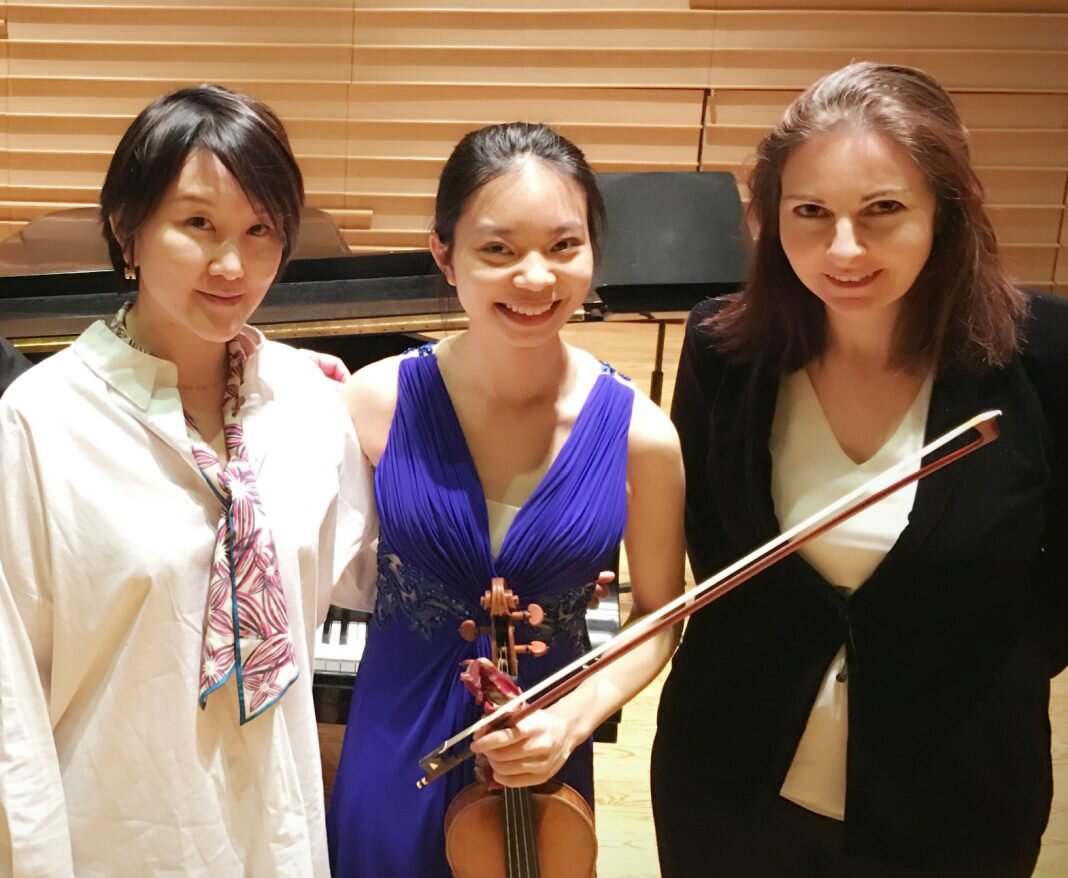
ARTISTIC DIRECTOR AND FOUNDER KLARA MIN, VC YOUNG ARTIST SIRENA HUANG & 2017 JURY MEMBER ALISSA MARGULIS
Honorable mentioned were in addition awarded to 2017 Finalists, violinist Belle Ting from Canada/Taiwan and violinist Maho Irie from Japan.