

New York Times: South Korean Pianist Wins the Van Cliburn Competition
Yekwon Sunwoo won the Van Cliburn International Piano Competition on Saturday, besting 29 rivals over two weeks of playing to become the prestigious contest’s first champion from South Korea. The Cliburn, held every four years in Fort Worth, was founded in 1962 by Van Cliburn, the American pianist who stunned the world by winning the Tchaikovsky competition in Moscow in 1958, at the height of the Cold War.
The New York Times
By Zachary Woolfe
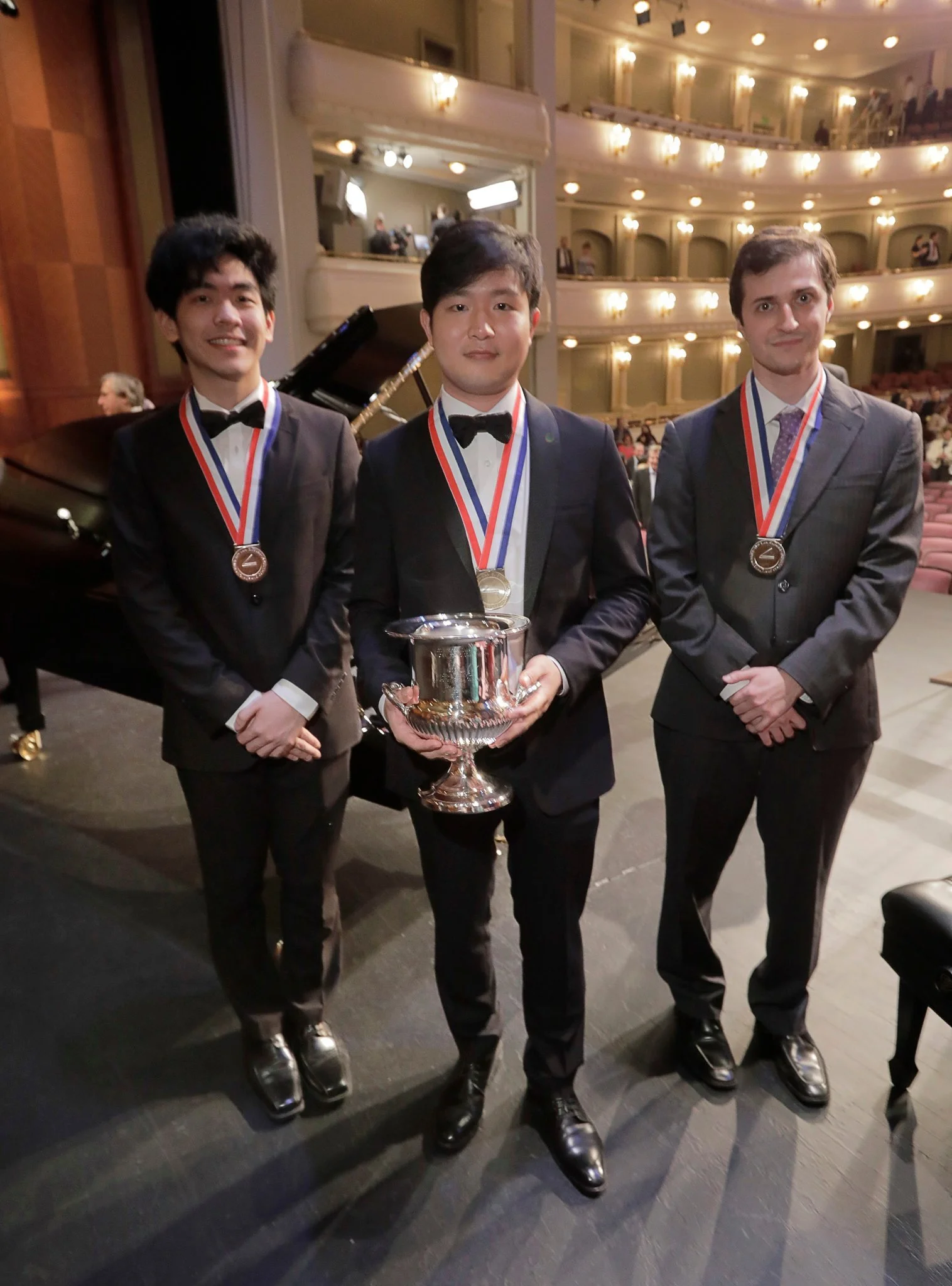
The Cliburn winner, Yekwon Sunwoo, center, with the bronze medalist Daniel Hsu, left, of San Francisco, and the silver medalist Kenneth Broberg, right, of Minneapolis. Credit Ralph Lauer
Yekwon Sunwoo won the Van Cliburn International Piano Competition on Saturday, besting 29 rivals over two weeks of playing to become the prestigious contest’s first champion from South Korea. The Cliburn, held every four years in Fort Worth, was founded in 1962 by Van Cliburn, the American pianist who stunned the world by winning the Tchaikovsky competition in Moscow in 1958, at the height of the Cold War.
Mr. Sunwoo, 28, played Rachmaninoff’s Piano Concerto No. 3 in the final round, when each of the six remaining contestants performed first with a string quartet and then with the Fort Worth Symphony Orchestra. The critic Scott Cantrell wrote in The Dallas Morning News that Mr. Sunwoo “tended to rush faster music, a common problem among other competitors — but he demonstrated a real, if not reliably mature, musical personality.”
Two Americans — Kenneth Broberg, 23, from Minneapolis, and Daniel Hsu, 19, of San Francisco — finished in second and third place.

Strings: A Musical Journey to India
The Juilliard415 ensemble's tour to India was organized by Classical Movements, a concert-tour company that promotes cultural diplomacy across 145 countries. Neeta Helms, president of Classical Movements, is a native of Mumbai and was delighted to show off her home country to us.
Strings Magazine
By Robert Mealy

We come onto the stage of a beautiful 19th-century concert hall with an elegant half-circle of seats facing a proscenium stage. It is packed with people—some even standing in the aisles. Juilliard415 is in Chennai, India, to perform a program of Rameau, Telemann, and Bach. But what does this audience expect? I wonder if they have heard much live Western classical music before. How to explain a concerto, a dance suite—the idea of early music as a whole?
Our ensemble, the Juilliard School’s historical-performance group, quickly found out, and won over the crowd, which responded with booming applause between movements and attentive listening while we played. Some of the younger members of the audience told us afterward that they had never heard Western classical music played live before—what a responsibility and an honor!
And so ended our tenth day on the road, with this concert in Chennai at the Government Museum. Our tour was organized by Classical Movements, a concert-tour company that promotes cultural diplomacy across 145 countries. Neeta Helms, president of Classical Movements, is a native of Mumbai and was delighted to show off her home country to us. Our first concert was in Delhi, in a spectacular hall that was part of the Bahá’í House of Worship, a building from the 1980s set in a gorgeous park. After a side-trip to Agra for a life-changing visit to the Taj Mahal (where we discovered that it is impossibly beautiful, even more so than one imagined), we went on to Mumbai to play at the National Centre for the Performing Arts, where they were just about to produce Gandhi: The Musical!
Juilliard415’s tour to India came out of an ongoing collaboration with Yale’s Schola Cantorum, the chamber choir of the Yale Institute for Sacred Music. Juilliard415 has done several projects with them over the years. It’s a natural fit that allows both groups to explore some of the major choral works of the Baroque, since a choir often needs an orchestra, and vice versa. The director of the Schola Cantorum, British conductor and organist David Hill, is a musician who is equally committed to early music as he is to new music. Thanks to his openness to both worlds, the result was a program unlike anything any of us had ever done before.
Sitar virtuoso Rabindra Goswami was a recent visiting scholar at the institute. Thanks partially to his presence at Yale, the idea took root to tour India with chorus and orchestra. Our concert program also featured Bach’s Magnificat, as well as a Rameau suite. But as the centerpiece of our collaboration was a new piece that Yale commissioned for the occasion from Reena Esmail, an Indian-American composer who is a graduate of both Juilliard and Yale. Reena produced an extraordinary, seven-movement meditation using texts from seven different sacred traditions, each in its own language: This Love Between Us: Prayers for Unity.
The result, a 40-minute work for choir, Baroque orchestra, sitar, and tabla, turned out to be especially resonant in light of our recent political upheavals. Being able to perform as Americans and Indians together with a message of breaking down boundaries, reaching across barriers, and connecting through music made each concert a moving occasion for everyone involved—both audience and musicians. The singers had to master the challenges of diction in languages like Malayalam, Ardha Magadhi, and Sanskrit, and had to discover how to make Reena’s written-down vocal improvisations into their own.
The piece was introduced with a raga by Goswami and his amazing tabla partner Ramchandra Pandit to set the stage for the collaboration between all these traditions. Interestingly, the question of playing at A=415 or A=440 didn’t matter for the Indian musicians—they worked from whatever pitch was given as a basis. What turned out to be more complicated was the integration of these two brilliant soloists into the highly ritualized traditions of orchestral playing. In the end, Reena sat next to the tabla and sitar, to give a kind of simultaneous translation of abstract conducting patterns into a pulse that could be felt and sensed.
It’s a challenge for contemporary composers to write music for Baroque instruments that brings out their special characteristics of color and rhythmic vitality. Reena had some great ideas that brought the worlds of Indian instruments and 18th-century strings together. Sometimes she introduced propulsive, polymetric vamps to accompany the tabla and sitar. In other sections, the Baroque strings provided a transparent wash of ethereal sustained chords as a background for the singers, or for solo moments by the winds.
We had the opportunity to sightsee in Mumbai and Chennai, where the choir and orchestra each did a separate performance, and one last joint concert. By the time we got to the deep south of Tamil Nadu and Chennai, temperatures were soaring around 104. And to our surprise, everyone congratulated us on missing the really hot weather.
The experience of India itself was overwhelming, saturating, totally fascinating, always compelling, sometimes exhausting. I think none of us were prepared for quite how intense the whole experience was—there was so much going on all the time, so much life, such endless varieties of existence. The most spectacular buildings, the most moving shrines, would be right in the midst of some of the poorest neighborhoods any of us had ever experienced. We had enough time to see wonders both great and small—temples, palaces, the Taj Mahal—and to witness the endlessly absorbing life of the street. Some of the most life-changing experiences for all of us came on the small guided tours that we received from inhabitants of Dharavi, one of the most extensive (and amazingly self-reliant) slums in Mumbai.
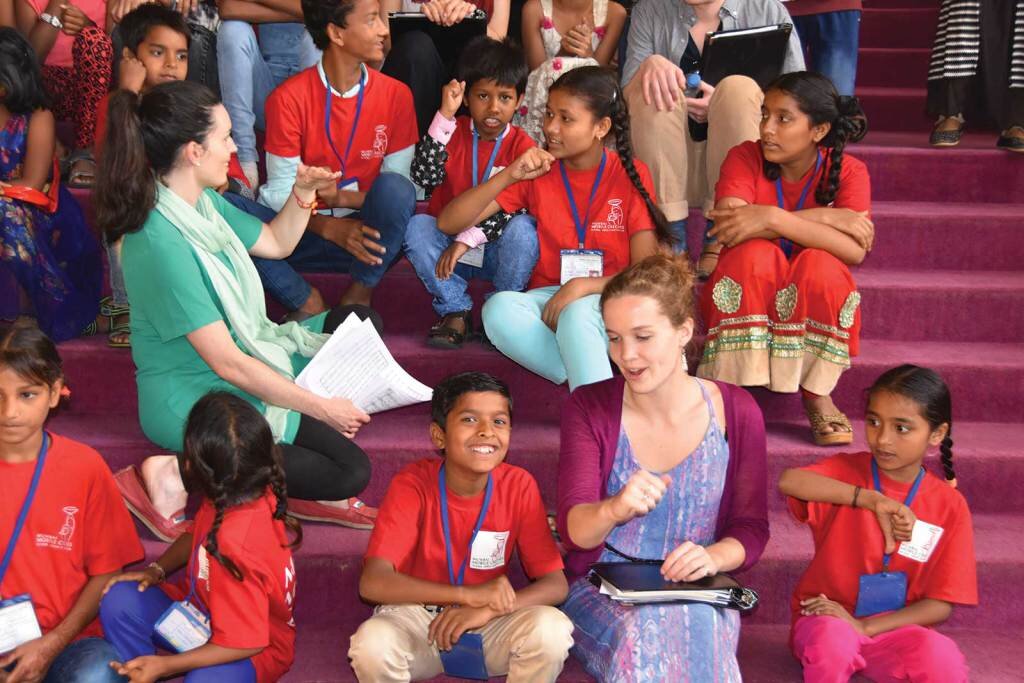
A particularly memorable day on the tour was thanks to an organization called Songbound, an initiative that brings collective music-making to some of India’s poorest and most marginalized children. Working with local partners, Songbound sets up and sustains children’s choirs that rehearse each week. They now have 15 choirs in Mumbai, and many of those children came to join us for a day of music-making together at the National Arts Centre. We sang, played, and danced together, and afterward had a great feast outside, where our students continued to, well, sing, play, and dance with the kids.
Each night in concert, it was overwhelming to encounter a great and venerable classical tradition in full flower that none of us really had known much about. Hearing Goswami and Ram playing ragas showed us a glimpse of a kind of improvisatory mastery that we could only dream of approaching. And the tour of one of Delhi’s great music academies, the Gandharva Mahavidyalaya Music School, where each room had a different kind of musical art being practiced, was spectacular, showing us the interrelationships between vocal artistry, instrumental virtuosity, and the exquisite control and power of dance.
These artists and concerts made me start to think how fragmented our Western tradition is, since fashions in music for us change so quickly and so radically. The idea of reclaiming a musical tradition that is 300 years old—the concept at the heart of historical performance—is a little hard to imagine in India, where it seems the great ancient traditions simply evolve to incorporate new technology as it proves useful. For example, the traditional music we heard was always amplified. And now instead of a tanpura player providing the glistening fabric of a drone for the sitar and tabla, players turn on a “tanpur-app,” via their iPhones to set the mood for their raga.
But there are also some strong Western musical traditions there. One particularly moving part of our tour was that each of our concerts was preceded by a brief recital from a local choir—they all sang from memory with a tremendous commitment to the music. They would join with us in the chorus “And the Glory of the Lord” from Handel’s Messiah, as a kind of grand finale.
Our tour was in connection with a much larger project, the India Choral Fellowship, a longterm vision of nurturing the choral tradition in India. As Helms says, “For those students bereft of basics like food, clothing, and shelter, a musical instrument is impossible to purchase and maintain. But the human voice, however, comes free of charge.” Judging by what we heard from the choirs that joined us in each city, as well as the tremendous energy and enthusiasm of the Songbound children, the choral tradition is thriving in India.
Those ten days in March now seem like a dream. For all of us who were on the tour, I think coming back to America was disconcerting. Yes, everything’s safer, cleaner, more organized, but it’s also all so very plastic, sanitized, bland. I would go back to India in a heartbeat, except it takes about 15 hours to get there.
Violinist, educator, recording artist, and early-music specialist Robert Mealy is the director of Juilliard’s historical-performance program.

Opera Wire: Prague Summer Nights Festival's Le Nozze di Figaro is a Top 10 Must-See 2017 Opera
Opera Wire names Prague Summer Nights Festival's production of Le Nozze di Figaro one of top 10 must-see operas in 2017.
Opera Wire
By Francisco Salazar
10 Must-See Operas During Summer 2017 [International Edition]
Last week Operawire took a look at some of the 10 must see summer operas in the United States. It featured a range of repertoire and some very intriguing new stars. This week we look at the European Festivals and see where the big stars will be and what they will be performing.
The following is a list of OperaWire’s 10 Must-See productions around the world over the summer.
10. Rigoletto
The Arena di Verona will present Verdi’s “Rigoletto” with numerous all-star casts that include Gianluca Terranova, Francesco Demuro, Arturo Chacón-Cruz, Amartuvshin Enkhbat, Carlos Álvarez, Leo Nucci, Elena Mosuc, Jessica Pratt, Irina Lungu, Jessica Nuccio and Andrea Mastroni. “Rigoletto” will be performed five times and will be directed by Ivo Guerra.
9. Le Nozze di Figaro
Legendary baritone Sherrill Milnes and Maria Zouves direct a new production of Mozart’s ‘”Le Nozze Di Figaro” at the Prague Summer Nights Festival which is set to star a number of young artists. Five performances will be given starting on July 3 and running through July 9.
8. Pinocchio
Stéphane Degout, Vincent Le Texier, Chloé Briot, Yann Beuron, Julie Boulianne and Marie-Eve Munger star in the world premiere of Philippe Boesmans’s new opera “Pinocchio” at Aix en Provence Festival. The opera promises to be something spectacular in a new production by Joël Pommerat and is later scheduled to be at the Monnaie and Opera National de Bordeaux. The opera opens on July 3, 2017, and has five performances in total.
7. Die Entfuhrung Aus Dem Serail
Teatro all Scala will celebrate the 20th anniversary of Giorgio Strehler’s death and the 10th anniversary of Luciano Damiani’s death with a revival of Mozart’s classic opera. The intriguing young cast stars Lenneke Ruiten, Sabine Devieilhe, Mauro Peter, Maximilian Schmitt, Tobias Kehrer and Cornelius Obonya. Zubin Mehta conducts the run which begins on June 17. It will also be broadcast on June 19, 2017.
6. Tannhäuser
The Bavarian State Opera will open a new production of Wagner’s “Tannhäuser” with Klaus Florian Vogt in the title role. He will make his role debut alongside Anja Harteros and Annette Dasch. Mathias Goerne and Christian Gerhaher also star in a production by Romeo Castellucci. Music Director Kirill Petrenko conducts the momentous Wagner work which opens on May 21, 2017.
5. Adriana Lecouvreur
Anna Netrebko may be singing the role at the Vienna State Opera later in the fall but Russian audiences will get a first look as the soprano will sing her first “Adriana” at the Mariinsky theater in a new production being created for her. Isabelle Partiot-Pieri directs with Netrebko scheduled to perform on open June 19 and 22, 2017.
4. The Siege of Corinth
Beverly Sills’ famously made this work known when she made her Metropolitan Opera debut in 1975. Now Nino Machaidze takes on the iconic role of Pamyra as she opens the Rossini Opera Festival on August 10, 2017, alongside Alex Esposito, John Irvin, and Sergey Romanovsky. Roberto Abbado conducts the new production by La Fura dels Baus.
3. La Clemenza di Tito
Continuing the annual Mozart cycle, Yannick Nézet-Séguin, and Rolando Villazón team up for Mozart’s Opera-seria with a star-studded cast at the Baden-Baden Festival. Sonya Yoncheva and Joyce Didonato also star alongside Regula Muhlemann, Tarra Erraught, and Adam Plachetka. The performances will take place on July 6 and 9, 2017, and are scheduled to be recorded for Deutsche Grammophon.
2. Aida
Anna Netrebko makes her role debut in Verdi’s masterpiece in the Salzburg Festival most anticipated production. The occasion will reteam the diva with Riccardo Muti and her frequent onstage partners Francesco Meli and Ekaterina Semenchuk. It will also see the extraordinary Luca Salsi and Roberto Tagliavani in what should one of the most memorable nights of the festival. Filmmaker Shirin Neshat directs a new production which opens August 6. The run is alsready sold out.
1. Otello
Jonas Kaufmann makes his role debut in Verdi’s “Otello” in a new production by Keith Warner at the Royal Opera House. Antonio Pappano conducts the production which will also star Maria Agresta and Ludovic Tezier. Opening June 21, 2017, all of Kaufmann’s performances are sold out. Gregory Kunde takes over the run for three performances.

Washington Post: Serenade! Choral Festival on the Hotlist for June
Serenade! Choral Festival named one of Washington Post's 13 things to see, eat, drink, and do in June.
Washington Post
By Going Out Guide Staff
The Hotlist: 13 things to see, eat, drink and do in June
Serenade! Washington D.C. Choral Festival at Kennedy Center, June 28-July 3
The international choral festival moves to the Kennedy Center, which continues its celebration of the 100th birthday of President John F. Kennedy by showcasing choirs from countries where his Peace Corps initiative has been active. The list is long: Depending on the day, you can see traditional groups from countries including India, Ireland, Panama, Zimbabwe, Bulgaria, Latvia, Mongolia or Ghana. Catch the grand finale July 3, at the Concert Hall, to see all of the choirs in action together. Free.
— Fritz Hahn, Maura Judkis, Peter Marks, Harrison Smith, John Taylor

Opera Wire: Neeta Helms on Classical Movements & The Prague Summer Nights Festival
During her 25 years with Classical Movements, Helms has worked with some of the most prestigious orchestras and concert artists in the world. She has traveled to 80 countries and has worked on some of the most complicated, difficult and pioneering projects in the music world.
Opera Wire
By Francisco Salazar

Neeta Helms is the founder and owner of Classical Movements, a premiere concert tour company for the world’s great orchestras and choirs, creating meaningful cultural experiences through music in 145 countries.
During her 25 years with Classical Movements, Helms has worked with some of the most prestigious orchestras and concert artists in the world. She has traveled to 80 countries and has worked on some of the most complicated, difficult and pioneering projects in the music world.
After many years focused on touring, Classical Movements founded the Prague Summer Nights Festival to help young artists build their profile and gain exposure in the opera world. Now in its third year, Prague Summer Nights continues to grow, with the festival set to expand to Salzburg this summer. OperaWire had the chance to speak with Neeta about the development of the program and about the major challenges of putting on a festival like this one.
OperaWire: Tell me about your role with Classical Movements and the work you’ve done with classical music and opera?
Neeta Helms: I am the President and founder of Classical Movements, which is now 25 years old. We are the premiere concert touring company for orchestras and choirs, so our focus has primarily been arranging tours and concerts. We work in 145 countries and have worked in the Czech Republic for a very long time. Since we have been business, we have organized four choral festivals; we started our first in the Czech Republic 10 years after the company was founded in 1992, then started festivals in South America, Washington DC and South Africa. We work with professional orchestras, as well as conservatories, youth symphonies and choral ensembles to arrange their tours. We’re uniquely placed in the world of classical music and we have a foothold in the worlds of both choral and orchestral music.Incidentally, our involvement in the opera world began as early as 1998 when we toured with the Pittsburgh Symphony and Andrea Bocelli; we have also arranged tours for Dmitri Hvorostovsky including his 45-day tour and with Renée Fleming.
OW: Why did you start Prague Summer Nights?
NH: It came into being because one of our clients, the University of Kentucky, has a very rich music department and had spoken about collaborating on a summer program, which they would plan. They were going to organize auditions and everything. We would arrange the production and all the housing, travel, sets and costumes, but it was going to be their program, not ours. Something fell through with the university, but we were very close to the conductor John Nardolillo, who dreamed of still doing it. After investing so much into we decided, ‘Why not do it ourselves?’ We felt very well placed because we were financially strong and could invest the necessary time and the source. One has to make sure you have everything you need a year in advance. And then you have to engage faculty and when you engage someone like Sherrill Milnes, who is such a giant in the industry, you have to plan to do everything in the best way possible. I never wanted it to be a small program. There is nothing wrong with that, but if we were going into this with our level experience, I really wanted it to be international and felt that we could do that better than anyone else. We were engaged many years ago to do the YouTube Symphony Orchestra; it was a crazy program and one of the things that attracted them to us was that they knew we were able to get the word out all around. And that is something that we brought to this program, as well. We also wanted high-level faculty; together with John Nadalillo, our artistic director, we made an effort to get fabulous faculty, not just from the United States, but from Europe as well. And that has been a major goal of ours. We also have established distinct opera and orchestra programs.
OW: How has the program evolved?
NH: The first year, we were dominated by our opera program. We engaged very famous people from the opera world. We did “Don Giovanni,” and then added “Suor Angelica;” we had so many women applicants that we didn’t want to turn any away. The second year, we added “Gianni Schicchi” and really started to build up the instrumental program as well. We felt that while the orchestra plays with the opera, we wanted to really build it up on its own. This year we’ve gone from “Suor Angelica” to “Gianni Schicchi” to two major operas, “The Magic Flute” and “Le Nozze di Figaro.” We’ve also added Salzburg to the program.
OW: How did that move to Salzburg come about?
NH: Salzburg came about because of the obvious Mozart connection, but it’s also an opera-loving city and therefore a great addition for the people who are performing, a really valuable experience for our performers and our faculty. Everyone was really attracted by the prospect. We’ll be performing at the famous Mozarteum Hall, where we will do “Magic Flute” and “Le Nozze di Figaro.”
OW: Tell me a little about the program?
NH: We started out 30 days in Prague and then in our second year, we spent 11 days in this lovely town called Tabor in Bohemia before going to Prague for 19 days. It was a very fine balance. The whole town was so interested in our program. We have long hours and long days, between coachings and staging rehearsals; everybody has things going on. We have so much happening and the town is in love with the idea of music being done in the summer. We start there and then we go to Prague. This year, because the Estate Theater is completely under repair, we will be at the second home of the Prague Symphony instead. It’s a beautiful venue, where we will stage all our productions, but we also wanted to perform at a prestigious hall, so that is why Salzburg was important. Where we will go in our fourth year, we shall see – but Salzburg is turning out to be a major attraction. We have also partnered with the Prague Conservatory, which is a legendary institution.
OW: Tell me about the audition process and what is it like?
NH: That process happens both in-person and online. We hold auditions in several cities twice: we have a round of auditions in early November in London, Beijing, Los Angeles, New York, Maryland, Washington and so on. And then we repeat those and add some other locations like Indiana, so we get a lot of people from all over the country. We do these auditions in January and February. We also do online auditions for applicants around the world. Then all the major conductors, faculty and stage directors check them out and based on their consensus, we make offers.
OW: Do any of the participants come back?
NH: Yes, that is actually something I want to highlight. One of our alumni, John Holland, did Masetto the first year and then Leporello the second year. And this year, he is going to sing Figaro. He comes back because he says this program has helped him out so much; he’s got roles and it’s really building his career. Our first year, we also had Marcello Ferrero, who came back in our second year. The chance to work with Sherrill Milnes in Europe, in these productions is obviously a huge draw. We are attracting a very high level of singing and that is helping these musicians’ careers.
OW: Tell me about working with Sherrill Milnes and his work with the festival?
NH: We’re really blessed to have him with us directing “Le Nozze di Figaro.” You know, he made his stage director debut with the Prague Summer Nights Festival program. It was major news in Europe and the press was all over it.
OW: What kinds of productions are produced?
NH: Very classic, all done the way they were meant to be done. We’re not at all avant-garde. We want to give people a chance to experience opera in the classical sense and really get them ready for these roles in their careers. Our goal is to give productions as close to the original as possible.
OW: How has the audience reacted during the first two years?
NH: Our audience tends to be half tourists and half local opera-lovers. We do a lot of promotion and so far we have had a lot of interest from the press, including coverage from the major opera press. That obviously reaches everybody in Prague and now Tabor. The tourists like to come to the Estate Theater because it’s so important to Prague. They just love the idea of seeing something in this opera house. There is a lot of word of mouth and the reviews have been good as well, so people know that the production is satisfying. We’ve had huge ovations from our audiences and have had packed halls. Our goal is to engage the locals – and if we get tourists, that is great too. But it is really exciting to see people discover opera through our festival.
For more information on Prague Summer Nights, please visit: www.praguesummernights.com.

The New York Times: 10 Spring and Summer Classical Festivals
Grand Teton Music Festival - The setting is everything at this event, located near Yellowstone and Grand Teton National Parks, but with Donald Runnicles in charge of the festival’s orchestra, musical quality is assured, too. Mr. Runnicles sprinkles some recent work — by Aaron Jay Kernis, Marc Neikrug and Luciano Berio — among weighty canonical fare, including Mahler’s Ninth and Beethoven’s Seventh. Guest artists include Yefim Bronfman, Garrick Ohlsson, Augustin Hadelich, Vasily Petrenko and James Ehnes.

The conductor Donald Runnicles is in charge of the orchestra at the Grand Teton festival. Credit: Michelle McCarron
The New York Times
By David Allen
Ah, sizzling burgers and a tasty side of the arts. We’ve picked the top festivals in theater, dance, pop and classical that we think you should see this spring and summer around the country.
Grand Teton Music Festival
JACKSON HOLE, WYO., JULY 3-AUG. 20 The setting is everything at this event, located near Yellowstone and Grand Teton National Parks, but with Donald Runnicles in charge of the festival’s orchestra, musical quality is assured, too. Mr. Runnicles sprinkles some recent work — by Aaron Jay Kernis, Marc Neikrug and Luciano Berio — among weighty canonical fare, including Mahler’s Ninth and Beethoven’s Seventh. Guest artists include Yefim Bronfman, Garrick Ohlsson, Augustin Hadelich, Vasily Petrenko and James Ehnes.

The New York Times: 8 Best Classical Music Moments - Diplomatic Harp
The New York Times
By Corinna da Fonseca-Wollheim
A Valiant Return to the Met Opera: This Week’s 8 Best Classical Music Moments
Diplomatic Harp
The harp is a diplomatic instrument: There is something about its sound, so clear in its attack and so graceful in its decay, that suggests an openness to other points of view. As such it should be a prized chamber-music companion, a point eloquently made by the harpist Sivan Magen in a sparkling concert of music for mixed ensembles. Some of the most beautiful moments found him at his most self-effacing, like in the gorgeous first Interlude for Harp, Clarinet and Cello by Jacques Ibert, in which Mr. Magen’s pealing chords supported a soaring line in the cello with the clarinet — less heard than felt — adding just a hint of a draft in the melody’s sails.

21CM: Surviving the First Decade
The odds of getting an ensemble off the ground can feel like those of launching a new restaurant. Most groups disband within a few short years for reasons that are often similar: Establishing a name in an already crowded market is tough, and the administrative burdens that come with it can make even the most organized group want to crawl into a hole. As the Israeli Chamber Project prepares to celebrate its tenth anniversary, we look back at what brought us here, at the challenges we faced and the lessons we learned along the way.
21CM
By Assaff Weisman
The odds of getting an ensemble off the ground can feel like those of launching a new restaurant. Most groups disband within a few short years for reasons that are often similar: Establishing a name in an already crowded market is tough, and the administrative burdens that come with it can make even the most organized group want to crawl into a hole. As the Israeli Chamber Project prepares to celebrate its tenth anniversary, we look back at what brought us here, at the challenges we faced and the lessons we learned along the way.
1
Work With People You Respect
You’ve formed a group and agreed on what to call yourselves – you may even have a couple of concerts lined up. Everyone is energized and the future looks promising, but the honeymoon doesn’t last forever. Soon, you and your new colleagues will face your first challenges – anything from temperamental differences, conflicting opinions on concert offers or how long to hold that fermata. Most likely, you’ll encounter all of these and more.
Conflicts are a natural part of any group dynamic, but when you work with people you respect, it’s much easier to accept those times when your individual input is overruled. You don’t necessarily have to be best friends with your ensemble mates, but what does matter is that you hold each other’s work in high regard and respect one another as people.
With ICP, we had good fortune in that most of our members grew up together in Israel, getting to know one another as part of the country’s small but very lively musical scene. Several of us met as students, so when it was time to come up with a roster, ICP’s founder and clarinetist, Tibi Cziger, already had some people in mind. At the time, pianist Yael Kareth was the only one of us living in Israel. Cziger, cellist Michal Korman, harpist Sivan Magen, violinist Itamar Zorman and I lived in New York, while violist Guy Ben-Ziony and violinist Daniel Bard were based in Europe. Despite the difficulties of running a group across three continents, our commitment to each other as musicians and people strengthened our commitment to the ensemble.
2
Know Your Identity
Knowing your identity is critical for reasons way beyond marketing. Naturally, you want to stand out from other ensembles, but you also need to know what you stand for. Are you a group that champions neglected composers or focuses on the core repertoire? Do your concerts support a broader mission or are you strictly about the music? It is especially powerful if you can point to an origin story, making it easier for people to grasp what sets you apart and why your voice is needed.
Back in 2008, seven of our eight founding members were pursuing careers outside of Israel – emblematic of a broader “brain drain” from the country, where lack of government funding, little to no private philanthropy and a small market severely limited the possibilities for a sustainable career in chamber music. But we all felt a strong connection to our cultural heritage and, wanting to give back to the community that had first guided us, we saw an opportunity to foster connections within Israel’s fragmented society while bringing a distinct musical energy to audiences abroad. Of course, we wanted to do this in a sustainable manner, which led to the birth of ICP.
What started as two annual tours across Israel (including places on the periphery, where live classical music is hard to come by, as well as metropolitan centers), quickly became three, and we were fortunate to bring along such distinguished guest artists as Peter Wiley, Antje Weithaas and Liza Ferschtman. Meanwhile, with five of our members in New York, we established a U.S. base of operations for North American tours. Today, though our founding members are still spread across the globe, we’re able to increase our activities on both sides of the Atlantic through a careful expansion of our roster, long-range planning and intensified fundraising.
3
Have a Clear Idea of Each Member’s Role
There is no one way to run a chamber ensemble. You should feel free to create a structure that suits your particular needs, but it’s very important for everyone to know what they’ve signed up for. Are you the kind of group that reaches decisions by consensus, majority vote or top-down action? Who will handle administrative duties? (And the more success you experience, the more of these you’ll have to deal with.) Establishing roles allows each member to assess whether this ensemble is the right fit. In ICP, only two of our artists take on administrative roles. Tibi Cziger serves as the artistic director. He’s responsible both for programming and the logistics of our Israeli tours. Meanwhile, I serve as executive director and I handle our North American activities. Additionally, our board of directors offers invaluable assistance with the running of the organization, and this allows our artists to focus solely on making music.
4
Flexibility is Key
Things happen. Marital statuses change, people have babies, they move to a different country, they sustain injuries. Any one of these can threaten to derail your hard-earned success. Or, you can choose to turn them into opportunities. ICP has experienced everything mentioned and more (think concertizing through a war zone), and we have always tried to extract the positive from any situation. So a geographical move may wind up strengthening the administrative structure, and an injury provides much needed rest for one member while allowing another to shine. When two of our artists – a couple since pre-ICP days – had their first child, we incorporated feeding stops into our travel schedule. All of us took turns babysitting backstage as the new parents performed, bringing the ensemble closer together. Through all the bumps in the road, what kept ICP going was the connection between our exceptional members and a belief in our core mission – to give back to our home country while showcasing Israeli culture abroad. We have faith in our audience to be moved by a wide range of musical styles if we present them with integrity and humility, and we are continually reminded of music’s power to reach across divides of culture, politics and socioeconomics.
No doubt, there are still many opportunities for growth. But here we are, about to celebrate a decade of meaningful music-making, and we’re looking forward to many more. If our experiences can help launch or sustain your ensemble, we would consider that among our successes as well.
To learn more about the Israeli Chamber Project, visit israelichamberproject.org

The Guardian: Facing the music - Long Yu
The Chinese conductor – music director of the Guangzhou Symphony Orchestra and artistic director of Beijing Music Festival – on his musical inspirations, from Beethoven to Benjamin, and Karajan to Qigang Chen
The Guardian
The Chinese conductor – music director of the Guangzhou Symphony Orchestra and artistic director of Beijing Music Festival – on his musical inspirations, from Beethoven to Benjamin, and Karajan to Qigang Chen

‘If I were not a musician, I would still want to connect people’ - conductor Long Yu. Photograph: PR
What was the first record or cd you bought?
My childhood coincided with the Cultural Revolution. During this period there was a ban on Western music, and I learned music theory through Chinese music. My generation was one of the first to study abroad, and after attending the Shanghai Conservatory, I studied at the Hochschule in Berlin, where a new world of recordings and music opened up to me. I don’t remember the first record I bought, but these times in Berlin were a time of deep exploration for me. I studied great conductors such as Karajan. To this day, I look back on my time in Germany and the recordings I studied with great affection.
... and the most recent?
Yo-Yo Ma’s Bach Trios with Chris Thile and Edgar Meyer.
What’s your musical guilty pleasure?
I am interested in learning more about many genres – pop, rock, and jazz. Exploring outside of classical music sometimes informs my approach to traditional repertoire.
Vinyl or digital?
Digital.
If you had time learn a new instrument, what would it be?
Before I was a conductor, I was a pianist and percussionist. My grandfather, a gifted composer and pianist, taught me to play the piano from an early age. He also guided me to become a conductor. He said the baton can lead you to a magical world, which is much more interesting because conductors experience different kinds of music including operas, concertos, and symphonic works. Having the faculty of an entire orchestra’s instruments now seems imperative to me.
Did you ever consider a career outside of music? Doing what?
I am lucky to conduct orchestras all over the world, and music offers a common language in which to communicate. This is probably what I enjoy most about my job; if I were not a musician, I would still want to connect people, perhaps through diplomacy.
hat single thing would improve the format of the classical concert?
I want young people to love music. If I could change one thing, I would make the classical concert accessible to as many people as possible.
What or where is the most unusual place/venue you’ve performed?
Last year, I had the great pleasure of touring in China with Yo-Yo Ma. We performed at some incredible places including an outdoor concert at the Old City Wall in Xi’an in Central China, and in Dunhang, at the edge of the Gobi Desert. We worked with young people in these places and encouraged them to continue their musical life. It was a very special experience for both of us.

What’s been your most memorable live music experience as an audience member?
I remember my formative years in Berlin watching Karajanand many of the last generation’s legendary artists. I will carry these concerts with me my entire life. In 1979, I was in the audience as Isaac Stern made his first appearances in China. I was 15 years old and I hadn’t ever heard violin playing like his. Years later, I was honoured to invite Maestro Stern to the Beijing Music Festival. Last year, the Stern family and I started the Shanghai Isaac Stern International Violin Competition to honour the importance and the impact of Maestro Stern’s visits to China. He brought many Chinese musicians to the world stage.
We’re giving you a time machine: what period, or moment in musical history, would you travel to and why?
I would love to travel to Vienna 7 May 1824 for the premiere of Beethoven’s Ninth Symphony. Can you imagine what it what have been like to be in the audience for that final movement when the chorus comes in? Or, to have seen Beethoven’s face when, not able to hear the audience, he finally turned around at the podium to see their wildly enthusiastic reaction? An incredible moment.

What is the best new piece written in the past 50 years?
In the last 50 years, there have been so many important composers such as Messiaen, George Benjamin, and Qigang Chen, who all all use their creative voice to move music a big step forward.
Imagine you’re a festival director with unlimited resources. What would you programme - or commission - for your opening event?
This October we’re celebrating 20 years of the Beijing Music Festival where, since founding it two decade ago I have been lucky to realise many of my musical dreams. This celebratory year, we are presenting co-productions with the Salzburg Easter festival and the Aix-en-Provence festival, and a Beethoven symphony cycle with Paavo Järvi and the Deutsche Kammerphilharmonie Bremen. The festival is such an important part of Chinese cultural life and has planted many classical music seeds in China.
Long Yu conducts the Guangzhou Symphony Orchestra in two concerts as part of its first UK tour: 14 May at Cadogan Hall, London and 16 May at Birmingham Symphony Hall.
The Spectator: Mao's Music
It’s early in the year but there is unseasonal heat as hundreds of earnest young musicians gather to learn from artists of the Silk Road Ensemble... Fostering innovation in China, a country hindered by an educational system that encourages rote learning and discourages asking questions, is not always easy. Some classical musicians have broken through: concert pianist and child prodigy Lang Lang is a celebrity here, commanding sell-out concerts and legions of fans. But Long Yu, the man who has helped spearhead China’s classical music renaissance (he is artistic director and chief conductor of the China Philharmonic Orchestra and music director of the Shanghai Symphony) wants more.
The Spectator
By Clarissa Sebag-Montefiore
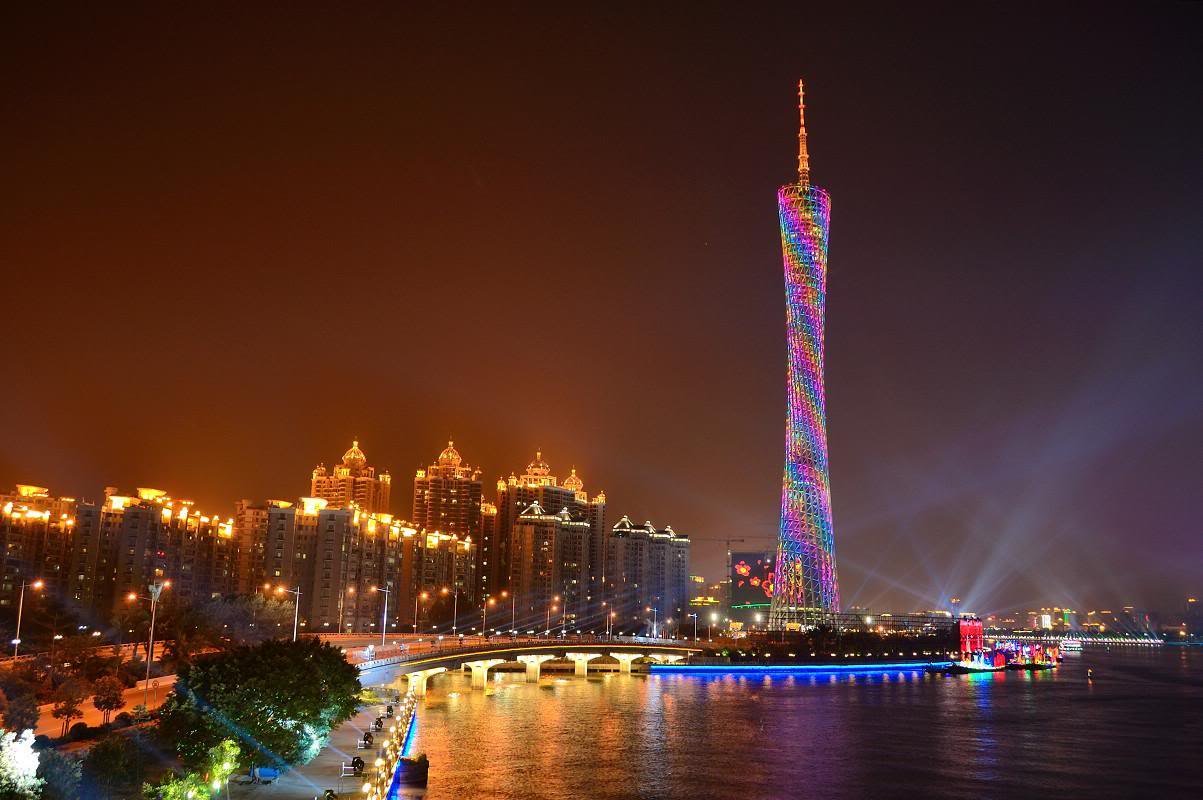
Smog is making me cough and I feel my eyelids smart and redden. High-rises are swaddled in a soupy haze and locals scuttle about their day, huddled against the cold, faces down. Has Beijing done nothing to improve pollution since I last lived there three years ago? This is a city that changes fast. There are the same old scruffy nail bars and lamb hot pot restaurants, the windows smudged with steam from boiling vats of oil and meat. But in the ancient hutongs or alleyways there is also a smattering of Scandinavian-style design stores. Hidden around the back of one is a tranquil café, at odds with the dirt and dust outside, classical music wafting into chilly air. Here are the locals you never see on the street: men in elegant cashmere coats, scarfs slung around their necks; women propping Louis Vuitton bags against long, poised legs. I stop for a hot chocolate and avocado cheese cake; it costs nearly twenty dollars.
‘There is in fact no such thing as art for art’s sake,’ Mao Zedong said. Under the ‘Great Leader’, during the tumultuous tragic years of the Cultural Revolution, classical Western music was particularly despised as ‘bourgeois’. Instruments were smashed, concertos ripped up, and conductors punished, sometimes with death. When facing execution for tearing up Mao’s Little Red Book, Lu Hongen, conductor of the Shanghai Symphony, said to his cellmate. ‘Visit Austria, home of music. Go to Beethoven’s tomb and lay a bouquet of flowers. Tell him his disciple is in China.’ Would Lu laugh or cry if he went to Guangzhou now? I’ve taken the long train ride south to see the very first Youth Music Culture Guangdong (YMCG) in action, the pet project of Chinese-American superstar Yo-Yo Ma and the Guangzhou Symphony Orchestra. It’s early in the year but there is unseasonal heat as hundreds of earnest young musicians gather to learn from artists of the Silk Road Ensemble. Among the educators is symphony conductor Michael Stern. When his father, violinist Isaac Stern, made history by touring China in 1979, just three years after Mao’s death, he found not one playable piano left in Shanghai. His son has arrived in a new era: China is now the largest piano producer in the world, and the largest consumer too with some forty million students learning to play. Beethoven, it seems, is not short of disciples.
Yo-Yo Ma, a believer in art for art’s sake, relishes the redemptive qualities of creation. I ask him why here, why now? Why China? ‘When the flood gates open there’s this moment of receptivity. There’s a small window in this society where you can do so much,’ he says. He looks down at his hands, adjusts his shirtsleeves rolled half way up his arms. ‘I think if that window closes it’s going to be harder to start things, to create habits, cultural habits. For me, it’s planting seeds that we may not see the resultsof for twenty, thirty years.’
‘I want you to have enough courage to stand up,’ Yo-Yo Ma later tells a room of shy young musicians, bent over their instruments, anxious to do well and to please. ‘Who’ll be the first victim?’
Fostering innovation in China, a country hindered by an educational system that encourages rote learning and discourages asking questions, is not always easy. Some classical musicians have broken through: concert pianist and child prodigy Lang Lang is a celebrity here, commanding sell-out concerts and legions of fans. But Long Yu, the man who has helped spearhead China’s classical music renaissance (he is artistic director and chief conductor of the China Philharmonic Orchestra and music director of the Shanghai Symphony) wants more. ‘Asian parents, they force the kids to learn instruments not to introduce arts to them but they want to train them to become a star, the next Lang Lang, or to add some points when they apply to university. But this is totally wrong,’ he insists. ‘We don’t need only one or two champions. We need a new generation to understand creativity.’ Some are rising to the challenge. Back in an improvisation workshop, under the cold glare of classroom lamps, a plump girl in a yellow frilly dress shakes her hips, forgetting the glasses that fall down her nose, while a percussionist taps out an addictive beat. Yo-Yo Ma is happy. His charges are starting to stand up, no longer victims. As he confides with a grin, there is a little known secret: ‘You can practise imagination’.